
Knee Support for Chondromalacia: What May Help—and Its Limits
Compare sleeves, patellar braces and straps for chondromalacia, understand the evidence limits, and learn how to judge a support trial.
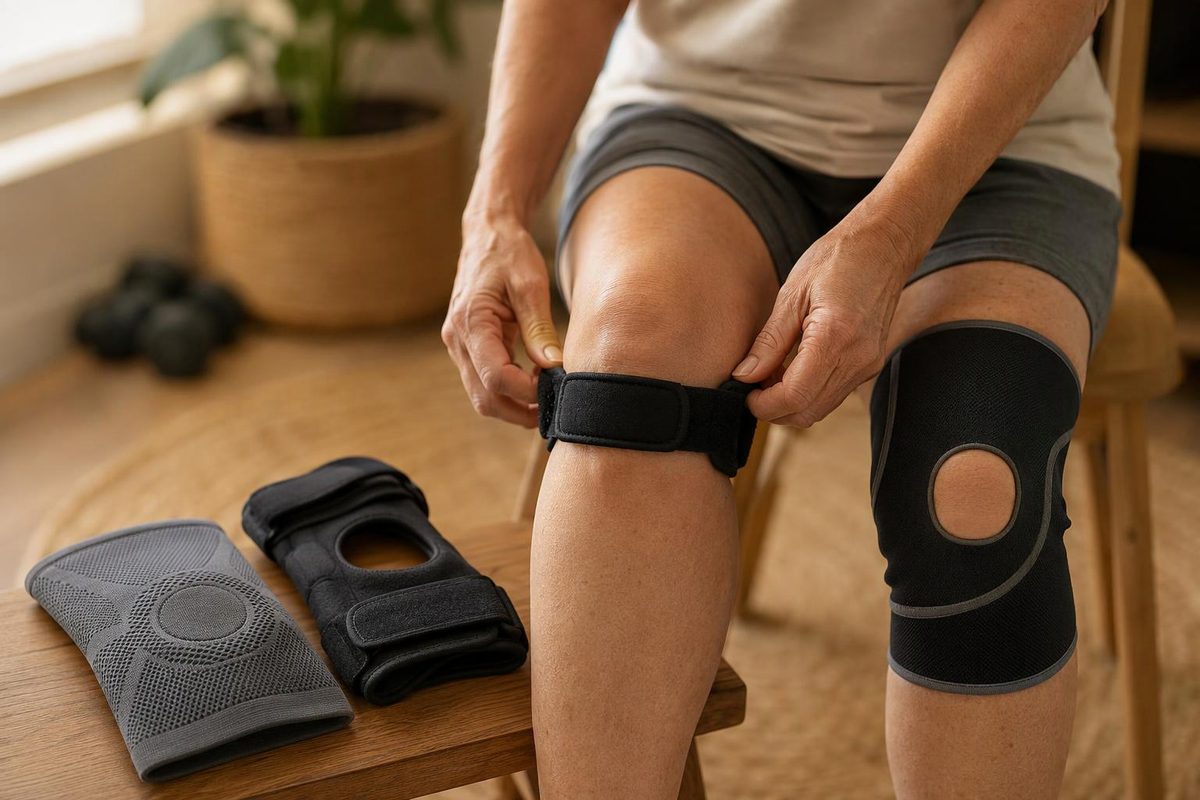
There is no established best knee support for chondromalacia. A brace may help some people manage kneecap-area pain, but the studies discussed below do not show that it repairs cartilage. Assessment and rehabilitation are a more sensible starting point than automatically choosing a more rigid or expensive support.
If a clinician recommends trying support, the useful question is: Does this particular device make an agreed activity more comfortable without causing pressure, skin problems or worse symptoms afterward?
Why the diagnosis matters before choosing support
Chondromalacia patella means softening and breakdown of the cartilage underneath the kneecap. Patellofemoral pain means pain around or behind the kneecap; cartilage damage may be present, but is not required. The terms overlap, yet they are not interchangeable. AAOS explains this distinction.
That matters because the support studies discussed below recruited people with patellofemoral pain, not a group selected specifically for confirmed chondromalacia. A product marketed for “runner’s knee” does not therefore have proven benefits for every degree of kneecap cartilage damage. Our chondromalacia overview explains the diagnosis and treatment more broadly.
Before buying, ask your clinician whether support is intended to help pain, guide kneecap tracking, or address a separate instability problem. Those are different goals.
What the evidence actually shows
The evidence does not justify routinely prescribing a sleeve, brace or strap for patellofemoral pain:
- A 2015 Cochrane review included five trials involving 368 adults with patellofemoral pain. It found very low-quality evidence of no clinically important short-term improvement in pain or function when a knee support was added to exercise. Comparisons did not establish that one support type was better than another. These uncertain findings are not proof that supports never help. Read the review.
- The 2019 physical-therapy guideline recommends against using patellofemoral braces, sleeves or straps to treat patellofemoral pain, while recommending hip- and knee-targeted exercise. This is a recommendation for patellofemoral pain, not proof that every individual with chondromalacia will respond identically. Clinical practice guideline.
A 2024 best-practice guide also places education and knee-targeted exercise, with hip-targeted exercise as appropriate, at the centre of patellofemoral pain care. Additional measures should be tailored to the person after assessment.
There is a more encouraging—but limited—result for a specific realignment brace. A 2016 trial of 156 adults aged 18–50 found better results on several pain and function measures, including less stair and sports pain, when a medially directed brace was added to physiotherapy at six and twelve weeks. However, the trial’s primary outcome—self-reported recovery—did not differ significantly between groups. Most between-group benefits had diminished by the 54-week follow-up.
The trial excluded grade 3–4 cartilage damage, could not blind participants to treatment, and disclosed manufacturer-related financial ties. It cannot establish that this brace helps severe chondromalacia or that other “patella stabilizers” perform the same way. Trial results and limitations.
These studies assessed symptoms and function, not cartilage repair. Feeling better in a support is useful, but it is not evidence that damaged cartilage has healed.
How the support options compare
| Support | What to consider for chondromalacia |
|---|---|
| Plain compression sleeve | A simple option if your clinician agrees to a comfort trial. The reviewed evidence does not establish added rehabilitation benefit; do not treat it as a cartilage-protection device. |
| Sleeve with a kneecap opening or patellar ring | A ring is not proof of better results. The Cochrane review found no important pain advantage over a plain sleeve in one small, poorly reported comparison; discomfort and skin abrasion were more frequent with the ring. |
| Directed patellar realignment brace | Designed to apply a force that guides the kneecap. The positive trial tested a specific medially directed design, fitted by a study physician—not every brace with an opening or side pad. Ask whether its direction of support fits your assessed problem. |
| Patellar tendon strap | Not a default choice for chondromalacia. Pain localized to the tendon below the kneecap may represent a different problem, such as patellar tendinopathy, and needs a different assessment. |
The sleeve comparisons come from the Cochrane review; the distinction between kneecap pain, instability and tendon pain is covered in the guideline summary. For device-selection details, see our patella stabilizer guide.
If you try one, judge function—not tightness
Agree on one target with your physiotherapist, such as a short walk or prescribed exercise. Keep the activity similar when comparing supported and unsupported sessions; do not increase mileage or squat depth simply because the support feels reassuring. Note comfort during the activity and symptoms later that day and the next morning.
Follow the product’s measurement and fitting instructions. The support should stay in place without painful pressure. Remove it and seek fitting advice if it causes numbness, tingling, skin-colour changes, persistent redness or swelling below it. Do not assume it should be worn all day or during sleep. Support fitting guidance.
If it offers no clear benefit, discuss stopping rather than escalating to a stronger brace. For patellofemoral pain, tailored patellar taping alongside exercise has guideline support for short-term pain relief; a physiotherapist can assess whether it is appropriate for you. Guideline summary.
When support is not the next step
Seek urgent assessment for very severe pain, inability to bear weight or move the knee, severe swelling or deformity, locking or giving way, or a hot/red knee with fever or chills. Arrange a clinical review if pain is not improving over a few weeks rather than repeatedly changing supports. NHS knee-pain guidance.
This is general education. A prescribed brace after injury or surgery should follow your treating team’s instructions, not a self-directed comfort trial.