
Brace for Hyperextension of the Knee: What to Look For
Learn which braces limit knee hyperextension, why extension stops and fit matter, and when an injury needs assessment before buying support.
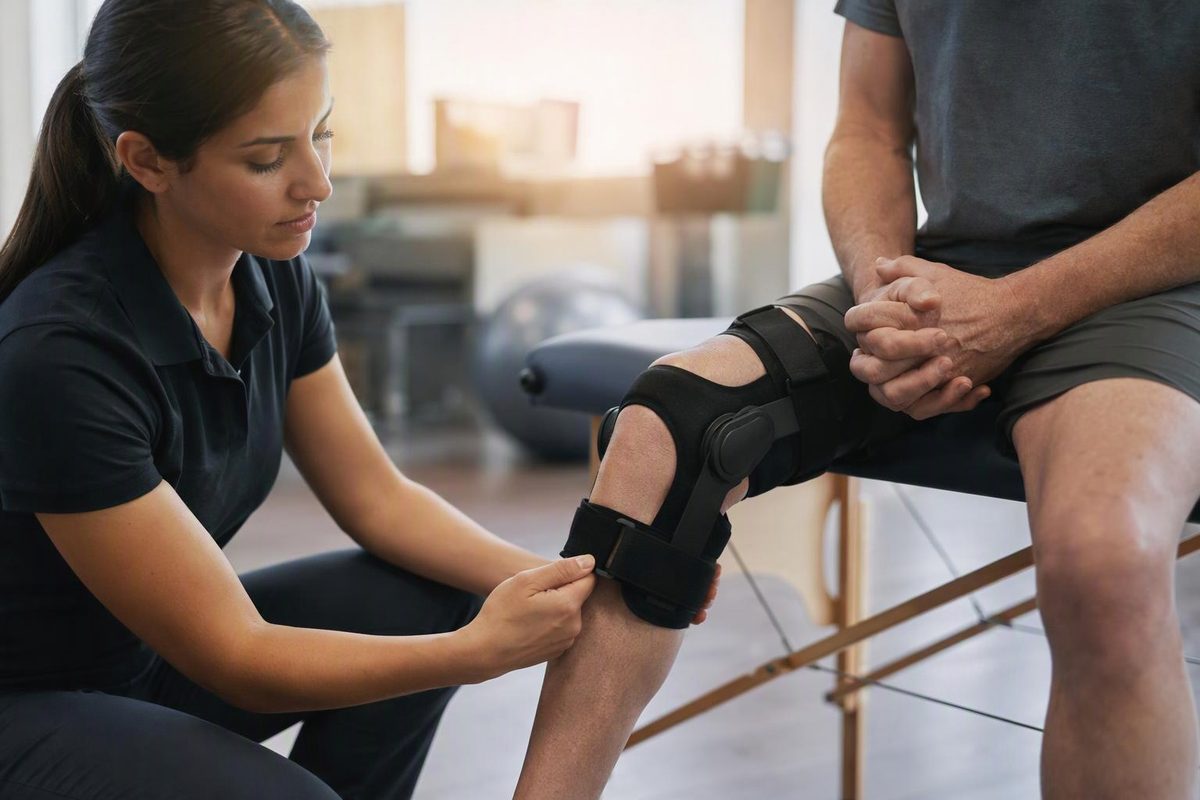
If your knee bends backward beyond straight, the feature to ask about is hyperextension control—often a hinged brace with an extension stop, or a dedicated hyperextension-control orthosis (an external support). An extension stop limits how far the brace straightens. A plain compression sleeve does not have that mechanical limit, and the word “hinged” alone does not guarantee one. For example, Össur’s Rebound range includes both range-of-motion (ROM) models with stop options and non-ROM models. Össur’s specifications show why the exact version matters.
The right choice depends on whether you have a new injury or a knee that repeatedly bends backward during standing or walking. A brace should address that problem, not simply feel tighter.
When assessment comes before shopping
After a fall, awkward landing or impact, hyperextension can injure ligaments or other knee structures—but it does not automatically mean a ligament has torn. Pain, swelling and trouble moving the knee warrant assessment rather than using a brace to push through activity. Cleveland Clinic’s guidance explains this distinction.
Seek urgent medical advice if your knee is very painful, badly swollen or misshapen; you cannot move it or bear weight; it locks or gives way; or it is hot or red with fever or chills. These are NHS knee-pain warning signs.
Match the brace to the reason your knee hyperextends
A new hyperextension injury
A clinician may choose a brace that protects an injured ligament or limits movement while tissues recover. The injury—not the label “hyperextended knee”—determines the support needed. Orthotics Plus describes using range-of-motion or ligament-specific braces for acute injuries, with return to activity guided by the treating team. This does not mean every hyperextension injury needs a brace.
Repeated backward bending while walking
Knee hyperextension is also called genu recurvatum. Arrange a walking assessment if it repeatedly affects your walking, especially if it is worsening or reducing confidence and function. An orthotist—a professional who assesses and fits external supports—can help determine which device is appropriate. Orthotics Plus’s guidance describes assessing both knee movement and walking patterns.
A knee orthosis can help some people: a small randomized study involving 31 adults with knee hyperextension after stroke found that, after four weeks of use, a hinged soft knee orthosis prevented the affected knee from hyperextending during testing and improved several balance and walking tests. Those findings apply to that post-stroke population; they do not establish the best brace for runners, ligament injuries or general joint looseness. Read the study abstract.
Sometimes support needs to extend beyond the knee. In a six-person post-stroke study, increasing an articulated ankle-foot orthosis’s resistance to downward ankle movement generally reduced knee hyperextension, although responses varied between participants. This supports checking ankle movement and the whole walking pattern rather than assuming a knee-only brace is sufficient. The study does not provide settings to copy at home.
Check the movement limit—not just the hinges
Before buying, check the exact model’s instructions for:
- An extension stop or stated hyperextension-control mechanism. Side hinges may offer stability without adjustable straightening limits.
- The supplied stop kit. Confirm which stops are included and whether additional parts are needed.
- Who selects and changes the settings. Ask your clinician to specify the permitted movement and explain adjustments.
Do not assume the factory setting is right for you. For example, the Rebound Knee ROM instructions specify preinstalled 10-degree extension stops and additional stop options. That is a product specification, not a recommendation to set every hyperextending knee at 10 degrees.
For the broader differences between sleeves and hinged designs, see our hinged knee brace guide.
Fit and wear time matter
Use the measurement chart for your exact model, then follow its fitting sequence. The brace should be firmly secured but comfortable, with the hinges and openings positioned as instructed. Ask the fitter to check it while you walk, not only while seated. Our model-specific measurement guide explains why sizes are not interchangeable.
Check your skin before and after use. Stop using the brace and seek advice if it causes new pain, swelling, skin irritation, numbness or other sensation changes. If your foot becomes blue, white or cold, remove the brace immediately and seek immediate medical advice. The manufacturer’s instructions identify these as possible signs of insufficient blood flow.
Follow your prescribed wear plan, including whether to wear the brace for walking, exercise or sleep. For functional supports, gradual wear-time increases may help skin and muscles adjust, as described by North Tees and Hartlepool NHS orthotics guidance; an injury-specific schedule takes priority.
Before leaving a fitting appointment, ask: What movement should this brace limit, what is my setting, when should I wear it, and what rehabilitation or review comes next?