
Knee Brace for Medial Collateral Ligament Injury: What Fits
Compare hinged braces, sleeves and immobilizers for an MCL injury, with guidance on injury grade, fit, wear time and when to seek urgent assessment.
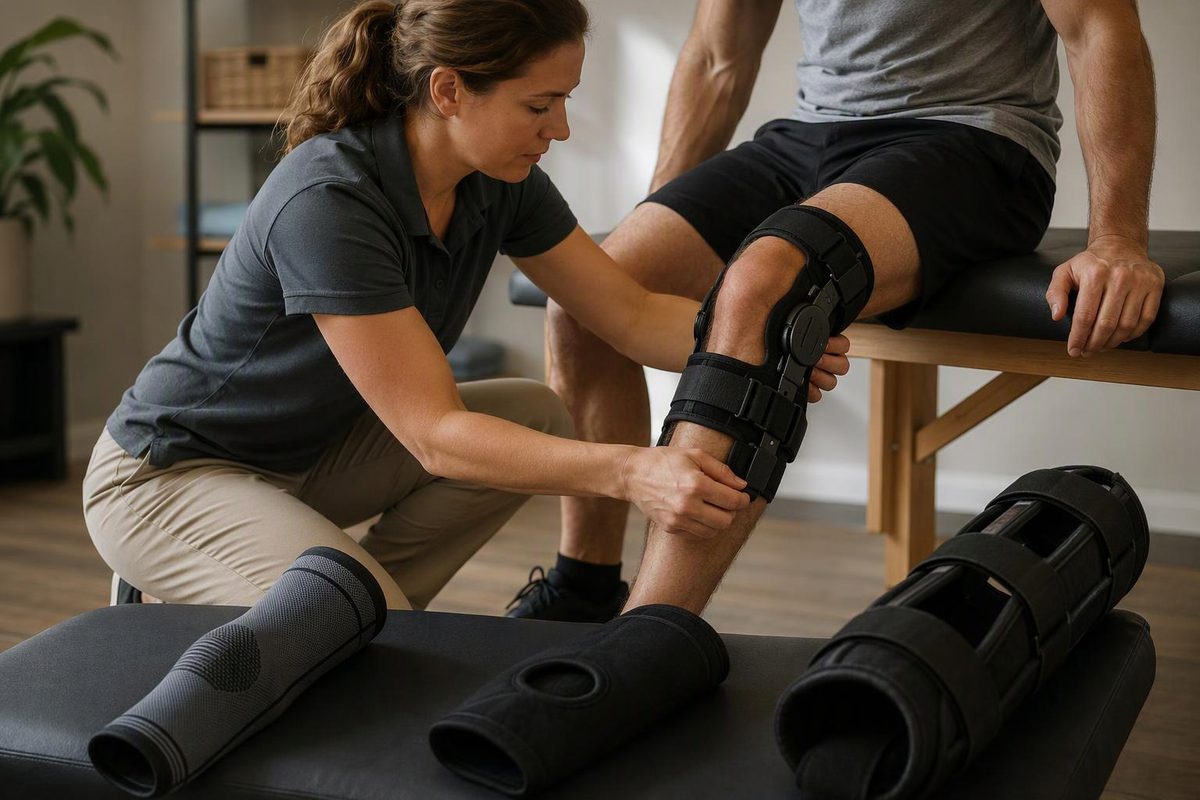
A hinged knee brace is commonly used when a medial collateral ligament (MCL) injury needs protection, especially for isolated grade 2 and grade 3 injuries. A plain compression sleeve is not a substitute for prescribed hinged protection. Mild, stable sprains may not need a brace; the choice depends on assessed knee stability, associated injuries and any prescribed movement limits.
The MCL runs along the inner side of the knee and helps control side-to-side movement. A hinged brace can protect against valgus stress: a force that pushes the knee inward and strains the inner ligament. However, a 2024 review of non-operative MCL treatment found very low-quality evidence for the effects of bracing. Common use does not establish one best brace or schedule for everyone.
Select your assessed injury and any warning signs to see what to discuss before choosing a brace.
Match the Brace Discussion to Your Assessment
Do not choose a grade based on pain alone.
Very painful knee; unable to move it or bear weight; badly swollen or misshapen; locking or giving way; or hot/red knee with fever or chills.
Assessment Before Purchase
Inner-knee pain alone does not establish an MCL injury. Arrange a clinical assessment before choosing injury-specific protection.
Ask whether you need side support, movement limits or weight-bearing restrictions. This tool does not diagnose an injury or set hinge angles.
Sources: AAOS injury definitions, Sanford isolated-MCL guidance and NHS warning signs. Brace model and wear schedule require an individual plan.
Assessment Comes Before Brace Selection
Inner-knee pain after a twist or collision is not enough to diagnose an MCL injury. A clinician checks ligament stability and looks for associated damage, including an ACL or meniscus injury. Those findings can change the brace and rehabilitation plan. The American Academy of Orthopaedic Surgeons (AAOS) describes examination and imaging as part of this assessment.
Seek urgent assessment rather than relying on a brace if the knee is very painful, you cannot move it or put weight on it, it is badly swollen or misshapen, it locks or gives way, or it is hot or red with fever or chills. These are NHS warning signs, not features to manage by buying stronger support.
Injury Grade Guides the Protection Discussion
The grade describes the damage and resulting looseness—not simply how much pain you feel.
| Assessed Injury | What the Grade Means | Brace Discussion |
|---|---|---|
| Grade 1 | Mild damage; the ligament still keeps the knee stable | A brace may not be necessary. Ask whether protection is needed for your symptoms and activities. |
| Grade 2 | Partial tear with some ligament looseness | A hinged brace is commonly used during recovery. |
| Grade 3 | Complete tear with instability | Ask which brace and movement limits are needed, and whether the tear pattern or other injuries require specialist treatment. |
These definitions come from AAOS. Sanford Health’s guideline for isolated MCL sprains describes protective bracing as possible for grade 1 and most often used for grades 2 and 3.
“Isolated” means the MCL injury occurs without accompanying damage to other knee structures. A plan for an isolated sprain should not be assumed suitable for an MCL injury combined with ACL or meniscus damage.
Hinged Braces Provide Side Support; Sleeves Do Not
A hinged brace supports either side of the knee while allowing the amount of bending your treatment plan permits. Some models have adjustable stops that limit bending and straightening, or a lock that prevents bending. Confirm whether you need these settings before choosing a model.
A plain elastic compression sleeve lacks that hinge-and-upright structure. Do not substitute one for prescribed hinged protection simply because it feels supportive.
An immobilizer, or a hinged brace locked straight, has a different job: preventing movement. More restriction is not automatically better. Use it only when your care team specifies it, and do not change prescribed hinge settings unless instructed. St George’s hospital guidance explains that the clinician selects the permitted range and changes it during recovery.
Correct Fit Matters More Than a “Best MCL Brace” Label
Start with the prescribed brace type and whether adjustable movement limits are required. The draft evidence does not establish a best brand or model for every MCL injury.
Use the exact model’s sizing chart. Take the measurements requested for that brace rather than relying on your usual clothing size. Our guide to knee brace measurement charts explains why charts are not interchangeable.
Check hinge position and strap pressure. The hinges should sit level with the knee joint, not slide down toward the calf. Straps should hold the brace securely without excessive pressure. Follow the fitting sequence for your model.
Inspect the skin when removal is permitted. Persistent redness, soreness or skin damage warrants a fitting review. St George’s fitting guidance emphasizes hinge position, secure but comfortable straps and regular skin checks. If the brace repeatedly slips, ask for a refit rather than continually tightening it.
Wear Time and Hinge Settings Need an Individual Plan
There is no universal MCL brace schedule. In the 2024 systematic review of isolated MCL injuries, reported brace use ranged from two to five weeks, but protocols varied and some used symptom-based stopping criteria. Evidence for the effects of bracing was rated very low quality. That range is not a personal deadline or proof that every MCL injury needs bracing.
Before leaving the fitting appointment, get specific instructions for walking, exercise and sleep. Ask when the brace may come off for washing, how much weight you may put through the leg, and whether you need crutches. Also confirm who will change the hinge settings and when brace use will be reviewed.
Do not assume nighttime removal is safe. Some acute-injury pathways prescribe all-day and overnight wear until specialist review, as in University Hospitals Sussex’s patient instructions. Those instructions apply to that pathway, not automatically to every MCL sprain.
Rehabilitation Determines Progress Beyond the Brace
Bracing does not replace regaining movement, strength and control. Exercises must respect your permitted knee motion and weight-bearing limits. For return to running or sport, feeling steadier inside the brace is not enough: AAOS guidance recommends restoring movement and strength, then progressing activities gradually with professional guidance.
Ask your treating clinician whether your knee needs side protection alone, or also limits on bending and weight bearing. That distinction is more useful for choosing support than buying the most restrictive brace available.