
When Can I Sleep Without a Brace After ACL Surgery?
No universal stopping night exists; keep wearing it until your surgeon or physical therapist explicitly clears nighttime removal for your procedure.
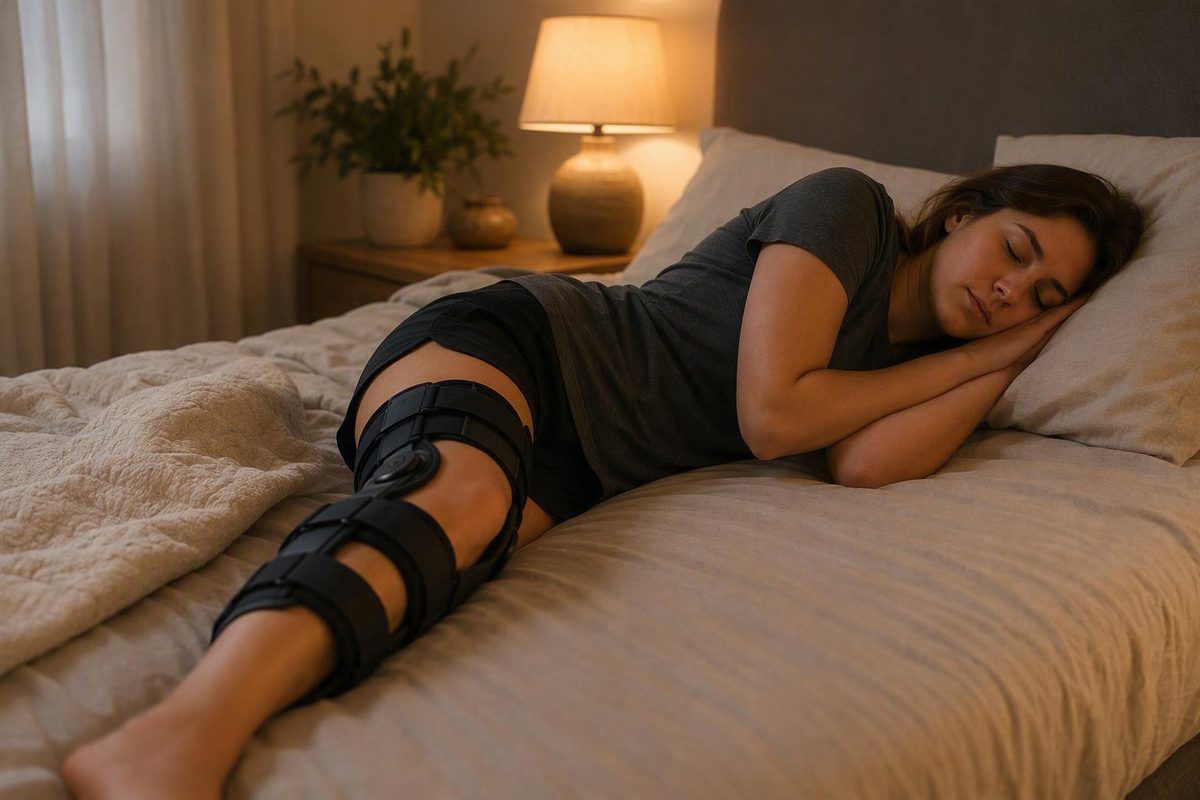
The short answer: wait for explicit nighttime clearance
There is no universal, evidence-based night when everyone can stop sleeping in a knee brace after ACL reconstruction. The safest practical answer is: keep wearing the brace at night until your operating surgeon or physical therapist explicitly says you may remove it for sleep.
Published instructions vary substantially. The Corvallis Clinic directs patients to wear the brace while sleeping for the first 7–10 days. That is one clinic’s protocol, not an automatic stopping date for every patient. See the Corvallis Clinic’s postoperative ACL instructions.
Other orthopedic guidance gives a broader estimate of approximately 1–4 weeks, with clearance depending on the surgeon’s protocol, the operation performed, knee stability, swelling, and recovery progress. Review Sigma Orthopedics’ discussion of nighttime brace duration.
A longer protocol from the Nicholas Institute of Sports Medicine and Athletic Trauma describes brace use for about 4–6 weeks, with the brace locked straight during walking and sleep until the surgeon or physical therapist changes the instruction. See NISMAT’s postoperative brace guidance.
These ranges illustrate variation in postoperative practice. They are not a countdown you can safely apply to yourself.
Your written discharge instructions take priority because they reflect the operation performed and your surgeon’s rehabilitation plan. If the paperwork says “at all times,” “while sleeping,” or “locked in extension,” continue following that instruction until the surgical team clarifies or changes it.
Do not remove the brace for sleep merely because:
- pain has improved;
- swelling looks better;
- you can perform exercises more easily;
- you can sit comfortably without the brace;
- you can tighten your thigh muscle or hold the leg straight;
- another patient stopped wearing a brace at the same stage;
- you have reached a date mentioned by a clinic or website.
Improvement can be encouraging, but pain and swelling alone cannot show whether unbraced sleep is appropriate.
The safest immediate action is straightforward:
- Find your discharge paperwork or rehabilitation protocol.
- Look specifically for instructions about sleeping, not just general brace use.
- Check whether the brace must remain locked straight overnight.
- Confirm whether your ACL reconstruction included another procedure.
- If the wording is absent or ambiguous, call or message the surgeon’s office or physical therapist.
- Ask whether nighttime removal is permitted now, given your exact operation and current progress.
If you cannot reach the team before bedtime, continue the protection already prescribed rather than substituting a generic online date.
Why ACL brace timelines range from days to several weeks
Postoperative bracing is not uniform across ACL practices. Some surgeons prescribe a hinged brace to restrict motion and reduce unintended movement. Others may not routinely use a brace after selected, uncomplicated ACL reconstructions. That difference in practice is one reason two people who both say they “had ACL surgery” can receive very different nighttime instructions.
The operation itself may also differ. “ACL reconstruction” does not tell you whether the surgeon also treated:
- a meniscus tear;
- an MCL injury;
- cartilage damage;
- another ligament;
- another structure within or around the knee;
- findings or complications discovered during surgery.
An isolated ACL protocol may therefore be inappropriate for someone who had a combined procedure. For example, ACL and MCL recovery instructions may depend on an individualized rehabilitation plan rather than a single removal week that applies to everyone. Heiden Orthopedics emphasizes procedure- and patient-specific rehabilitation after ACL or MCL treatment.
This does not mean every additional procedure automatically requires longer nighttime bracing. It means the complete operation—not the words “ACL surgery” alone—must guide the plan.
At follow-up, a clinician may consider:
- the exact reconstruction and any associated procedures;
- findings from the postoperative examination;
- knee stability;
- swelling;
- healing progress;
- the ability to maintain knee extension;
- quadriceps control;
- walking stability;
- concern about uncontrolled bending or twisting.
General rehabilitation guidance describes swelling, stability, range of motion, walking, and quadriceps control as factors that may influence how brace use is reduced. These are clinician-assessed considerations, not a validated home clearance test. Doc Ortho describes these factors within a general, surgeon-dependent brace timeline.
Nor does minimal swelling automatically override a restriction intended to protect another repair.
Protocol design also matters. One surgeon may prescribe continuous brace use and then reduce it in stages. Another may allow early removal in controlled settings while retaining the brace for walking or sleep. Another may use no routine brace in selected cases. Follow-up findings can then modify the original plan.
An online protocol may be accurate for its intended patients and still be wrong for you because it may have been written for:
- a different surgical technique;
- an isolated rather than combined reconstruction;
- a first reconstruction rather than a revision;
- a different postoperative brace;
- a different approach to weight-bearing and motion;
- a particular surgeon’s patient population;
- a rehabilitation pathway with different follow-up timing.
Published timelines are useful for understanding why answers differ. They should not override the team that knows what was repaired inside your knee.
Do not confuse sleeping with other brace-removal milestones
“Can I take off the brace?” is not one question. It is at least five separate questions:
- May I remove it to shower?
- May I remove it for prescribed exercises?
- May I remove it while sitting in a controlled setting?
- May I remove it while sleeping?
- May I remove it while standing or walking?
Each permission applies to a different situation. Approval for one activity does not automatically grant approval for another.
The Corvallis Clinic protocol illustrates the distinction. It permits brace removal while sitting at home or in another controlled environment after seven days, but separately directs patients to wear it during sleep for the first 7–10 days and whenever walking or outside the home. “Brace off while sitting” therefore does not mean “brace off in bed.” Compare the activity-specific instructions in the Corvallis protocol.
NISMAT’s longer protocol makes a similar distinction. It allows removal for prescribed exercises or use of a continuous passive motion machine, while requiring the brace to remain locked straight during walking and sleeping. Its guidance says the surgeon or physical therapist should unlock the hinges and advise when the brace may come off. Review NISMAT’s activity-specific brace instructions.
Sleep deserves a separate instruction because you cannot reliably control your movements once asleep. A prescribed exercise performed in a controlled way is not equivalent to several hours of unconscious turning.
Side-sleeping is another separate decision. Your team might allow you to sleep on your non-operative side while still requiring the postoperative brace. Permission to change position does not mean the brace may come off.
Before interpreting any instruction, obtain explicit answers to both questions:
- Must I wear the brace while sleeping?
- If so, must it remain locked, and at what setting?
If your paperwork says the brace may come off for exercises, showering, or “rest,” ask whether rest includes overnight sleep. Do not assume it does.
What to confirm before the first night without the brace
A safe decision begins with your own surgical documents, not a calendar estimate. Use the following decision path.
First, read the instructions by activity. Identify what they say about:
- sleeping;
- whether the hinges remain locked;
- prescribed exercises;
- sitting or resting;
- showering and wound care;
- standing and walking;
- use outside the home.
Do not collapse those directions into one general “brace on” or “brace off” rule. If nighttime use is not mentioned, the omission is a reason to ask for clarification—not proof that removal is allowed.
Second, confirm what operation you actually had. Review the operative summary or ask whether this was an isolated ACL reconstruction. Specifically ask whether the surgeon repaired or otherwise treated the meniscus, MCL, cartilage, or another structure. Mention if the operation was a revision rather than a first reconstruction.
Third, ask what determines nighttime clearance in your surgeon’s protocol. The clinician may use the postoperative examination, healing progress, swelling, stability, extension, quadriceps control, walking ability, and concern about uncontrolled rotation. The relevance of each factor depends on the procedure and examination, so do not convert them into a home checklist.
Use this exact script if helpful:
“Given my exact procedures and current exam, may I sleep without the brace now, and if not, when will you reassess it?”
Then ask two separate follow-up questions:
“May I sleep on my side?”
“If I still need the brace at night, should it remain locked or unlocked, and at what setting?”
Try to obtain an unambiguous answer, such as:
- “Wear it locked during sleep until your next visit.”
- “Keep it on at night, but use the setting shown at today’s appointment.”
- “You may sleep without it starting tonight.”
That is safer than trying to interpret broad language such as “wean as tolerated.”
If instructions from the hospital, surgeon, and physical therapist appear to conflict, contact the surgical team. Quote the exact wording from each document. Until the conflict is resolved, continue the protection already prescribed rather than selecting the least restrictive version.
If you accidentally sleep without the brace, do not repeatedly bend, twist, or stress the knee to test whether anything happened. Tell the surgical team what occurred, report any new symptoms, and follow its instructions.
How to wear the brace at night while it is still required
Several postoperative protocols require the brace to remain locked in extension, meaning the leg is held straight, during sleep. General brace guidance also describes locked extension during the first part of recovery, while emphasizing that the operating surgeon’s instructions take priority. See the example locked-extension guidance from Doc Ortho.
This does not mean every patient should set a brace to the same angle. It means “wear the brace” and “wear it at the prescribed setting” are inseparable instructions.
Use the setting written in your protocol or demonstrated by your clinician. Do not independently unlock the hinges, remove hinge stops, or change the permitted range of motion because the brace feels restrictive. If you are unsure whether it is locked correctly, ask the surgeon’s office, physical therapist, or brace provider to show you.
Nighttime discomfort is common. Pain, swelling, pressure from the brace, and restricted mobility can all interfere with sleep. However, discomfort alone is not permission to change a prescribed motion restriction.
Published strap advice is inconsistent. Blackrock Orthopedics suggests keeping the brace snug rather than tight and allows some loosening for comfort, while other orthopedic guidance advises against loosening straps unless the surgeon approves it. Because brace design, swelling, fit, and surgical restrictions vary, there is no safe universal loosening rule. Read Blackrock Orthopedics’ nighttime fit advice.
Ask the team how to adjust your specific brace, including:
- how snug each strap should be;
- where the hinges should sit;
- how to prevent the brace from sliding;
- whether changes in swelling require refitting;
- whether a liner or skin barrier is permitted;
- whether straps may be adjusted overnight;
- whom to contact after hours if the fit becomes intolerable.
Seek individualized guidance if the brace causes numbness, marked pressure, persistent skin irritation, repeated slipping, or uncertainty about hinge placement. Difficulty moving the foot or toes requires prompt clinical advice rather than an improvised refit.
Do not add padding, alter brace components, move hinge stops, or perform a home repair unless the surgical team or brace provider tells you to do so.
The practical rule is: make comfort adjustments only within the instructions provided for that brace, without changing the prescribed lock or knee position.
A safer sleep setup during early ACL recovery
Back sleeping is commonly recommended early because it limits opportunities for unintended rotation and makes it easier to keep the operated leg aligned. It does not guarantee graft protection, and it does not replace the brace or restrictions prescribed by your team.
If your instructions call for elevation, place support beneath the calf, heel, or ankle, depending on the directions you received. Avoid placing a pillow directly behind the knee unless your surgical team specifically tells you to do so.
Many early protocols prioritize regaining or maintaining full knee extension. A pillow directly behind the knee can hold it in a bent position and conflict with that goal.
A basic setup may look like this:
- Lie on your back.
- Keep the brace at its prescribed setting.
- Support the lower leg where your protocol directs.
- Keep the knee and leg aligned rather than allowing the leg to roll inward or outward.
- Arrange pillows before settling down so you do not repeatedly twist to reposition them.
- Keep prescribed crutches or other mobility aids within reach for getting out of bed.
Do not combine elevation heights, icing schedules, medication timing, and brace settings from several unrelated internet protocols. Each source may be addressing a different operation or rehabilitation plan. Follow your discharge directions for elevation, cold therapy, medication, and brace use.
Later, your team may permit sleeping on the non-operative side. A firm pillow between the legs may help support the operated leg and reduce uncontrolled crossing or rotation. Blackrock Orthopedics estimates that side sleeping may become possible after pain improves, often around 10–14 days, but that estimate is not permission to stop wearing the brace or personal clearance to change position after every ACL-related procedure. See Blackrock Orthopedics’ side-sleeping guidance.
If side sleeping is approved while nighttime bracing is still required:
- ask whether the operated leg should remain on top;
- keep the brace in the prescribed setting;
- use enough support to prevent the operated leg from dropping or twisting;
- avoid assuming that reduced pain means all positions are permitted;
- contact the team if the position produces new pain, pressure, numbness, or instability.
Sleep-position approval and brace-removal approval are separate milestones.
What research on routine bracing can—and cannot—tell you
It is reasonable to wonder why nighttime bracing is necessary when some research questions routine brace use after ACL reconstruction.
One randomized controlled trial included 84 patients: 42 were assigned an adjustable hinged brace for four weeks, and 42 received no postoperative brace. In that study population, routine bracing did not improve the measured subjective or objective outcomes. Read the randomized trial on bracing after ACL reconstruction.
That finding helps explain why surgeons do not all use the same postoperative brace protocol. It does not answer which night an individual patient can stop wearing a brace in bed.
The central limitation is that the trial compared general postoperative bracing with no bracing. It did not separately randomize or analyze sleeping with a brace versus sleeping without one. It therefore cannot identify a safe nighttime stopping date.
Other limits affect how broadly the results can be applied:
- the sample was relatively small;
- participants were predominantly male;
- one surgeon performed the reconstructions;
- patients with certain additional instability or previous ligament reconstruction were excluded;
- all participants followed the study’s rehabilitation framework rather than the full range of protocols used in practice.
These limitations do not make the study unhelpful. They keep its conclusion appropriately narrow: routine bracing did not improve the outcomes measured in that particular study population and protocol.
The study cannot determine whether a brace restriction was prescribed because of another repair, a specific intraoperative finding, a particular movement restriction, or the patient’s current examination. It should not be used as personal authorization to disregard a postoperative order.
The most useful interpretation is that research questioning routine bracing helps explain legitimate variation among surgeons. It does not establish a universal night for unbraced sleep.
When symptoms require a prompt call to the surgical team
Routine brace discomfort should not be used to explain away new or worsening symptoms. Contact the surgical team promptly for:
- severe calf pain or unusual calf swelling;
- rapidly increasing knee swelling;
- fever or chills;
- worsening or poorly controlled pain;
- increasing incision redness or drainage;
- difficulty moving the foot or toes;
- new giving way or instability.
Orthopedic postoperative guidance identifies these types of calf, swelling, fever, incision, pain, and foot-movement symptoms as reasons to contact a healthcare professional. Review Sigma Orthopedics’ postoperative warning signs.
These symptoms can have different causes. Do not repeatedly test the knee or improvise a different brace position in an attempt to diagnose the problem yourself.
Also contact the team if reducing brace use is followed by increased pain, swelling, or instability. Stop self-testing and ask the surgical team what to do next.
Use the urgent and after-hours instructions supplied with your discharge materials. If your surgeon gave you a dedicated postoperative number, use it rather than waiting for a routine physical-therapy visit. For severe or rapidly worsening symptoms, follow the emergency directions provided by your clinical team.
Important: Knee Pain Zone provides general education, not individualized treatment or postoperative clearance.
Frequently asked questions
Can I stop sleeping in the brace after 7–10 days?
Possibly, but not simply because the calendar has reached day seven or day ten. That range comes from one clinic protocol; other practices continue nighttime bracing for several weeks.
Check whether your own instructions distinguish between sitting, exercises, sleep, and walking. Then ask specifically whether you may remove the brace overnight now. If you have not received explicit nighttime clearance, continue the prescribed protection.
Does my ACL brace need to stay locked while I sleep?
If your protocol requires nighttime bracing, it may also require the brace to remain locked with the leg straight. The correct setting must come from your surgeon, physical therapist, or written protocol.
Do not independently unlock the hinges. If your paperwork says to wear the brace but does not give a nighttime setting, ask the surgical team before changing it.
Can I sleep on my side while still wearing the brace?
Sometimes. A clinician may allow sleeping on the non-operative side while the brace remains on, often with a firm pillow between the legs to support the operated leg.
Ask separately about side sleeping and brace removal. Permission to lie on your side does not imply permission to stop wearing the brace.
Does a meniscus or MCL repair change how long I wear the brace at night?
It can. An associated meniscus, MCL, cartilage, or other procedure may come with restrictions different from those used after an isolated ACL reconstruction. The complete operation may affect brace use, allowed motion, weight-bearing, or the timing of nighttime removal.
ACL and MCL recovery guidance specifically emphasizes following the individualized rehabilitation plan and asking the surgeon or physical therapist before changing nighttime brace use.
Confirm what was performed and follow the protocol for the complete operation rather than a generic isolated-ACL timeline.
Where should I put pillows after ACL surgery?
Early protocols commonly place support under the calf, heel, or ankle rather than directly behind the knee. This supports the leg without deliberately holding the knee bent, which may conflict with the early goal of maintaining extension.
Follow your own instructions for the exact support location and amount of elevation. If side sleeping is approved, a firm pillow between the legs may help support alignment, but it does not replace the brace if nighttime wear is still required.
Do not choose a stopping night from an online range. Check your written protocol, confirm which procedures were performed, and obtain explicit permission from your surgeon or physical therapist before sleeping without the brace. Until then, use the prescribed setting, position the leg as instructed, and promptly report concerning symptoms or worsening pain, swelling, or instability.