
Hinged Knee Brace: When It Helps and How to Choose
Learn when a hinged knee brace may help, how it differs from a sleeve, and which fit checks and prescribed movement limits matter.
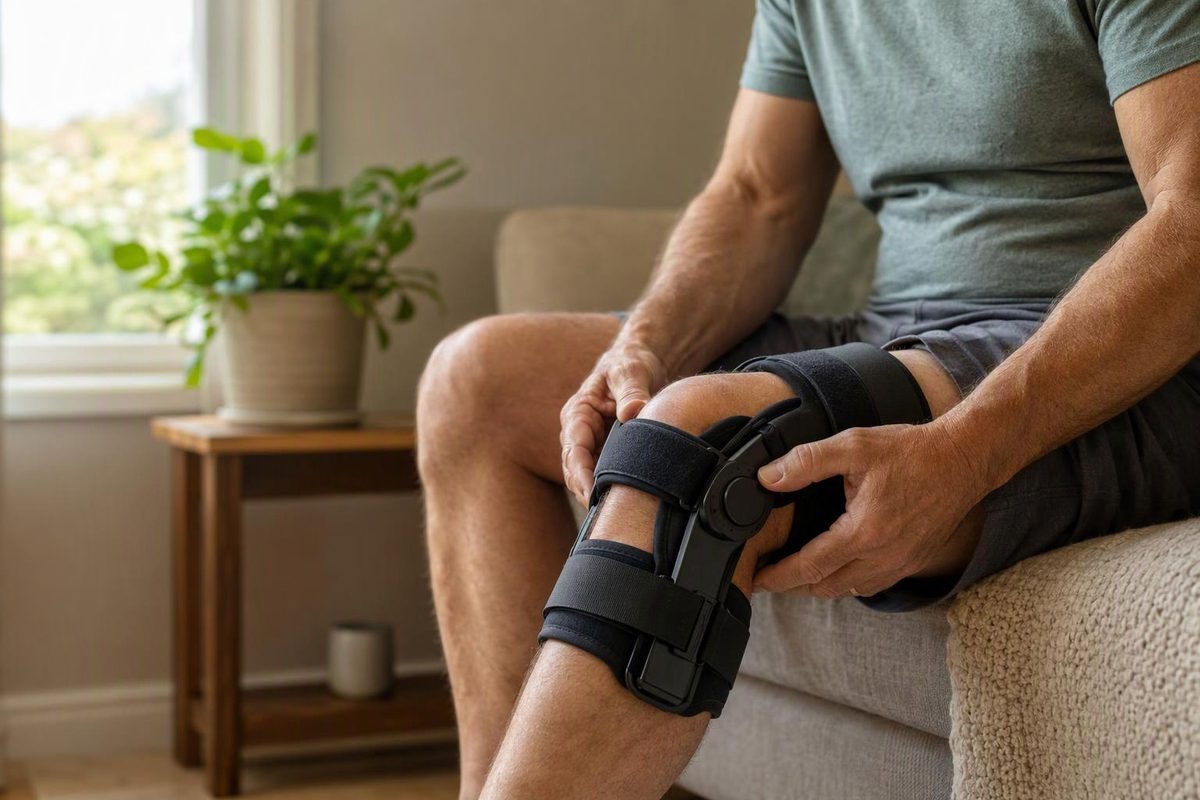
A hinged knee brace supports the joint from the sides. Some models also limit how far the knee can bend or straighten. It may be useful after a diagnosed ligament injury or surgery, but knee pain alone does not tell you whether you need hinges—or which kind.
Before buying, identify the job the brace needs to do: support an injured ligament, protect a healing repair, support the kneecap, or reduce pressure from arthritis. Those are different tasks, and the supports are not automatically interchangeable. Cleveland Clinic explains the main brace types and their purposes.
When a hinged knee brace may help
A diagnosed collateral-ligament injury. The medial collateral ligament (MCL) runs along the inside of the knee; the lateral collateral ligament (LCL) runs along the outside. These ligaments control side-to-side movement. AAOS describes hinged bracing as part of nonsurgical care for selected MCL and LCL injuries, alongside physical therapy to restore movement and strength. Whether that approach fits depends on the injury’s severity and any other damaged structures—not simply where it hurts. AAOS collateral-ligament guidance
Protection after an injury or operation. A prescribed range-of-motion (ROM) brace can be locked or set to allow only a specified amount of bending and straightening. The treating team chooses those limits and changes them as recovery progresses. Do not replace a prescribed brace with a retail hinged support unless your team confirms it meets your treatment requirements. St George’s hinged-brace instructions
Some ongoing stability problems. Functional braces limit excessive movement in particular directions. A clinician can assess whether that support matches your problem. Cleveland Clinic’s brace overview explains their purpose; giving way is not proof that a stronger brace will solve the problem.
More bracing is not automatically better. The 2022 AAOS ACL guideline advises against routine functional bracing when returning to activity after an isolated, first-time anterior cruciate ligament reconstruction; this is a limited-strength recommendation. It does not mean you should stop wearing an early post-operative brace prescribed to protect your repair. AAOS guideline summary
Hinged brace, sleeve or another support?
| Support | Main purpose |
|---|---|
| Compression sleeve | Light compression rather than rigid movement control |
| Functional hinged brace | Support and restriction of excessive movement after selected injuries |
| ROM brace | Prescribed limits on bending and straightening during recovery |
| Patellofemoral brace | Support around the kneecap and front of the knee |
| Unloader brace | Reduce pressure on the knee in selected arthritis cases |
These categories describe the purpose, not just the appearance, and can overlap. Check what the device is designed to do, rather than choosing by the number of straps or how substantial it looks. Brace-type overview
If your clinician recommends kneecap-focused support, our patella stabilizer selection guide covers that separate choice.
How to choose and check the fit
For a prescribed brace, ask the fitter to watch you put it on and take it off. Get clear instructions for:
- The permitted bending and straightening settings.
- How much weight you may put through the leg and whether you need crutches.
- When to wear it, including during sleep.
- When and how you may remove it for washing and skin checks.
- Which exercises are allowed and when the plan will be reviewed.
There is no universal wear schedule: it depends on the injury and treatment plan. Do not adjust a prescribed hinge dial unless your team has specifically told you how and when. UCLH brace advice
For sizing, use the exact model’s measurement chart, not your usual clothing size or another brand’s “medium.” For example, United Ortho’s short hinged-brace instructions use circumference measured six inches above the centre of the kneecap. Our knee brace measurement-chart guide explains why measurement locations matter.
At fitting, the hinges should sit at the level of the knee joint. Straps should be snug without pain or a feeling of restricted circulation. Follow the device’s fastening instructions: St George’s describes a one-finger strap check, while UCLH describes two, so do not treat either as a rule for every brace. If it repeatedly slips or needs uncomfortable tightening to stay up, request a fit review. Check the skin regularly as instructed, including beneath straps and rigid edges. St George’s fitting guidance and UCLH fitting advice
When a brace is not the next step
Seek urgent assessment if you cannot bear weight or move the knee, it is very painful, badly swollen or misshapen, it locks or gives way, or it is hot and red with fever or shivering. Do not use a brace to postpone that assessment. NHS knee-pain guidance
While wearing a brace, contact your treating team straight away for rubbing, blister-like pain or persistent redness. Cold, blue or white toes, persistent numbness, or severe escalating pain need immediate medical assessment. New calf pain or swelling needs urgent assessment; chest pain or sudden breathlessness needs emergency care. UCLH brace warning signs
The useful question is not “Which hinged brace is strongest?” It is: “What movement needs support or restriction, and for how long?” That answer should guide both the brace and the rehabilitation plan.