
Knee Brace for Knee Tendonitis: Is a Tendon Strap Worth Trying?
Learn when a patellar tendon strap may ease knee tendon pain, how to check fit, and why support should not replace progressive rehabilitation.
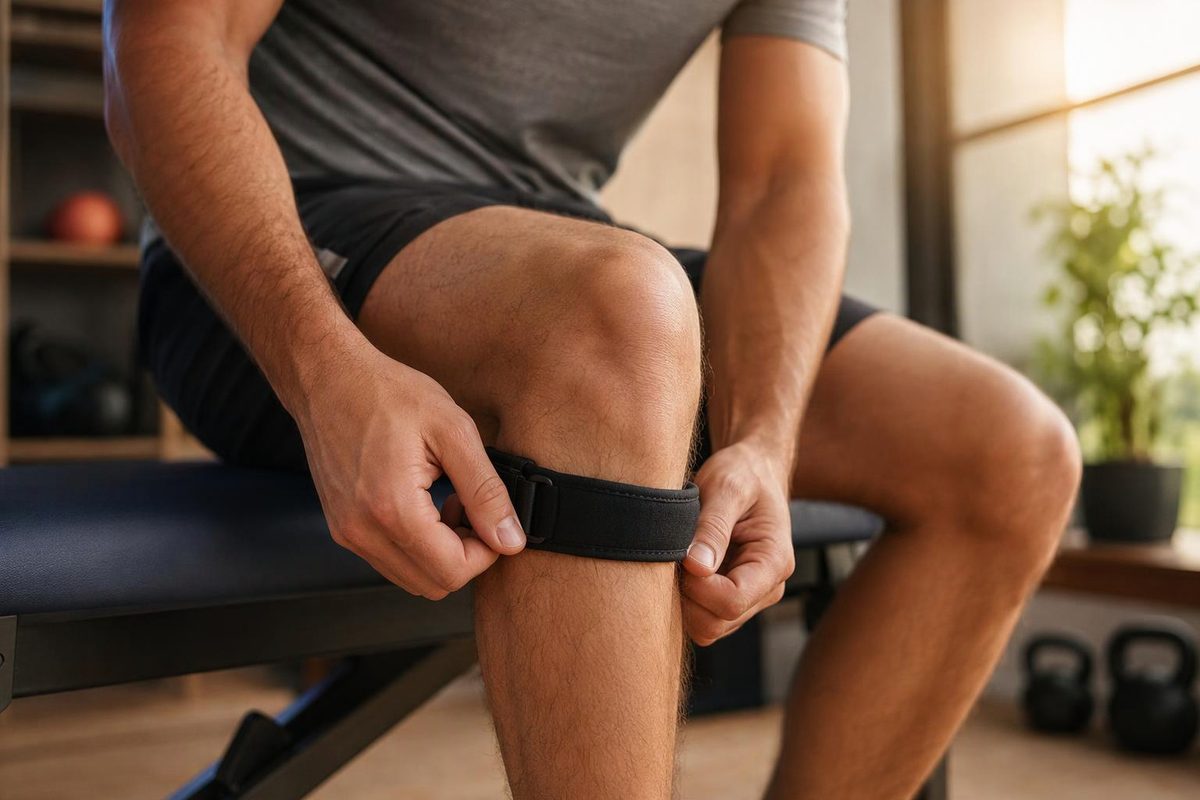
For confirmed patellar tendon pain just below the kneecap, a patellar tendon strap may offer temporary relief. It has not been shown to heal the tendon or provide lasting improvement on its own. Buying a brace is optional; managing aggravating activity and progressively strengthening the tendon remain the priorities. Clinical management review
First, check which tendon—or problem—you are supporting
“Knee tendonitis” is a broad label. This article focuses on the patellar tendon, which connects the kneecap to the shinbone. Persistent, activity-related pain in this tendon is usually called patellar tendinopathy: tendon pain and reduced function associated with loading, rather than necessarily a simple episode of inflammation.
Pain is commonly localized near the bottom edge of the kneecap and aggravated by tendon-loading activities. However, location alone does not confirm the diagnosis. Pain around or behind the kneecap may instead be patellofemoral pain, and other knee conditions can overlap. The evidence for patellar straps should not automatically be applied to pain above the kneecap, at the inner knee or behind it. Clinical management review
Which support makes sense?
Patellar tendon strap: a targeted symptom-relief option
An infrapatellar strap is a narrow band worn below the kneecap, over the patellar tendon. Unlike a full brace, it leaves most of the knee uncovered and applies localized pressure.
Laboratory modelling suggests that a strap may change tendon geometry and reduce localized strain. That is a proposed mechanism—not proof that a strap repairs an injured tendon or prevents further injury. The modelling study involved 20 men without current knee problems. Laboratory study
If your clinician has confirmed patellar tendinopathy and you want to discuss a support, a tendon strap is a reasonable option to ask about.
Compression sleeve: do not assume equivalent benefits
A sleeve covers a larger area than a tendon strap. You might prefer its feel, but the strap trial discussed below does not establish that a plain compression sleeve produces the same benefit. Choose it for comfort if helpful—not on the assumption that compression will heal the tendon.
Kneecap stabilizer or hinged brace: a different support question
A kneecap stabilizer and a brace with hinges should not be treated as interchangeable with a tendon strap. Functional braces can be prescribed for joint or kneecap stability and other clinical needs; more hardware does not establish greater benefit for tendon pain. NHS brace guidance
If your clinician has identified a separate kneecap-stability problem, see our guide to patella stabilizer knee braces.
How much relief can a strap provide?
A randomized trial analyzed 97 athletes with patellar tendinopathy, comparing a strap, sports tape, placebo tape and no support.
During a single-leg decline squat, the strap reduced pain by 14 mm on a visual pain scale compared with no support—but it was not significantly better than placebo tape. Some short-term pain improvements after sport also occurred with placebo tape. The study supports possible temporary relief, not a guaranteed strap-specific effect. Randomized trial
These were athletes with an identified tendon condition. The findings do not establish the same benefit for every walker or runner with unexplained knee pain.
Guidance is also cautious about when to add support. A Dutch multidisciplinary guideline recommends exercise, education and loading advice first, considering a patellar strap when 12 weeks of thorough rehabilitation has not produced meaningful improvement. It favors straps among additional options because of their low cost and ease of use, while emphasizing the weak evidence. Dutch guideline
If you try a strap, check fit and usefulness
Follow the particular product’s sizing and placement instructions. Look for adjustable pressure and a fit that stays in position without repeated tightening.
- Keep it snug, not constricting. The laboratory study used a snug fit that did not restrict circulation. Strap-fitting method
- Check your skin. Stop and seek fitting advice if it creates persistent redness, tenderness or irritation. General NHS brace guidance recommends monitoring skin daily. NHS skin guidance
- Judge it during a familiar, tolerable activity. Do not test its benefit by suddenly adding running distance or jumping volume.
- Check later and the next morning. Less pain while wearing it is not enough if the overall activity leaves you more sore afterward. Monitoring symptoms after loading helps guide activity adjustments. Load-management guidance
If it does not make a useful difference, you do not need to keep wearing it or move automatically to a larger brace.
Keep rehabilitation—not the brace—as the main treatment
For diagnosed patellar tendinopathy, rehabilitation usually combines reducing aggravating loads with gradually increasing quadriceps and tendon-loading exercise. Progression should reflect symptoms, function and your activity goals. A strap is an adjunct, not permission to push through worsening symptoms. Clinical management review
Our guide to exercises for jumper’s knee explains how strengthening fits into that progression.
Seek urgent assessment rather than shopping for support if your knee is very painful, you cannot move it or bear weight, it is badly swollen or deformed, it locks or gives way, or it is hot/red with fever or chills. Arrange a clinical review if pain is not improving within a few weeks. NHS knee-pain guidance
This is general education, not an individual diagnosis or brace prescription.