
Knee Valgus Deformity Exercises: What They Can Change
Learn what exercises can do for structural knock knees, two gentle strengthening options, and when adult or childhood alignment needs assessment.
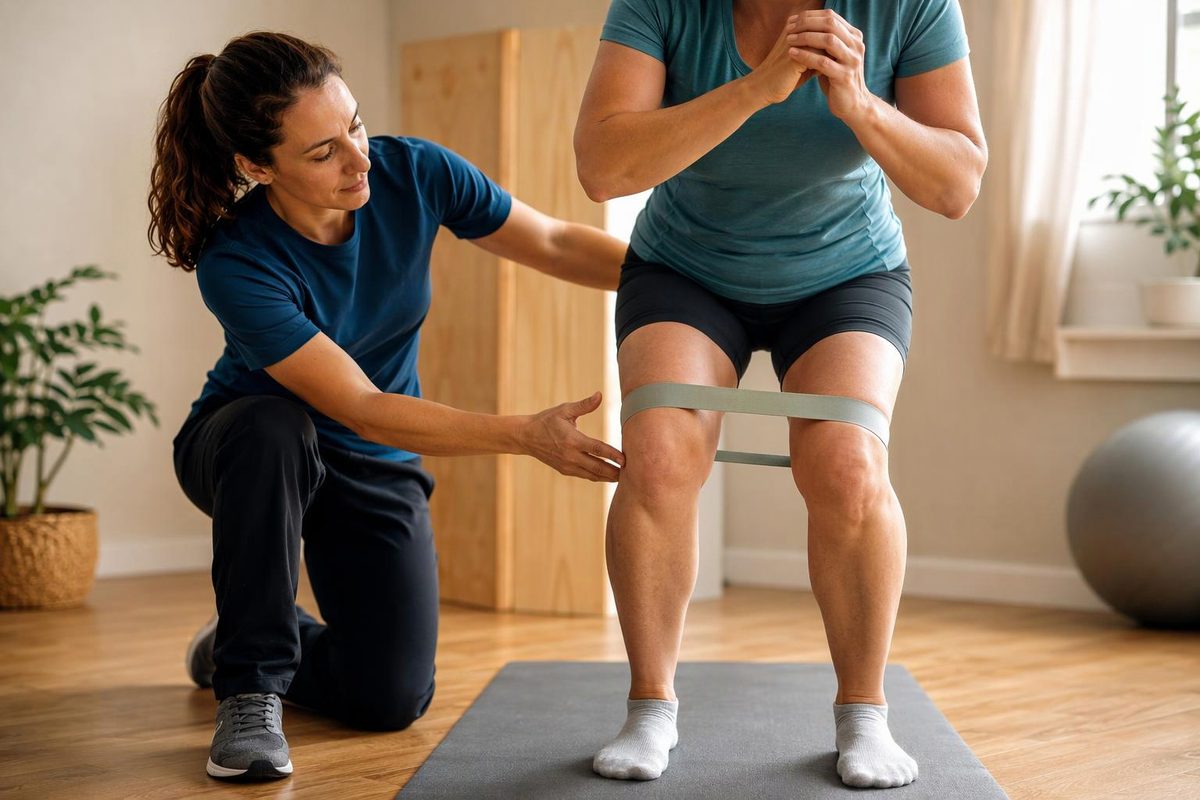
Exercises can strengthen the muscles supporting your knees, but they should not be presented as a way to straighten an adult’s established bony knock-knee deformity. The useful goal is better strength and function—not forcing your legs into a different shape. AAOS describes exercise as knee conditioning; Hospital for Special Surgery states that nonsurgical measures, including keeping fit, do not change the deformity. (AAOS, HSS)
The first question is whether you have a movement-control problem, a structural alignment difference, or both.
Standing alignment is different from inward movement
Genu valgum, commonly called knock knees, describes knees that angle inward while standing, leaving a gap between the ankles when the knees are together. A clinician assesses the legs and walking pattern; when needed, standing images from hip to ankle help locate the deformity. A photograph or squat video alone is not that assessment. (HSS)
If your main concern is a knee that drifts inward during squats or step-downs, see our separate guide to exercises for dynamic knee valgus. That guide addresses movement control rather than correction of a fixed deformity.
For structural knock knees, judge exercise progress by what you can comfortably do: completing repetitions, getting out of a chair or walking more easily. Do not use a shrinking ankle gap as the target.
When alignment needs assessment first
Arrange an assessment if knock knees started in adulthood, are worsening, affect one leg more than the other, or cause pain, stiffness, swelling, limping or difficulty walking. These are reasons to investigate rather than assume the problem is weak hip muscles. (NHS 111 Wales)
Possible underlying causes include arthritis, a previous injury or fracture, and conditions affecting bone health. Assessment may therefore change both the treatment and the exercise plan. Not every person with knock knees needs surgery. (HSS, NHS 111 Wales)
Seek urgent medical advice instead of exercising for severe pain, inability to move or bear weight, major swelling or a newly changed knee shape, locking or giving way, or a hot/red knee with fever or feeling unwell. Pain that does not improve within a few weeks also needs review. (NHS knee-pain guidance)
Two strengthening options to discuss
For an adult whose alignment is stable and whose clinician agrees that strengthening is appropriate, these are simple options from the AAOS knee-conditioning program. They are general strength exercises, not a tested genu-valgum correction routine. After surgery or an injury, follow your prescribed rehabilitation restrictions instead.
Warm up with five to ten minutes of comfortable walking or stationary cycling. AAOS advises that exercises should not hurt; stop a painful exercise and discuss it with your doctor or physiotherapist. (AAOS)
Seated knee extension
This trains the quadriceps—the muscles at the front of your thigh.
- Sit upright on a sturdy chair, feet resting on the floor.
- Tighten one thigh and slowly straighten that knee as far as comfortable.
- Hold for up to five seconds, then lower the foot gently.
- Repeat on the other side.
Start without an ankle weight. Avoid swinging the leg or using momentum.
Supported hamstring curl
This trains the muscles at the back of your thigh.
- Hold a counter or sturdy chair back for balance.
- Bend one knee, lifting the heel behind you within a comfortable range.
- Hold for up to five seconds, then lower slowly.
- Repeat on the other side.
Do not force your knees together or twist your leg to imitate a straighter alignment. These instructions adapt the AAOS exercises.
As a cautious first trial, try one set of five to eight repetitions per side on two nonconsecutive days a week. This is a starting suggestion, not a validated deformity-treatment dose. Build repetitions before adding resistance, and reduce or pause the routine if it leaves symptoms worse afterward. A physiotherapist can decide whether hip strengthening or weight-bearing exercises should be added.
Children usually do not need “corrective” exercises
Common developmental knock knees are a different situation from an adult’s fixed deformity. Most affected children’s leg shape changes naturally as they grow; they do not need special exercises, physiotherapy or braces simply to correct normal developmental alignment. Keep ordinary play and activity separate from a corrective routine. (NHS inform)
Seek assessment for a child with unequal leg alignment, persistent pain limiting activity, worsening alignment, or knock knees before age two. Age thresholds for reviewing persistent knock knees vary: NHS 111 Wales advises review after age five, while NHS inform advises review after age eight or if alignment has not improved over 12 months. Ask your child’s healthcare professional rather than waiting for an age cutoff if you are concerned. Do not spend months pursuing an exercise-based straightening promise when the child’s growth and alignment need checking. (NHS 111 Wales, NHS inform)