
Exercises for Knee Valgus: Train Inward Knee Control
Try three exercises for dynamic knee valgus, with alignment cues, a cautious starting dose and guidance on when knock knees need assessment.
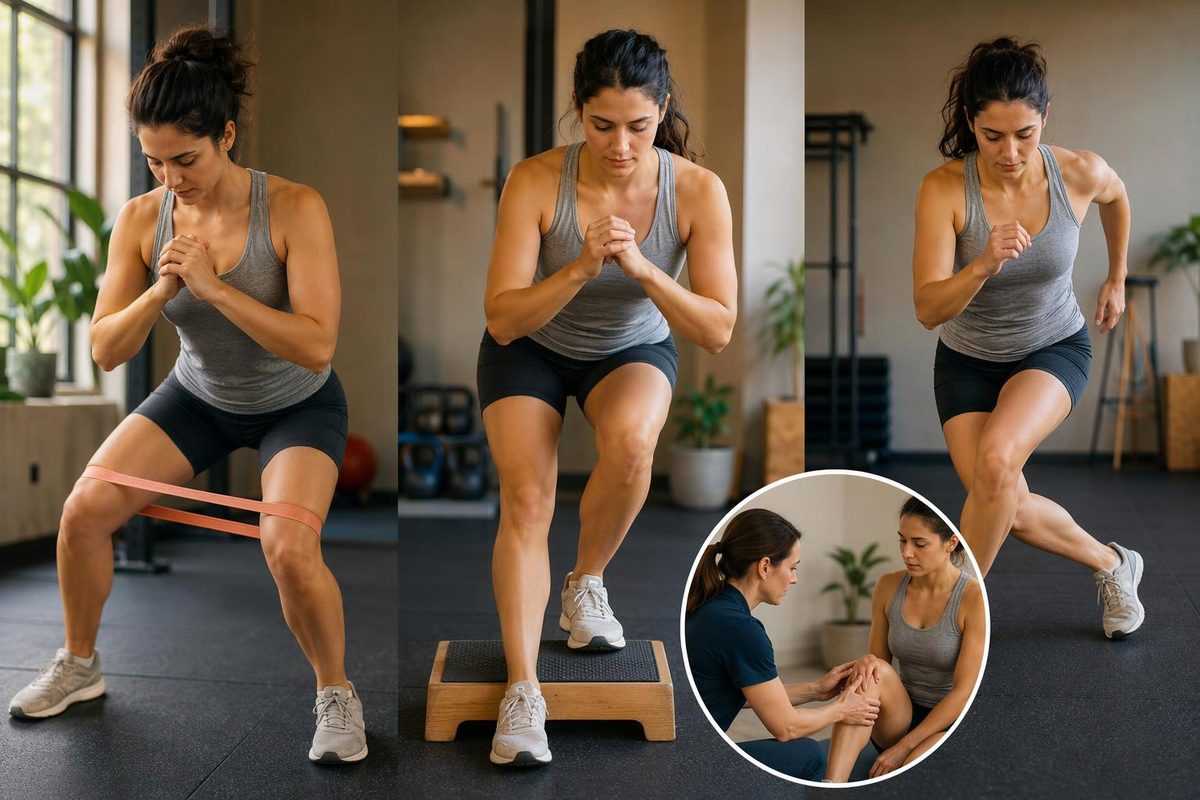
If your knee drifts inward during a squat or step-down, useful exercises combine leg and hip strengthening with practice controlling that specific movement. A mirror squat, side-lying leg raise and supported step-down are practical starting options—not a guaranteed fix for every inward knee position.
First, distinguish movement from standing alignment
Dynamic knee valgus means the knee moves inward during an activity. It can involve movement at the hip, knee, ankle and foot; it does not automatically mean your hip muscles are weak. Research also shows that knee alignment can differ between squatting and landing, so improving one task does not necessarily improve another. A review of single-leg movement studies explains these distinctions.
Structural knock knees, or genu valgum, describe inward alignment present even while standing. These exercises train strength and movement control; they should not be presented as a way to straighten an adult’s bones. If standing alignment is worsening, noticeably different between sides or making walking difficult, seek assessment rather than trying to force the knees apart. Hospital for Special Surgery describes how structural alignment is evaluated and treated.
Before exercising, get urgent medical advice for a knee that locks or gives way, severe pain, major swelling, inability to bear weight, or a hot/red knee with fever. Pain that does not improve within a few weeks also warrants assessment. These are NHS knee-pain warning signs, not problems to correct with an alignment drill.
What exercise can realistically change
A 2021 systematic review found reduced dynamic valgus in seven of ten exercise studies, but programs and testing tasks varied, and most participants were female. This supports trying targeted training—not assuming one routine works for everyone.
Movement feedback is worth including. In a 2019 trial of 64 young female volleyball players with patellofemoral pain—pain around or behind the kneecap—a six-week supervised program combining strengthening with verbal and mirror feedback improved pain, hop-test performance and knee valgus during a single-leg squat. The three drills below are simpler practice options, not a reproduction of that program or a promise of the same results.
Three exercises to practise knee control
Warm up with five to ten minutes of comfortable walking or stationary cycling. Choose a pain-free range; AAOS guidance advises against ignoring pain during exercise. If you are recovering from an injury or surgery, check that these exercises fit your rehabilitation plan before starting.
1. Shallow squat with mirror feedback
Purpose: Practise controlling the inward drift while both feet support you.
- Stand facing a mirror, feet about shoulder-width apart. Have a counter or sturdy chair back within easy reach if you need support.
- Slowly move your hips backward and bend your knees into a shallow squat.
- Watch whether either knee moves inward relative to its foot. Aim for the knees to travel in the same general direction as the toes, keeping both feet planted.
- Return to standing smoothly.
Start with a small bend, rather than chasing depth. Do not shove your knees as far outward as possible or roll onto the outer edges of your feet.
Mirror-supported squat practice was part of the valgus-control trial. The goal here is a repeatable movement, not a perfectly straight-looking leg.
2. Side-lying hip abduction
Purpose: Build the outer-hip muscles without needing to balance on the working leg.
- Lie on your side with the bottom knee bent for support.
- Keep the top leg straight, but do not lock its knee.
- Slowly lift the top leg, keeping your pelvis steady and avoiding rotation of the leg to lift it higher.
- Pause briefly, then lower with control. Repeat on the other side.
These directions adapt the AAOS hip-abduction exercise. Begin without an ankle weight.
Treat this as supporting strength work, not the whole solution. Studies of hip strengthening and functional practice have produced mixed results, as described in the single-leg movement review.
3. Supported lateral step-down
Purpose: Practise inward-knee control when one leg carries most of your weight.
- Stand sideways on a secure, low exercise step—about three inches high—beside a handrail or counter.
- Keep the working foot on the step and slowly bend that knee, lowering the other heel toward the floor.
- Lightly touch the heel down, then return using the leg on the step. Do not push off the floor or lock the working knee.
- Keep your pelvis reasonably level and use the same knee-over-foot cue as in the squat.
This adapts Northwestern Medicine’s lateral step-down instructions. If the knee drifts inward, shorten the lowering distance or use more hand support. If it hurts, stop rather than repeatedly correcting through pain.
Start small, then reduce the help
For a cautious first trial, try one set of six to eight repetitions per side, or six to eight squats, on two or three nonconsecutive days each week. This is a starting suggestion, not a validated valgus-treatment dose.
When repetitions are comfortable and controlled, add a second set. Then change one challenge at a time: slightly more squat depth, less hand support or light resistance for the hip exercise. Keep the step low until the lowering movement is steady.
Occasionally try a few squat repetitions without watching the mirror. The aim is to retain control without constant visual checking.
Track comfort and control in the activity that matters to you. A better shallow squat is useful progress, but it is not proof that running, jumping or cutting mechanics have changed. If you cannot find a comfortable version or symptoms persist, a physiotherapist can assess the movement and help choose a more suitable progression.