
Knee Extensor Exercises: 4 Ways to Train Your Quads
Learn four knee extensor exercises, how each trains your quadriceps, and how to progress from thigh contractions to controlled, loaded movements.
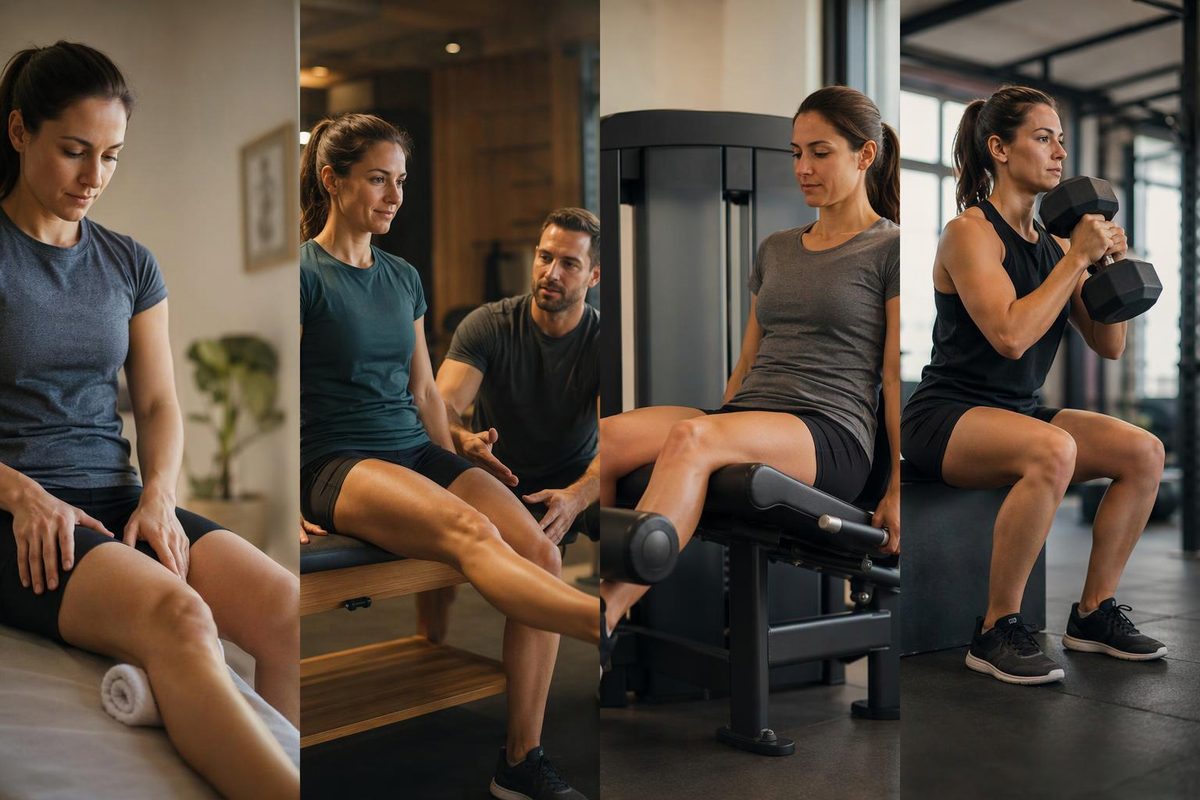
Knee extensor exercises train the muscles that straighten your knee—the quadriceps at the front of your thigh. Useful options include quad sets, seated knee extensions, straight-leg raises and supported squats. They do not all work the same way: some hold the knee straight, while others move it against resistance. Cleveland Clinic explains the quadriceps’ role.
The aim here is to choose and progress exercises for these specific muscles, not assemble a complete knee-rehabilitation routine. For broader muscle support, see exercises to strengthen the muscles around your knee.
Before you start
These are general exercise options, not treatment for an undiagnosed knee problem. After surgery or a recent injury, ask your physiotherapist which movements, ranges and loads are allowed; the AAOS knee-conditioning program is intended to be used under professional supervision.
Seek urgent assessment rather than exercising if you cannot move the knee or bear weight, have severe pain or marked swelling, or the knee locks or gives way. Fever or shivering with a hot or red knee also needs urgent care. Arrange an assessment if pain is not improving within a few weeks. These are NHS warning signs.
1. Quad set: tighten the thigh without lifting the leg
A quad set is an isometric contraction: the muscle tightens with little or no knee movement. It is a simple way to practise contracting the quadriceps before adding a moving exercise.
- Lie down or sit with your leg supported and extended.
- Tighten the front of your thigh and try to straighten your knee gently.
- Hold for 5 seconds, then relax fully.
- Keep your heel supported; do not use your hands to force the knee straight.
Progression: Make the contraction steady and repeatable, then lengthen the hold toward 10 seconds if comfortable. Once this feels easy, consider adding a knee-extension movement rather than relying only on longer holds.
The AAOS knee-replacement exercise guide describes this technique with 5–10-second holds. Its postoperative schedule is specific to knee replacement, not a timetable for everyone.
2. Seated knee extension: straighten the knee against gravity
This is the most direct moving exercise in the group: the thigh stays on the chair while the lower leg rises.
- Sit upright on a stable chair with your feet on the floor.
- Tighten one thigh and slowly straighten that knee as far as comfortable.
- Hold briefly—up to 5 seconds—then lower the foot under control.
- Do not swing the leg or lean backward to finish the repetition.
Progression: First make the unweighted repetitions smooth. Then add a light ankle weight and return to fewer repetitions if needed. A gym leg-extension machine is another option, but get help with its setup and begin with a manageable load. AAOS includes both seated extensions and gradual resistance increases.
3. Straight-leg raise: maintain extension while lifting
Here, the knee stays straight rather than repeatedly bending and straightening. The quadriceps must maintain that position as you lift the leg.
- Lie on your back with the non-working knee bent and its foot flat.
- Tighten the working thigh before lifting.
- Keep that knee straight and raise the leg about 6–10 inches.
- Pause briefly, then lower slowly without dropping it.
Progression: Prioritize keeping the knee straight throughout. If it bends as you lift, lower the leg and seek technique advice rather than adding weight. Once controlled, a light ankle weight can increase the challenge. AAOS describes the raise and resistance progression.
4. Supported half squat: extend the knees with your feet planted
Squats train the quadriceps alongside other muscles, including the buttocks. Unlike seated extensions, your feet stay on the floor.
- Stand with your feet about shoulder-width apart, holding a sturdy support if needed.
- Slowly bend your hips and knees, lowering as though beginning to sit down.
- Start shallow, keeping your chest lifted and feet planted.
- Push through your feet to stand, without bouncing.
Progression: Build comfortable, controlled repetitions before increasing depth or adding hand weights. Change only one of those at a time. The AAOS half-squat instructions include support for balance and gradual loading.
Choose a starting dose, then build
You do not need all four exercises in every session. If appropriate for your knee, try two or three repetitions of one or two options as a cautious first trial—not a prescribed rehabilitation dose. NHS inform recommends starting new knee exercises gradually, adding one or two repetitions every few days as they become easier.
Warm up with 5–10 minutes of comfortable walking or cycling. Build controlled repetitions before considering another set or a small resistance increase. Muscle effort is expected; do not push through knee pain. Stop a painful exercise and ask a physiotherapist about changing its range or load. These warm-up and pain precautions follow the AAOS conditioning guidance.
Check your response afterward, too: your existing knee pain should not be worse overall or worse the next morning. If it is, stop progressing and seek advice; NHS inform advises stopping exercises that worsen symptoms or cause new pain.
After recovery, AAOS suggests exercising two to three days a week to maintain knee strength and movement. During rehabilitation, follow your individual schedule instead.