
Knee Replacement Rehab Exercises: An Early Recovery Guide
Learn early knee replacement rehab exercises, movement cues, how to use your prescribed routine, and when to progress or contact your care team.
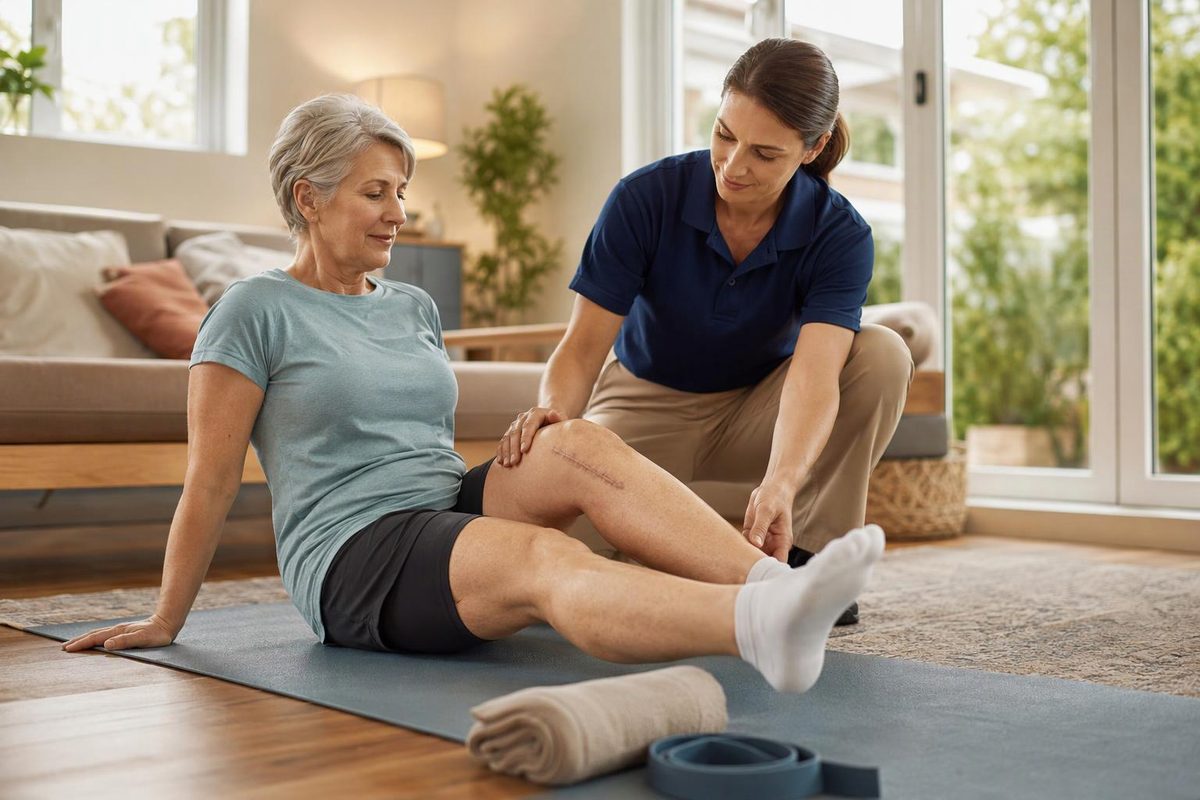
After a total knee replacement, early rehabilitation usually combines ankle movement, thigh-muscle contractions, knee bending and straightening, and short walks with an aid. Later, rehabilitation adds more demanding strength and balance work. Walking matters, but it is not the whole exercise programme: targeted exercises also work on knee movement and muscle control. The AAOS exercise guide covers both.
Use this guide to understand exercises your physiotherapist has cleared—not to replace your discharge plan. If you had a partial replacement, revision surgery or additional procedures, check which movements and weight-bearing instructions apply to you.
Five early exercises and how to do them
These movements appear in the AAOS postoperative guide and United Lincolnshire Hospitals’ knee replacement programme. Your team decides when to begin and how much to do; use their prescribed hold times and repetitions.
1. Ankle pumps
Purpose: Keep your lower legs moving and support circulation.
- Lie down or sit with your leg supported.
- Slowly point your foot away from you, then pull it back towards your shin.
- Keep the movement at your ankle rather than lifting the whole leg.
These are often started immediately after surgery. They are part of clot-prevention care, not a substitute for prescribed anticoagulants or compression stockings.
2. Quadriceps sets
Purpose: Activate the quadriceps—the large muscles at the front of your thigh that straighten your knee.
- Lie or sit with your operated leg straight in front of you.
- Tighten your thigh, gently pressing the back of your knee towards the bed.
- Hold for 5–10 seconds if prescribed, then relax fully.
Look for the thigh tightening without lifting the leg. This is a muscle contraction, not a forceful stretch.
3. Heel slides
Purpose: Practise knee bending, also called flexion.
- Lie on your back with your legs out straight.
- Slide the operated heel towards your bottom, keeping it on the bed.
- Bend only as far as you can comfortably manage.
- If prescribed, hold the bend for 5–10 seconds, then slide the heel away to straighten the leg.
Move slowly; do not jerk the knee into a deeper bend. A seated alternative is to slide your foot backwards under a chair, keeping your thigh supported.
4. Supported knee straightening
Purpose: Practise extension—getting your knee straight.
- Lie with a small rolled towel just above your heel, leaving the heel clear of the bed and the knee unsupported.
- Gently tighten your thigh and try to straighten the knee towards the bed.
- Hold for 5–10 seconds if prescribed, then relax.
The AAOS guide describes this active straightening exercise. If your therapist also prescribes a passive stretch—letting gravity straighten your supported leg—South Tees Hospitals advises limiting the time in that position and working within what pain allows. The NHS recovery advice says not to sleep with a pillow under the knee.
5. Straight-leg raises
Purpose: Build thigh-muscle control while holding the knee straight.
- Lie with the operated leg straight.
- Tighten your thigh first, as in a quadriceps set.
- Keeping the knee straight, lift the leg a few inches from the bed.
- Hold for 5–10 seconds if prescribed, then lower slowly.
If the knee bends as you lift, or you cannot control the lowering, ask your therapist to check the movement before continuing. Do not add ankle weights to make an early exercise harder on your own.
How many repetitions—and how often?
Follow the dose on your discharge sheet. Published programmes differ, so there is no single schedule everyone should copy. For example, United Lincolnshire Hospitals gives a general instruction of 10 repetitions every couple of hours, adjusted for difficulty. AAOS uses different time-based instructions for several movements. These are examples of postoperative programmes, not a combined routine to follow.
Before leaving hospital, or at your next therapy visit, confirm:
- Which exercises you should do now.
- The repetitions, hold times and sessions per day.
- How much weight you may put through the operated leg.
- What symptoms should prompt you to reduce activity or call.
Some discomfort and swelling can occur after exercise. Ice wrapped in a towel and leg elevation may help; United Lincolnshire Hospitals advises icing for no longer than 20 minutes. If activity leaves you progressively more painful, swollen or less mobile, contact your therapist rather than increasing repetitions. Hospital exercise and symptom guidance
Walking and progressing beyond bed exercises
Begin with the short walks and walking aid your team recommends. Aim for controlled, even steps—not distance at the expense of limping. Keep the aid if you are unsteady without it; South Tees Hospitals explicitly prioritises better walking over giving up the stick early.
As control and mobility improve, your therapist may introduce sit-to-stands or shallow supported squats, step-ups and balance exercises. Stationary cycling is another option for movement and strength. AAOS describes starting with a seat height that leaves the knee nearly straight at the bottom of the pedal stroke, trying backwards pedalling first, and progressing to forward pedalling when comfortable. Add resistance only as advised and as strength improves—not simply because a certain week has arrived. Progression guidance: South Tees and AAOS.
For necessary stairs early on, use the rail and the technique you were taught: usually the non-operated leg leads upwards and the operated leg leads downwards, one step at a time. That is different from later step-up strengthening practice. AAOS stair guidance
When to seek help instead of exercising
After a recent replacement, seek urgent medical advice for new throbbing or cramping leg pain, fever or chills, wound drainage, or knee redness, tenderness, swelling or pain that is not improving or is worsening. These can signal infection or a blood clot. Chest pain or difficulty breathing—especially with leg pain or swelling—requires emergency care. NHS complication guidance
For recovery trends beyond the early exercise programme, see progress and warning signs three months after total knee replacement.