
Knee Flexor Exercises: How to Strengthen Your Hamstrings
Learn standing and seated hamstring curls, with clear form cues, ways to add resistance, a cautious starting plan and checks for knee symptoms.
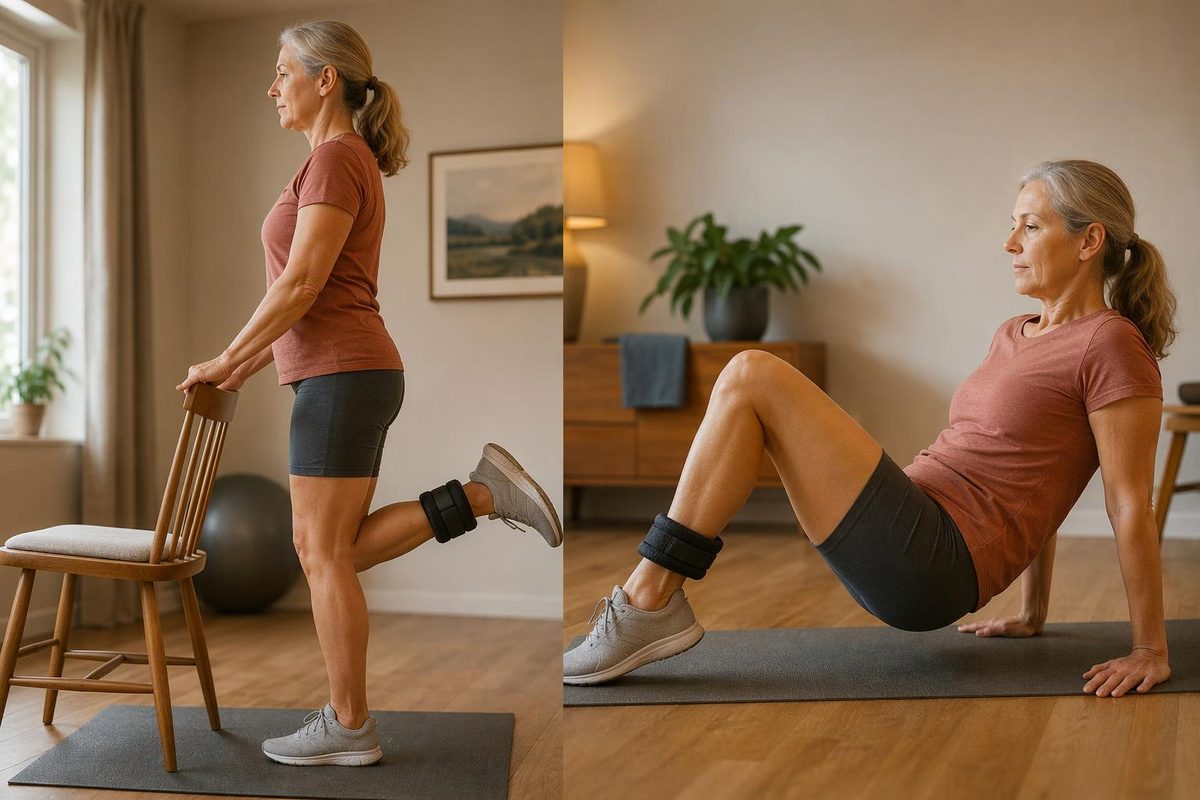
Knee flexor exercises train the muscles that bend your knee, particularly the hamstrings at the back of your thigh. Hamstring curls let you practise that action against the weight of your lower leg, an ankle weight or a resistance band. The AAOS knee-conditioning program includes curls specifically for hamstring strengthening.
This is different from working on how far your knee can bend. If stiffness is your main limitation, start with exercises for knee-flexion mobility. Here, the focus is building strength through a comfortable range—not forcing a deeper bend.
Before you start
These are general exercise options, not a treatment for an unexplained painful knee. After a recent injury or surgery, follow any exercise and movement restrictions you have been given rather than adding resistance yourself. AAOS recommends performing its conditioning program under a doctor’s supervision. NHS inform advises people with a diagnosed knee condition or recent knee surgery to follow their healthcare professional’s advice.
Seek urgent medical advice instead of exercising if your knee is very painful, you cannot move it or bear weight, it is badly swollen or misshapen, or it locks or gives way. Fever or feeling shivery with redness or heat around the knee also needs urgent assessment. Arrange a routine assessment if pain is not improving within a few weeks. These are NHS knee-pain warning signs.
1. Standing hamstring curl
Use this to start without equipment. You need a stable chair back or counter for balance.
- Stand upright and hold the support.
- Keep your knees close together and bend one knee, bringing that heel up behind you.
- Lift only as far as you can without knee pain. Keep the movement at the knee rather than swinging the whole thigh backward.
- Hold briefly—up to five seconds if comfortable—then lower slowly.
- Repeat on the other side if appropriate for your exercise plan.
You should feel effort at the back of your thigh. Avoid using momentum to lift the heel higher. The AAOS instructions use a five-second hold, a pain-free bend and support for balance.
To progress: Once the unweighted movement is easy and controlled, a light, securely fitted ankle weight can add resistance. Start lighter rather than trying to reach a particular weight. AAOS also identifies a leg-curl machine as an alternative; ask gym staff to show you its setup before using it.
2. Seated resistance-band curl
Choose this if you prefer a seated exercise or want adjustable resistance. You need a sturdy chair and a securely anchored exercise band.
- Sit upright toward the front of the chair, leaving room to move your foot underneath it.
- Secure one end of the band to a stable anchor in front of you and loop the other end around the exercising ankle.
- Keep your other foot on the floor.
- Pull the exercising foot backward under the chair by bending your knee against the band.
- Hold briefly, then return slowly without letting the band snap your leg forward.
The University of Melbourne’s knee-osteoarthritis exercise library describes this seated curl with a five-second hold. South Tees Hospitals’ physiotherapy guidance also uses controlled seated knee flexion and advises progressing band resistance as directed by a physiotherapist.
Check the band and anchor before each session. South Tees recommends safety goggles when using resistance bands.
A cautious starting plan
You do not need to do both exercises in the same session. Choose the one you can perform most comfortably and control best.
- Warm up: Try five to ten minutes of comfortable walking or stationary cycling, as suggested by AAOS.
- Test the movement: Begin with two or three repetitions, without added weight or with very light band resistance.
- Build gradually: If symptoms remain settled, add one or two repetitions every few days. Work toward a small set of controlled curls before adding resistance.
- Change one thing at a time: Add repetitions, hold time or resistance—not all three together.
This is a cautious trial, not a prescribed rehabilitation dose. The starting repetitions and gradual increases follow NHS inform’s general knee-exercise advice, rather than a curl-specific strengthening prescription. That guidance also recommends checking that knee pain is no worse the following morning.
Aim for muscular effort rather than knee pain. Stop if curls cause new pain or worsen your symptoms; if the knee is more painful the next morning, reduce the next session’s range, repetitions or resistance. Persistent difficulty is a reason to ask a physiotherapist which loading level fits your knee.
Hamstring curls are one part of knee strengthening. For a routine that also trains the front of the thigh, hips and calves, see exercises to strengthen the muscles around your knee.