
6 Exercises to Strengthen the Muscles Around Your Knee
Build knee support with six controlled exercises for the quads, hamstrings, hips and calves, plus guidance on progression, pain and warning signs.
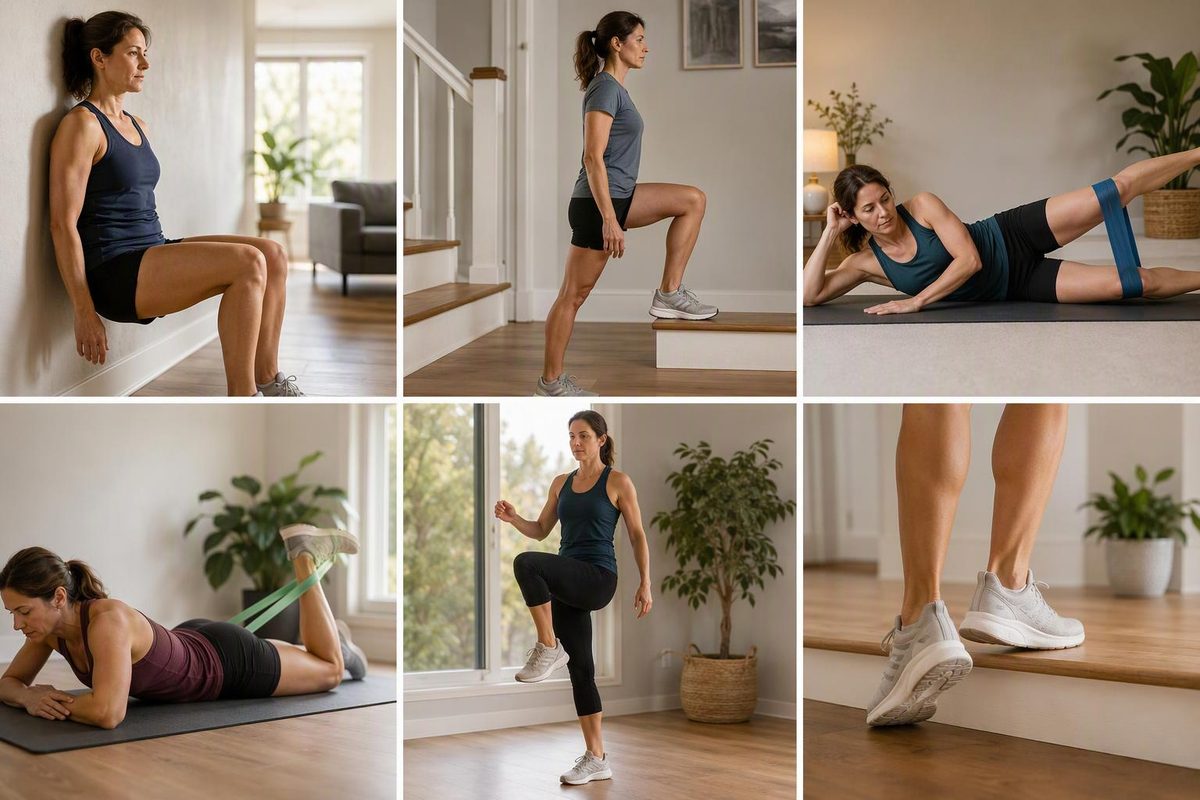
You cannot directly strengthen a joint. You can strengthen the muscles that move and support it—particularly the quadriceps, hamstrings, glutes and calves. These muscles help control the knee and absorb load during walking, stairs and other daily activities.
The routine below is a general starting point for adults who can bear weight and have no recent significant knee injury. It is not a rehabilitation plan for a fracture, ligament or tendon tear, recent surgery, or an acutely swollen knee.
Before you begin
Warm up with 5–10 minutes of easy walking or stationary cycling. The American Academy of Orthopaedic Surgeons (AAOS) recommends this kind of low-impact warm-up before knee exercises and advises starting slowly rather than immediately adding many repetitions or weights (AAOS).
Use a stable chair or counter for balance. Move slowly and stay within a comfortable range; a deeper bend is not automatically better.
Six useful knee-strengthening exercises
1. Sit-to-stand
Works: quadriceps and glutes Start with: 1–2 sets of 8 repetitions
- Sit near the front of a firm chair, with your feet about hip-width apart.
- Lean forward slightly from your hips.
- Press through both feet and stand without pushing off with your hands, if comfortable.
- Lower yourself back to the chair under control.
Use your hands or a higher chair if needed. To progress, slow the lowering phase or use a slightly lower seat. The Royal Orthopaedic Hospital includes sit-to-stand among its exercises for people with knee osteoarthritis (ROH NHS).
2. Straight-leg raise
Works: quadriceps Start with: 1–2 sets of 8–10 per side
- Lie on your back with one knee bent and the other leg straight.
- Tighten the front thigh of the straight leg.
- Lift that leg about 6–10 inches without jerking or arching your back.
- Pause briefly, then lower slowly.
If you cannot keep the knee straight, first practise tightening the thigh with the leg resting on the floor. A seated knee extension is another way to train the quadriceps; see how it differs from a hamstring curl in Leg Extension vs Leg Curl.
3. Bridge
Works: glutes and hamstrings Start with: 1–2 sets of 8–10
- Lie on your back with both knees bent and feet flat.
- Tighten your abdomen gently and squeeze your buttocks.
- Raise your hips until your trunk and thighs form a comfortable line.
- Pause, then lower slowly.
Keep your knees facing forward and your pelvis level. Add repetitions before trying a harder version.
4. Side-lying leg raise
Works: outer hip muscles, including gluteus medius Start with: 1–2 sets of 8–12 per side
- Lie on your side with the lower knee bent and the top leg straight.
- Keep your hips stacked and the top toes pointing forward.
- Raise the top leg without rolling your pelvis backward.
- Pause, then lower under control.
The hip muscles help control the position of the thigh above the knee. For people with patellofemoral pain—pain around or behind the kneecap, often aggravated by squatting, stairs or running—a 2024 best-practice guide recommends knee-targeted exercise, with hip-targeted exercise included according to individual needs (British Journal of Sports Medicine). That evidence does not mean every case of knee pain is patellofemoral pain.
5. Calf raise
Works: calf muscles Start with: 2 sets of 10
- Stand behind a sturdy chair and hold it lightly.
- Rise onto the balls of both feet.
- Pause, then lower your heels slowly.
Progress from two legs to one only when balance and control are reliable. Do not bounce.
6. Low step-up
Works: quadriceps, hamstrings and glutes Start with: 1 set of 6–8 per side
- Place one whole foot on a low, secure step.
- Hold a rail or counter if needed.
- Press through that foot to step up.
- Lower slowly and repeat.
Use a lower step if the knee hurts or you cannot control the descent. If stairs are the activity that triggers your symptoms, knee pain going up or down stairs may require a more tailored exercise choice and load adjustment.
How often—and how to progress
A practical starting pattern is two sessions per week with a recovery day between them. If that settles well, you can add a third weekly session. Pick four to six exercises rather than forcing yourself through every movement. AAOS uses two or three days per week for maintenance in its knee-conditioning program (AAOS).
When the final repetitions feel controlled and fairly easy, change one variable:
- add 1–2 repetitions;
- add another set;
- use a slightly greater range of motion; or
- add light resistance.
Do not increase all four at once. Return to the previous dose if the change causes a clear and lasting increase in symptoms.
How much discomfort is acceptable?
Muscle effort and mild next-day muscle soreness can occur. Stop an exercise if it causes sharp pain, catching, instability or steadily increasing joint pain.
Pain rules also depend on the condition. In a knee-osteoarthritis program, the Royal Australian College of General Practitioners notes that some discomfort can occur but advises reducing the dose if pain is excessive, remains elevated for more than two hours, or joint swelling is worse the next day (RACGP). NICE likewise recommends exercise tailored to the individual for osteoarthritis rather than one universal program (NICE).
When exercise should wait
Seek urgent care rather than starting this routine if the knee is badly swollen or deformed, you cannot move it or bear weight, it locks or gives way, or it is hot and red while you feel feverish or unwell. These signs can require prompt assessment (NHS).
If symptoms began after an injury but none of those urgent signs is present, arrange an assessment before using a generic routine. Also seek advice if symptoms repeatedly worsen with exercise or have not improved after a few weeks. A clinician or physical therapist can help match the movements and loads to your symptoms, goals and current capacity.