
Leg Extension vs Leg Curl: Muscles and Workout Roles
Extensions straighten the knee and target quads; curls bend it and target hamstrings. A common approach puts both after compound exercises.
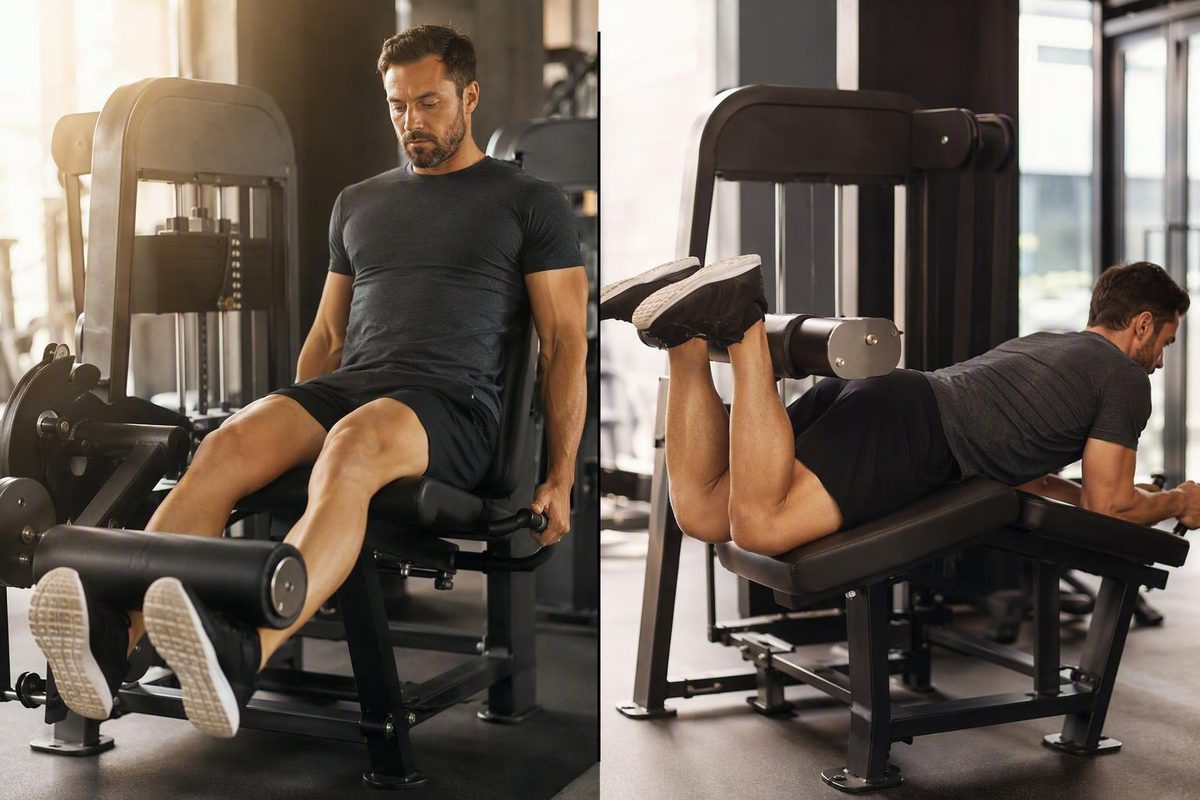
Leg Extension vs Leg Curl: The Short Answer
The main difference is the direction your knee moves:
- A leg extension straightens the knee against resistance, primarily training the quadriceps on the front of the thigh.
- A leg curl bends the knee against resistance, primarily training the hamstrings on the back of the thigh.
Because they use opposite knee actions, leg extensions and leg curls are complementary exercises rather than interchangeable versions of the same movement.
Choose leg extensions when you want additional direct quadriceps work. Choose leg curls when you want additional knee-flexion work for the hamstrings. Use both when your program would benefit from targeted work for both sides of the thigh.
There is no universal winner. Neither exercise is mandatory, and neither one by itself constitutes a complete lower-body program.
| Comparison | Leg extension | Leg curl |
|---|---|---|
| Joint action | Knee extension: straightening the knee | Knee flexion: bending the knee |
| Primary muscles | Quadriceps at the front of the thigh | Hamstrings at the back of the thigh |
| Usual body position | Seated | Seated, lying/prone, or standing |
| Common variations | Bilateral or single-leg | Seated, lying/prone, standing, or single-leg |
| Best-fit goal | Additional quadriceps training | Additional knee-flexion hamstring training |
| Role in a workout | Usually an accessory or targeted isolation exercise | Usually an accessory or targeted isolation exercise |
| Principal setup concern | Aligning the knee with the machine pivot and placing the pad comfortably on the lower shin | Aligning the knee with the intended pivot while keeping the hips and torso stable |
The useful question is therefore not “Which machine is better?” It is “Which movement and muscle group does my current program need?”
Muscles Worked and Movement Mechanics
A leg extension and a leg curl can look similar because both often involve a padded roller, a weight stack, and movement centered on the knee. Their effects differ because the resistance opposes movement in opposite directions.
Knee extension means straightening the knee. The quadriceps are the primary muscle group responsible for this action. The group contains four muscles:
- Rectus femoris
- Vastus lateralis
- Vastus medialis
- Vastus intermedius
All four contribute to knee extension. The rectus femoris also crosses the hip, which helps explain why its response to an exercise can differ from that of the other quadriceps muscles. This anatomy and its relevance to extension training are reviewed in E3 Rehab’s leg-extension guide.
Knee flexion means bending the knee. The principal hamstring muscles involved are:
- Biceps femoris
- Semitendinosus
- Semimembranosus
The gastrocnemius may also assist with knee flexion in some positions, but it is a calf muscle—not one of the hamstrings. The primary emphasis of a machine leg curl remains the muscles at the back of the thigh.
Movement direction determines the main training effect. During an extension, the quadriceps produce force to straighten the knee and move the roller away from the body. During a curl, the hamstrings produce force to bend the knee and pull the roller toward the body.
“Primary” does not mean “exclusive.” It would be too strong to say that the quadriceps perform every part of a leg extension without any contribution from positioning or stabilization. Likewise, a machine curl emphasizes the hamstrings without establishing that every possible hamstring function is trained equally.
Both extensions and curls are generally considered isolation exercises because most of the visible movement occurs at the knee. Compound exercises—including squats, lunges, leg presses, and deadlift variations—coordinate movement across more joints and involve more muscle groups.
That distinction affects how the exercises are used. Leg extensions provide targeted practice and loading for resisted knee extension. Leg curls do the same for resisted knee flexion. Compound exercises train broader movement patterns. Isolation and compound exercises are therefore different tools, not mutually exclusive categories.
Which Exercise Fits Your Goal?
Your goal and current program should decide the leg extension vs leg curl question.
For additional quadriceps work, consider leg extensions. They let you focus on knee extension without also having to coordinate a squat, lunge, or leg press. This can be useful when the quadriceps are a specific training priority or when you want targeted work after compound lifting.
For additional hamstring work, consider leg curls.
For broader thigh development, both can fit. Training the front and back of the thigh with separate exercises is a practical option, but it is not an obligation. Your routine may already contain enough relevant work, or one of the machines may not suit your comfort, schedule, equipment access, or goals.
Compound and isolation exercises also have different roles:
- Squats, lunges, and leg presses train coordinated lower-body movement involving the knees, hips, and multiple muscle groups.
- Deadlift and other hinge variations provide a different lower-body movement pattern from a machine curl.
- Leg extensions provide direct knee-extension work.
- Leg curls provide direct knee-flexion work.
For strength goals, define what kind of strength you mean. Leg extensions can help you improve your ability to produce force during the extension exercise, while curls can do the same for knee flexion. That is not identical to broader multi-joint strength in a squat, lunge, press, or deadlift variation, and the evidence does not establish either machine as universally better for overall lower-body strength.
Leg extensions may also create a quadriceps stimulus that is not identical to squat training. Research summarized by E3 Rehab reports that seated extensions can emphasize rectus femoris development differently from squats. That supports extensions as a targeted option, but it does not establish that everyone needs them or that they are categorically superior to compound training (E3 Rehab).
A simple program audit is more useful than an exercise ranking:
- Do you already have enough direct quadriceps work? If not, extensions may fill the gap.
- Do you have resisted knee flexion in your program? If not, curls may fill that gap.
- Are your broader lower-body movement patterns represented? Isolation exercises do not reproduce every demand of compound training.
- Would another isolation exercise add useful work or merely unnecessary fatigue?
- Can you perform the exercise with a stable setup and acceptable comfort?
A goal-based decision is therefore more defensible than declaring one machine better for strength, growth, performance, or knee health in every context.
How to Set Up and Perform a Leg Extension
Machine designs vary, so use the manufacturer’s adjustment markings and ask gym staff for help if the controls are unfamiliar. The following checklist applies to many common seated machines.
- Adjust the seat and back support. Sit far enough back that your torso is supported and your knees can bend comfortably in the starting position.
- Align the knee with the machine pivot. Your knee should sit approximately in line with the machine’s rotating axis. Perfect visual alignment is not always possible, but the machine should not pull the knee conspicuously away from its intended path.
- Position the roller on the lower shin. Place it comfortably just above the ankle rather than directly across the ankle joint. It should not sit so high that it presses into the middle of the shin or substantially changes the movement.
- Stabilize your body. Keep your back supported, hold the handles if provided, and maintain contact with the seat rather than lifting your hips to move the resistance.
Start with light, manageable resistance.
To perform the repetition:
- Begin with your knees bent in a comfortable starting position.
- Straighten your knees smoothly, moving the pad without kicking or swinging it.
- Approach the top only as far as you can remain controlled and comfortable.
- Pause briefly if desired, but do not force the position.
- Bend your knees and lower the resistance under control rather than letting the stack drop.
The lockout question is often reduced to an unhelpful rule. The practical priority is control rather than aggressively chasing or avoiding a particular visual endpoint.
Common mistakes include:
- Selecting more resistance than you can control
- Allowing the hips to lift from the seat
- Setting the seat so the knee is poorly aligned with the machine pivot
- Placing the roller too high on the shin or directly over the ankle joint
- Kicking the roller with momentum
- Leaning or rocking to finish the repetition
- Letting the return phase drop rapidly
- Forcing an uncomfortable range
If part of the movement is uncomfortable, stop the repetition before that point and reassess the setup and resistance. Using a shorter range is an exercise modification; it does not identify or treat the reason your knee hurts.
How to Set Up and Perform a Leg Curl
Leg curls come in three common machine configurations: seated, lying or prone, and standing. Each bends the knee against resistance, but the pads, pivots, restraints, and body position differ.
Seated leg curl setup
- Adjust the seat or backrest so your back is supported.
- Position the knee approximately in line with the machine’s intended axis or pivot.
- Place the moving roller against the lower leg, just above the back of the ankle.
- If the machine has a thigh restraint, secure it comfortably above the knees. It should stabilize the thighs without painfully compressing them.
- Hold the handles if provided and keep your torso against the support.
From the starting position, bend your knees and draw the roller down and back through a comfortable range. Keep your hips and torso stable. Return slowly until your knees are extended as far as the machine and your comfort allow, without letting the weight stack crash.
Lying or prone leg curl setup
- Lie face down with your knees positioned appropriately near the machine pivot.
- Place the roller above the heels or ankles rather than directly on the heel or ankle joint.
- Brace gently and keep the hips and torso stable against the bench.
- Curl your heels toward your glutes through a comfortable range.
- Lower the resistance slowly until you return to the starting position.
A common compensation is lifting the hips or arching the lower back as the heels approach the body. If this happens, reduce the resistance, check the setup, and avoid forcing more range than you can control.
Other common mistakes include:
- Twisting or lifting the hips
- Arching the lower back to move the load
- Jerking the roller at the beginning of the repetition
- Cutting the return phase short
- Letting the weight pull the legs back rapidly
- Using excessive resistance
- Setting the machine so the knee moves away from its intended alignment
- Forcing the heels closer to the glutes after controlled knee flexion has ended
Balance, torso position, and machine adjustment become especially important.
The supplied evidence does not establish that seated, lying, or standing curls are definitively superior for long-term muscle growth. Choose according to machine access, fit, stability, comfortable range, and your ability to perform the repetition without unwanted hip or lower-back movement.
A poor experience on one curl machine does not necessarily mean every version of the movement will feel the same.
How to Program Leg Extensions and Leg Curls
A practical example is two to four controlled sets in a moderate repetition range, with approximately 8 to 15 repetitions per set. These figures come from commercial exercise guidance rather than evidence that one exact range is optimal for everyone, so treat them as a starting framework rather than a rule (Altas Strength).
The appropriate load and volume depend on your experience, effort, recovery, symptoms, other lower-body training, and how close each set comes to the point where technique begins to deteriorate.
Standard accessory approach: Perform demanding compound exercises first, then use extensions and curls for targeted work. This lets you approach squats, lunges, presses, or deadlift variations before isolation fatigue accumulates.
Priority approach: Put an isolation exercise earlier when its target muscle is the main goal of the session. For example, someone prioritizing the quadriceps might perform extensions before later leg exercises.
Superset approach: Alternate a set of extensions with a set of curls, resting as needed after each pair. Because the exercises emphasize opposite sides of the thigh, this can organize the session efficiently. It is a time-management option—not proof of faster muscle growth.
Beginner accessory pairing
After one main lower-body exercise, a beginner might perform:
- Leg extension: 2 controlled sets of 8–15 repetitions
- Leg curl: 2 controlled sets of 8–15 repetitions
These numbers are a flexible example drawn from the same commercial programming guidance, not a universal beginner prescription (Altas Strength). Choose resistance that lets you preserve the same setup and movement quality throughout each set. Stop before the exercise turns into kicking, hip lifting, twisting, or uncontrolled lowering.
Quadriceps-priority session
- Main squat, lunge, or leg-press pattern
- Several controlled sets of leg extensions
- A deadlift or other hinge variation
- An optional small amount of leg-curl work
Extensions can instead be placed first if targeted quadriceps work is the clear priority. Expect that doing so may affect performance on later knee-dominant exercises.
Hamstring-priority session
- Deadlift or other hinge variation
- Several controlled sets of leg curls
- Squat, split-squat, or leg-press pattern
- An optional small amount of leg-extension work
This template includes both a curl and a broader lower-body movement rather than treating one isolation exercise as a complete leg session.
One simple progression option is to add repetitions while maintaining consistent setup, control, and acceptable comfort. When the current work becomes manageable throughout your chosen range, consider a small resistance increase. This is only one progression method; effort, recovery, symptoms, available machine increments, and the rest of your program should determine whether it fits.
Do not compare stack numbers between machines. Your starting weight is the load you can control—not a universal number printed in an article or copied from another gym user.
Knee Pain, Previous Injury and Exercise Modification
Leg extensions are not automatically unsuitable for every painful knee, but that does not make extensions or curls appropriate for every diagnosis, injury, or postoperative stage. Exercise tolerance can be affected by resistance, range of motion, machine fit, movement control, current symptoms, and medical history. General knee-extension guidance recommends beginning with light resistance, working through a tolerable range, and avoiding joint irritation (Hinge Health).
If mild discomfort appears during a repetition, use a conservative sequence:
- Stop the repetition rather than pushing farther.
- Check the seat, knee-to-pivot alignment, and pad position.
- Reduce the resistance.
- Shorten the movement to a range that feels tolerable.
- Reassess rather than repeatedly provoking the symptom.
These steps are general exercise modifications, not a diagnosis or treatment protocol. If adjusting the setup, load, or range does not resolve the problem, do not assume that further experimentation under greater resistance is the answer.
Muscular effort, burning, and fatigue can occur during resistance training. Because symptom descriptions cannot establish the cause, persistent or worsening symptoms should be discussed with an appropriately qualified healthcare professional; clinician-reviewed guidance likewise advises avoiding exercise that irritates the joint and consulting a healthcare provider when needed (Hinge Health).
Locking, giving way, or swelling after an injury warrants clinical attention. Knee Pain Zone’s terms also clarify that its articles provide general education rather than treatment and identify those signs as reasons to involve a clinician (Knee Pain Zone terms).
If you are recovering from an injury or operation, follow the restrictions and progression supplied by your healthcare team. A general gym article cannot account for the procedure performed, the tissue involved, the stage of recovery, or diagnosis-specific restrictions.
Knee-extension exercises are used in some rehabilitation settings. That fact does not establish that a machine leg extension is suitable for every knee condition or every recovery stage. It supports only the more limited point that appropriately selected knee-extension work may form part of an individualized rehabilitation plan.
The same caution applies to leg curls. Their appropriateness depends on the underlying issue, loading, positioning, symptoms, and any restrictions you have been given.
A Practical Decision Checklist
Use this decision path at your next workout:
- Use leg extensions when direct quadriceps work is the goal.
- Use leg curls when direct knee-flexion hamstring work is the goal.
- Use both when both movement patterns fit your program and recovery.
- Use neither when they add unnecessary volume, do not support your goal, or produce unresolved symptoms.
Before dismissing a movement, check the machine itself. An exercise that feels awkward on one machine may feel more natural on another.
Before each set, check:
- The seat and backrest are adjusted to your body
- The knee is approximately aligned with the machine pivot
- The roller is placed comfortably on the lower leg
- The selected load is manageable
- Your hips and torso are stable
- You can move the resistance without jerking
- The intended range is comfortable or otherwise tolerable
After each set, ask:
- Did the target muscle perform most of the noticeable work?
- Did my setup and body position remain stable?
- Did I control both the lifting and lowering phases?
- Did I avoid sharp joint pain?
- Should I reduce the load, range, or repetitions on the next set?
Exercise selection should follow your goals and tolerance, not claims that one machine is always better. Leg extensions target the quadriceps by straightening the knee; leg curls target the hamstrings by bending it. You can use one, both, or neither according to your training gaps, total workload, machine fit, and comfort.
Direct comparison evidence remains limited, and much of the available online coverage comes from businesses selling the machines being discussed. Treat strong promises about injury prevention, joint protection, rehabilitation, or guaranteed muscle growth cautiously.
Frequently Asked Questions
Should I do leg extensions and leg curls in the same workout?
Yes, if both fit your goals and total training workload. A common approach is to perform compound exercises first and then complete a manageable amount of controlled work on each machine. You can also alternate extensions and curls as a superset when time is limited, provided fatigue does not compromise technique or comfort.
You do not have to perform both in every leg workout. They can be split across sessions or omitted when your program already supplies enough relevant training.
Can leg extensions replace squats or leg presses?
Not as a like-for-like replacement. Leg extensions isolate knee extension and emphasize the quadriceps, while squats and leg presses coordinate movement across more joints and involve more of the lower body.
Extensions can supplement those movements or provide direct quadriceps work when a compound exercise is unavailable or unsuitable. Whether they can temporarily serve as your main quadriceps exercise depends on your goals and circumstances, but they do not reproduce everything trained by squats or presses.
Should I fully straighten my knees during a leg extension?
Straighten them only as far as you can do so smoothly and comfortably. A controlled final portion of knee extension is different from snapping the joint, forcing lockout, or pushing through pain.
There is no need to chase a rigid visual endpoint. If the top of the repetition is uncomfortable, stop, check the setup, reduce the load, and try a shorter range. Persistent discomfort warrants professional assessment rather than repeated testing under heavier resistance.
Is a seated or lying leg curl better?
Neither version is definitively better for everyone. Both train resisted knee flexion, but they differ in body position, machine geometry, stabilization demands, and fit.
Use the version that suits your proportions, allows stable technique, provides a useful comfortable range, and is available in your gym. Standing curls are another practical alternative, particularly when unilateral training or equipment access favors them.
When should knee pain make me stop the exercise?
Stop the set if pain is sharp, clearly centered in the joint, or worsening as you continue. Do not repeatedly test the same painful range under greater resistance. If symptoms persist or worsen, obtain guidance from an appropriately qualified healthcare professional.
Locking, giving way, or swelling after an injury are specific reasons to stop and seek clinical assessment. If you are postoperative or recovering from a diagnosed injury, follow the restrictions supplied by your healthcare team rather than a general exercise article.