
Knee Stretch Exercises: 3 Gentle Options for Stiffness
Try gentle calf, hamstring and quadriceps stretches with clear form cues, a cautious starting routine and signs that mean you should seek care.
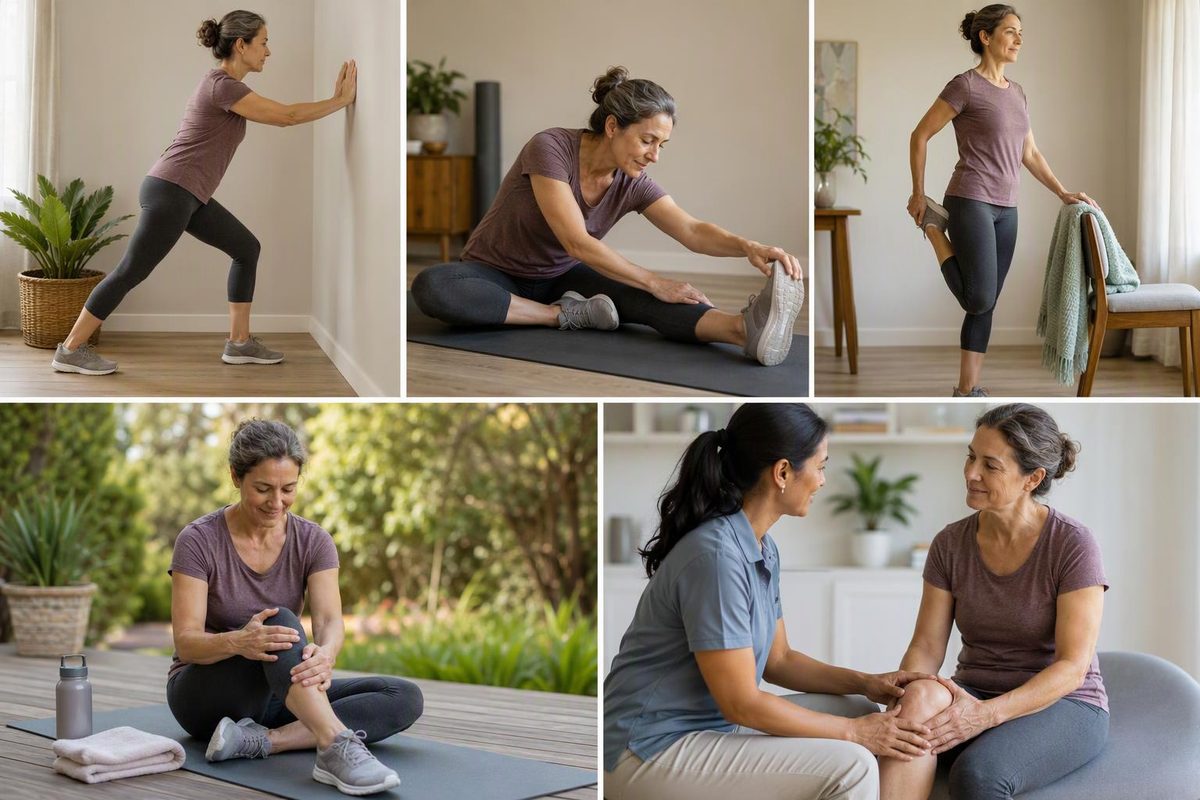
Knee stretch exercises usually target the muscles around the knee—not the joint itself. The three options below stretch the calf, back of the thigh and front of the thigh. They can be part of a flexibility routine, but a knee that feels tight does not automatically need a deeper stretch.
These are general exercise options, not treatment for an unexplained knee problem. If you have a diagnosed condition, recent surgery or prescribed movement limits, follow your clinician’s plan rather than adding this routine. NHS inform makes the same distinction. The American Academy of Orthopaedic Surgeons (AAOS) recommends that its knee-conditioning program be performed under a doctor’s supervision, with exercises selected to suit your rehabilitation goals.
When to seek care instead of stretching
Seek urgent medical advice if your knee is very painful, badly swollen or misshapen; you cannot move it or bear weight; it locks or gives way; or it is hot or red and you have a fever or feel shivery. Arrange an assessment if knee pain is not improving within a few weeks. These are reasons to check the problem—not push through a stretch. NHS knee-pain guidance
Before you start
Warm up with 5–10 minutes of comfortable walking or stationary cycling, as recommended in the AAOS knee-conditioning program. If that is painful, do not force the warm-up just to reach the stretches.
Aim for a gentle muscle pull, not knee pain. Start with a short hold and work toward 20–30 seconds if comfortable. Stop if a stretch causes new pain or worsens your symptoms; your knee should be no worse the following morning. NHS inform’s exercise guidance
1. Calf stretch at a wall
Where you should feel it: the calf of the back leg, extending toward the heel.
- Face a wall and place your hands against it for support.
- Step the leg you want to stretch behind you. Keep its knee straight and heel on the floor.
- Bend the front knee slightly.
- Move your hips gently toward the wall until you feel a calf stretch.
- Hold, then ease out. Switch sides if comfortable.
Keep both heels down and avoid arching your back. Move closer to the wall or shorten your stance if you cannot hold the position comfortably. The AAOS heel-cord stretch uses this supported position.
2. Hamstring stretch lying down
Where you should feel it: the back of the thigh. Do not chase a painful pull behind the knee.
- Lie on your back with both knees bent.
- Lift one leg and bring its knee toward your chest.
- Support the back of that thigh with your hands. If reaching is difficult, loop a towel around the thigh and hold its ends.
- Slowly straighten the raised knee only as far as comfortable.
- Hold, then bend and lower the leg. Repeat on the other side if comfortable.
You do not need to get the knee completely straight. Support the thigh rather than pulling directly on the knee joint, a key form cue in the AAOS hamstring-stretch instructions.
3. Supported standing quadriceps stretch
Where you should feel it: the front of the thigh.
- Hold a wall or the back of a sturdy chair for balance.
- Bend one knee, bringing the heel toward your buttock.
- If you can reach comfortably, hold your ankle and gently bring the heel closer.
- Keep your back from arching or twisting.
- Hold, release slowly and switch sides if comfortable.
Do not force your heel to touch your buttock. If reaching the ankle or bending the knee causes pain, skip this stretch rather than pulling harder. This follows the position described in the AAOS quadriceps stretch.
A small starting routine
For a cautious first session, choose one or two comfortable stretches and try one hold on each side. Build toward two or three holds as tolerated, keeping the stretch gentle rather than forcing greater range. This is a smaller starting routine, not the full AAOS rehabilitation program.
Stretching addresses flexibility, while strengthening helps the muscles support the knee and absorb shock. The AAOS program includes both. If these stretches are comfortable and you want to build support, see our knee-strengthening exercises and starter plan. If bending itself feels restricted, our guide to a knee that feels tight when bending can help you consider the next sensible question.