
Knee Feels Tight When Bending: Causes and What to Do
Sort possible causes by onset and symptoms, then learn when comfortable movement is reasonable or swelling, locking, or instability calls for assessment.
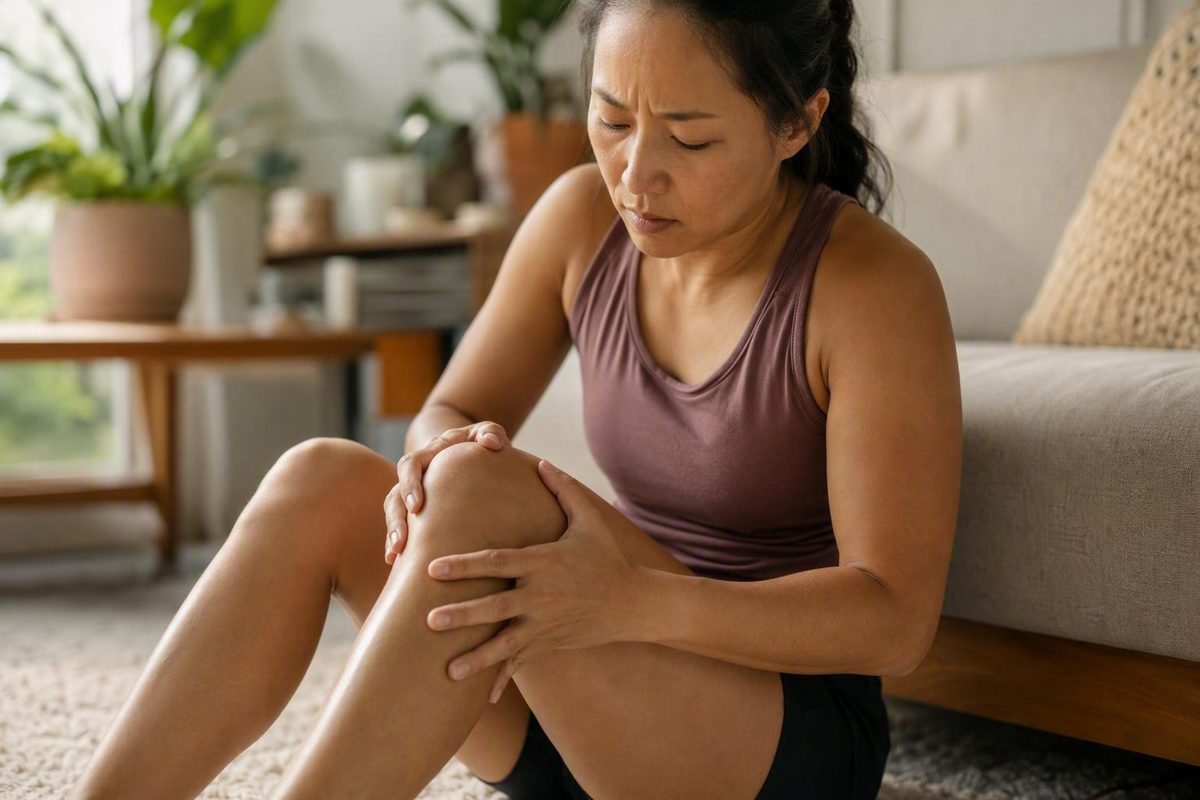
What Does a Tight Knee When Bending Actually Mean?
A knee that feels tight when bending is describing a sensation, not a diagnosis. It may reflect temporary stiffness, tension in nearby muscles, fluid or irritation inside the joint, an injury, or tissue that restricts movement. Tightness alone cannot identify the cause.
It helps to distinguish three experiences that people often describe using the same word:
- Pressure or tension with normal motion: The knee feels full, resistant, or “gummy,” but it still bends and straightens through its usual range.
- Reduced range of motion: The knee genuinely does not bend or straighten as far as normal. Pain, swelling, protective muscle guarding, or tissue restriction may contribute.
- True locking: The knee appears physically blocked and may become stuck at a particular angle. Mechanical symptoms can occur with problems inside the joint, but locking or catching alone does not identify the affected structure.
Painless tightness is generally less concerning than tightness accompanied by pain, warmth, swelling, instability, or loss of motion. Even without pain, however, persistent restriction deserves attention if it affects walking, stairs, exercise, or other normal activities.
Before deciding what to do, note:
- Can you straighten the knee as fully as the other knee?
- Does bending stop because it becomes uncomfortable, or because it meets a firm or abrupt block?
- Can you put your normal weight through the leg?
- Is the knee swollen, warmer than the other side, or unstable?
- Did the symptom follow a twist, impact, increase in activity, or operation?
- Does comfortable movement loosen the knee, or make the restriction more noticeable?
Do not use a deep squat, forceful bend, or twisting maneuver to test what is wrong. Those movements can aggravate an irritated or injured knee without providing a reliable diagnosis.
This article provides general education rather than individualized diagnosis or treatment, in keeping with Knee Pain Zone’s medical-information notice. If the knee locks, gives way, swells after an injury, or develops another warning sign described below, seek clinical advice.
Why Bending Can Make the Knee Feel Tight
Different tissues become stressed or compressed in different ways as the knee bends. In some conditions, fluid, swollen tissue, internal scar tissue, or displaced tissue becomes more noticeable in deeper flexion. That can create pressure, fullness, resistance, or an abrupt limit. This is one possible mechanism rather than a universal explanation for every tight knee.
A joint effusion is extra fluid inside the joint. Even a subtle effusion can occupy enough space to make bending feel restricted before the knee looks visibly enlarged. Fluid may develop after overuse, injury, or irritation from a joint condition, but its presence does not reveal the underlying cause. SPORT Orthopedics’ overview of fluid-related knee tightness similarly notes that swelling may feel like stiffness before it becomes visually obvious.
Muscle-related tension may feel different. Tight quadriceps can resist bending, while tight hamstrings or calves may create tension behind the knee or limit comfortable movement. Weakness may also contribute to guarded or inefficient movement. When symptoms appear muscular and there is no injury, swelling, instability, catching, or blocked motion, gentle mobility and gradual strengthening may help. A specialist-clinic guide to stiff-knee stretching emphasizes controlled, comfortable movement and identifies sharp pain, recurrent swelling, locking, catching, and instability as reasons to seek assessment.
That does not mean every tight knee needs more stretching. A swollen joint, unstable knee, recent injury, catching sensation, or apparent mechanical block should not be forced into a deeper range.
Pain can add a second layer of stiffness. When bending hurts, people naturally move less or hold the knee in a protected position. Reduced movement may then make the knee feel stiffer, even though it does not explain the original source of pain.
After an operation, swelling, inflammation, guarded movement, and internal scar tissue may restrict motion. The expected course depends on the procedure, healing stage, and surgeon’s precautions. Generic online exercises should never override procedure-specific instructions.
Common Causes, Organized by Symptom Pattern
How the tightness started and which symptoms accompany it are usually more informative than the sensation alone. The associations below are clues, not diagnostic criteria.
| Pattern | Accompanying clues | Possible explanations | Appropriate next step |
|---|---|---|---|
| Mild tightness after prolonged sitting | Eases after several comfortable steps; no swelling, instability, or meaningful loss of motion | Temporary inactivity, muscle stiffness, guarded movement, or joint changes | Keep moving comfortably, interrupt long periods of sitting, and monitor the trend |
| Tightness after more walking, running, squatting, kneeling, or repetitive work | Mild aching, tenderness, or fullness corresponding with an activity increase | Overuse, temporary joint irritation, tendon irritation, muscle fatigue, or kneecap-related symptoms | Temporarily reduce the provoking movement while maintaining comfortable activity |
| Gradual stiffness after rest | Aching, swelling, grinding, or reduced motion; may loosen with movement | A pattern that can occur with osteoarthritis, although stiffness does not confirm arthritis | Arrange assessment if it persists, worsens, or limits normal activity |
| Tightness after a twist or impact | Joint-line pain, delayed swelling, catching, instability, or difficulty straightening | Meniscus, ligament, cartilage, or another traumatic injury | Avoid twisting and deep bending; seek clinical assessment |
| Front-of-knee tightness or aching | Worse with stairs, squatting, kneeling, or prolonged sitting | Kneecap-related irritation, tendon irritation, or another anterior knee problem | Modify the provoking activity and seek assessment if symptoms persist or limit function |
| Localized warmth, swelling, or tenderness | Pain with pressure or kneeling; a distinct swollen area | Bursitis or another inflammatory process | Avoid direct pressure and obtain assessment if marked, persistent, red, or accompanied by illness |
| Tightness after injury or surgery | Swelling, guarded movement, reduced range, or progressive loss of motion | Inflammation, tissue injury, scar formation, or postoperative restriction | After injury, seek care according to severity; after surgery, contact the surgical or rehabilitation team |
| Tightness in both knees or several joints | Prolonged morning stiffness, swelling elsewhere, or broader symptoms | Possibilities extending beyond one local mechanical problem | Discuss the overall pattern with a clinician rather than self-diagnosing |
After sitting or inactivity
A knee may initially resist movement after a long drive, desk session, or time on the sofa. If the sensation is mild, resolves with comfortable movement, and is not accompanied by swelling, instability, or lost motion, short-term monitoring may be reasonable.
A similar “stiff after rest” pattern may also occur with joint conditions. One episode cannot distinguish temporary inactivity from arthritis or another cause. Recurrence, pain, swelling, previous injuries, and functional change all affect how the pattern should be interpreted.
After increased activity
An increase in distance, speed, hills, stairs, squats, kneeling, or physical work can expose the knee to more repetition than it is accustomed to. Tightness may accompany temporary irritation, tendon symptoms, muscle fatigue, or kneecap-related loading.
The useful question is not merely “Did I exercise?” but “Was this substantially more than my recent baseline?” A familiar activity can behave like a new load after illness, travel, reduced training, or an extended sedentary period.
Gradual stiffness with aching or swelling
Osteoarthritis is one possible explanation for stiffness after rest accompanied by aching, swelling, grinding, or declining motion. Those features are not exclusive to arthritis, however, and neither age nor morning stiffness confirms the diagnosis.
If both knees are involved, stiffness lasts longer than usual, or several joints are stiff or swollen, the possibilities become broader. Discuss that pattern with a healthcare professional rather than assuming it represents ordinary wear and tear.
After a twist, pivot, fall, or impact
A twist with the foot planted may injure a meniscus or ligament. Relevant clues include joint-line pain, swelling after the event, catching, instability, and difficulty bending or straightening. A displaced section of meniscus can sometimes obstruct motion, although these symptoms do not prove a tear. Guidance on possible meniscus-tear symptoms recommends clinical evaluation and selective imaging rather than diagnosis from symptoms alone.
Do not repeatedly twist, squat, or force the knee straight to check for a tear. If motion is blocked, weight bearing is difficult, or swelling is substantial, arrange assessment.
Front-of-knee symptoms
Aching or tightness around or behind the kneecap that worsens with stairs, squatting, or prolonged sitting can fit a patellofemoral pattern. Pain and tenderness immediately below the kneecap may involve the patellar tendon, particularly when running, jumping, or stairs provoke it.
A localized swollen area that is painful with kneeling or pressure may occur with bursitis. These symptom clusters overlap, so a pain map cannot reliably establish the diagnosis. An orthopedic review of pain patterns during knee bending describes these associations while emphasizing the need to identify the underlying cause.
After surgery
Early postoperative stiffness may relate to swelling and guarded movement. Persistent or worsening restriction can have other explanations, including scar tissue, but the expected course varies considerably between procedures.
Follow the surgeon’s instructions on range of motion, weight bearing, bracing, wound care, and exercise. New loss of motion, worsening swelling, or a reversal of previous progress warrants contact with the surgical team.
What the Location of the Tightness Can—and Cannot—Tell You
Location can guide the questions you ask, but it cannot establish a diagnosis. Several structures sit close together, symptoms may spread, and different conditions can produce similar sensations.
Front of the knee
Tightness or a dull ache around or behind the kneecap may accompany patellofemoral irritation. Stairs, squatting, rising from a chair, and prolonged sitting with the knee bent are common triggers in this pattern.
Tenderness directly below the kneecap can occur with patellar tendon irritation. A distinct swollen area that hurts when kneeling or pressing on it may fit bursitis. These are possibilities rather than conclusions.
Inner or outer joint line
Symptoms along the inner or outer joint line deserve greater attention when they began after twisting and occur with catching, delayed swelling, instability, or difficulty straightening. That cluster may accompany a meniscus injury, but it can overlap with ligament, cartilage, or arthritic symptoms.
A completely locked knee is different from a momentary click or reluctant movement.
Behind the knee
Pressure, fullness, or a lump behind the knee may relate to hamstring tension, fluid inside the joint, or a Baker’s cyst. A Baker’s cyst is a collection of joint fluid behind the knee and may become more noticeable during bending. It can arise alongside another process that causes the knee to produce excess fluid, so finding a cyst does not necessarily identify why the fluid developed.
A lump or feeling of fullness cannot confirm a Baker’s cyst by touch alone. Clinical assessment, and sometimes imaging, may be used when the diagnosis is uncertain or symptoms are significant. Spire Healthcare’s overview of posterior symptoms during knee bending lists Baker’s cyst, hamstring tendon irritation, and knee injury among the possibilities.
Red Flags: When a Tight Knee Needs Medical Care
Knee-tightness triage
Seek urgent same-day assessment if you have:
- A hot, red, swollen knee with fever or a feeling of being acutely unwell
- Major or rapidly increasing swelling after an injury
- An obvious deformity
- Inability to bear weight
- A completely locked knee
- Inability to straighten the knee after trauma
- New calf pain and swelling, particularly when one-sided
Arrange a prompt clinical assessment if you have:
- Severe pain
- A pop at the time of injury followed by loss of function
- Repeated buckling, giving way, or marked instability
- Catching or intermittent locking
- Persistent loss of bending or straightening
- Symptoms that interfere with walking, stairs, work, sleep, or exercise
Short-term monitoring may be reasonable when:
- Tightness is mild and improving
- There was no meaningful injury
- You can bear weight normally
- There is no marked swelling, warmth, locking, instability, or lost motion
There is no single deadline that applies to every tight knee. Severity, injury history, functional loss, and whether symptoms are improving matter more than an arbitrary number of days.
For nonurgent symptoms, arrange a routine appointment when tightness persists, repeatedly returns, worsens, or begins to limit normal activities. Seek help sooner if the knee was recently injured or operated on.
A pop by itself does not identify an injury. A pop followed by swelling, severe pain, instability, or loss of function is more concerning. Repeated giving way also deserves assessment because it can reflect instability, pain-related muscle inhibition, or another knee problem.
If symptoms are mild and trending better, short-term home monitoring can include reducing the specific aggravating activity while maintaining comfortable movement. New swelling, instability, lost motion, or systemic illness should shift the plan toward clinical assessment.
Safe First Steps for Mild, Non-Traumatic Tightness
The suggestions below apply only to mild symptoms without a significant recent injury, marked swelling, locking, instability, fever, or inability to bear weight. They are not substitutes for postoperative instructions or acute injury care.
Reduce the aggravating movement, not necessarily all movement
If deep squats trigger tightness, temporarily use a shallower range or choose another activity. If a long walk caused symptoms, shorten the route or use flatter ground. The aim is to reduce the particular load that aggravates the knee rather than automatically stopping all activity.
Short periods of comfortable movement may help prevent additional stiffness. Easy walking or gentle bending and straightening can be reasonable if the knee does not become more painful, swollen, or unstable. Do not force deeper bending simply because the knee “should” move farther.
Use ice or heat according to the pattern
Ice may feel comfortable after a recent aggravation or when swelling is present. Place a cloth between the cold source and the skin, and stop if the area becomes painful, numb, or irritated.
Heat may feel better for non-acute stiffness when the knee is not newly injured, hot, or actively swollen. It may improve comfort, but it cannot remove a mechanical block or address every cause of joint inflammation.
Neither option is universally superior. Use the one that fits the symptom pattern and feels comfortable.
Be cautious with stretching
Gentle stretching is most reasonable when the sensation appears muscular—for example, diffuse thigh or hamstring tension after prolonged sitting—and there is no acute swelling, instability, catching, or blocked movement.
Stretching should feel controlled and mild. Do not push through sharp pain, joint pressure, or an abrupt endpoint. A blocked sensation is a reason to stop, not a target to overcome.
Treat the next morning as feedback
The knee’s later response can be more informative than how it feels during a few repetitions. Reduce the range, repetitions, resistance, duration, or total activity.
If symptoms settle promptly and the knee is no worse the following morning, the dose may have been tolerable. This is a load-management guide, not proof that the underlying problem is harmless.
Check before using pain medicine
Over-the-counter pain medicines are not suitable for everyone. Ask a pharmacist or clinician whether an option is appropriate for you, and do not use temporary symptom relief as permission to force a restricted knee.
A Gentle Starter Routine—and Clear Stop Rules
Do not begin this routine if you have had recent knee surgery, have a diagnosed condition with specific restrictions, or currently have acute trauma, significant swelling, locking, instability, inability to bear weight, or any red-flag symptom. Follow your clinician’s instructions instead.
For an otherwise mild, non-traumatic tight knee, start conservatively. The purpose is to explore comfortable movement—not to force the joint back to normal in one session.
1. Supported heel slides
- Lie on your back or sit with the leg supported.
- Keep the heel in contact with the bed, floor, or another smooth surface.
- Slowly slide the heel toward your body.
- Stop at the first point of comfortable resistance.
- Pause briefly, then slide the heel away until the leg is comfortably straight.
The motion should remain smooth. Stop if the knee catches, locks, develops sharp pain, or meets an abrupt block.
2. Quadriceps contractions
- Sit or lie with the leg supported.
- Keep the knee in a comfortable position.
- Tighten the muscles at the front of the thigh as though preparing to straighten the knee.
- Hold briefly, then relax.
- Do not contract so forcefully that the knee becomes painful.
This exercise activates the quadriceps without requiring repeated deep bending.
3. Supported straight-leg raise, if comfortable
Try this only if you can keep the knee stable and reasonably straight without increasing symptoms.
- Lie down with the symptomatic leg supported.
- Tighten the muscles at the front of the thigh.
- Lift the leg a short distance while maintaining control.
- Lower it slowly.
- Stop if the knee bends unexpectedly, shakes markedly, or becomes more painful.
This movement is optional. Heel slides and quadriceps contractions are enough for a first session.
4. Optional muscle mobility
If the sensation appears muscular and there is no swelling or mechanical restriction, gentle hamstring, quadriceps, or calf mobility may be added. Use a supported position and stop at mild tension.
Do not bounce, twist the knee, or pull the heel forcefully toward the buttock. A stretch should feel like gentle lengthening—not sharp pain, increasing joint pressure, or a blocked endpoint.
How much to do
Begin with only two or three comfortable repetitions of each selected movement. Add repetitions gradually over later sessions if the knee remains settled. NHS Inform’s knee-exercise guidance advises beginners to start with two or three repetitions and work gradually toward no more than two sets of 15, while ensuring symptoms settle quickly and are no worse the following morning.
There is no need to reach that upper limit. More repetitions are not automatically better, especially when the cause of the tightness is unknown.
Stop or reduce the routine if you notice:
- Sharp or escalating pain
- Catching or locking
- Buckling or instability
- A new symptom, including numbness
- Increasing warmth or swelling
- Feeling unwell
- Symptoms that do not settle promptly
- More pain, stiffness, swelling, or limping the following morning
What a Clinician May Check If the Tightness Persists
A concise symptom record can make an appointment more productive. Note:
- When the tightness began
- Whether it followed an injury, operation, or increase in activity
- Its exact location
- Whether the knee looks or feels swollen
- Whether stiffness is worse in the morning or after sitting
- What makes it better or worse
- Any catching, locking, popping, grinding, or buckling
- Whether you can straighten the knee fully
- Whether you can bear weight normally
- Which activities are limited
- Whether one or both knees—or other joints—are affected
During an examination, a clinician may compare the knees, assess bending and straightening, look for joint fluid, and identify areas of tenderness. Depending on the history, the examination may also assess kneecap movement, ligament stability, and signs associated with meniscus injury.
No single examination maneuver necessarily provides the whole answer. The history, physical findings, symptom severity, and suspected cause determine whether testing is likely to change treatment.
Imaging is not automatically required for every tight knee. An X-ray may be selected when the clinician needs to assess bone, a possible fracture, alignment, or arthritis-related changes. MRI may be considered when a clinically significant soft-tissue injury, such as a meniscus or ligament problem, is suspected. An orthopedic overview of knee-tightness evaluation similarly describes imaging as selective rather than routine.
If infection, gout, or another inflammatory process is suspected, testing fluid taken from the joint may be considered. This is a diagnosis-dependent decision, particularly when a knee is acutely hot and swollen.
Treatment is also diagnosis-dependent. Selected patients may be advised to modify activity, attend physical therapy, use a brace, receive an injection, or undergo surgery. None of these is a routine remedy for nonspecific tightness.
Postoperative note: Discuss new, worsening, or unexpectedly persistent tightness after surgery with the surgical team. Its restrictions on bending, weight bearing, bracing, and exercise take priority over any general routine online.
Frequently Asked Questions
Can a knee feel tight from swelling even if it does not look swollen?
Yes. A small amount of extra fluid inside the joint can create fullness or resistance during bending before swelling becomes visually obvious.
The cause of the fluid still matters. It may follow overuse, injury, or joint irritation. Arrange assessment if the tightness persists, becomes increasingly painful or warm, or is associated with declining motion.
Is knee tightness without pain usually harmless?
It is generally less concerning than tightness accompanied by marked swelling, warmth, instability, pain, or loss of function, but it is not automatically harmless.
Temporary painless stiffness after sitting that resolves with comfortable movement may be reasonable to monitor. Persistent restriction, recurrent fullness, inability to straighten fully, or progressive loss of motion deserves attention even without pain.
Does catching or locking mean I have a meniscus tear?
No. A meniscus tear is one possible explanation, especially when symptoms began after twisting and include joint-line pain, swelling, or difficulty straightening. Other joint problems can produce similar symptoms, and momentary catching is not the same as a completely locked knee.
Diagnosis depends on the history and examination, with imaging used selectively when it would clarify a suspected soft-tissue injury.
What can cause tightness or pressure behind the knee?
Possible explanations include hamstring tension, fluid inside the joint, or a Baker’s cyst. A Baker’s cyst is a fluid collection behind the knee and may be associated with another process causing excess joint fluid.
A lump or posterior pressure should not be diagnosed by feel alone. Seek assessment if it persists, enlarges, restricts movement, or follows an injury.
Should I stretch a knee that feels tight when bending?
Gentle stretching may be reasonable when the tightness appears muscular and there has been no acute injury, significant swelling, instability, catching, or blocked motion. Stay within a comfortable range and aim for mild tension rather than pain.
Do not force a swollen, recently injured, unstable, catching, or locked knee. Stop if stretching produces sharp pain, increasing swelling, or worse symptoms the following morning.
A Simple Decision Framework
Mild tightness that is improving, follows no meaningful injury, and causes no swelling, locking, instability, or lost function may be managed initially by reducing the aggravating activity and maintaining comfortable movement.
Tightness that persists, recurs, worsens, or limits walking, stairs, work, sleep, or exercise should be evaluated.
The goal is not to name a condition from one sensation. Use the onset, location, associated symptoms, functional change, and overall trend to choose the safest next step.