
Bruised Knee: Symptoms, Treatment, Healing Time & Red Flags
A bruised knee after a bump, fall, collision, or awkward twist is often a minor injury. However, the mark on the skin cannot show whether the damage stops at…
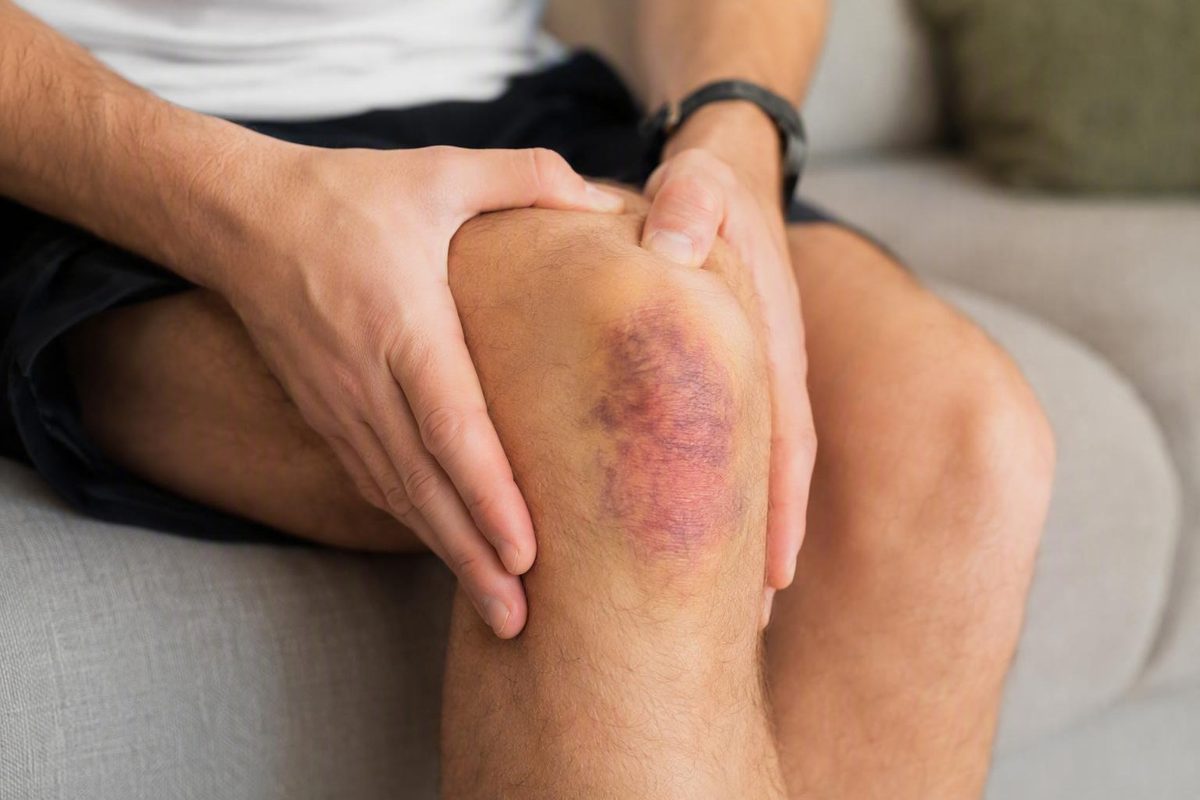
A bruised knee after a bump, fall, collision, or awkward twist is often a minor injury. However, the mark on the skin cannot show whether the damage stops at the surface. A ligament sprain, meniscus injury, kneecap injury, fracture, or bone bruise can produce overlapping symptoms.
The practical question is not simply, “Is this a bruise?” It is, “How well does the knee work, and are the symptoms improving or becoming more concerning?”
Start Here: Is Home Care Reasonable, or Does the Knee Need Assessment?
Use these three paths to decide what to do next.
Home care may be reasonable
Short-term home care may be reasonable when:
- The injury involved a minor impact rather than major trauma.
- Tenderness, swelling, and discoloration are mild to moderate.
- You can walk without major difficulty.
- You can bend and straighten the knee reasonably well.
- The knee does not lock, buckle, or feel unstable.
- Symptoms are stable or beginning to improve.
Protect the knee from further impact, reduce activities that worsen symptoms, use wrapped ice, elevate the leg, and monitor how well the knee functions over the next few days.
Arrange prompt assessment
Contact a clinician or urgent-care service if you have:
- Substantial or persistent swelling.
- Difficulty bearing weight.
- Inability to bend or straighten the knee fully.
- Locking, catching, buckling, or giving way.
- A pop followed by swelling or loss of function.
- Severe or steadily worsening pain.
- Pain after trauma that repeatedly wakes you at night.
- Symptoms that are not progressing as expected.
These findings do not prove that something is torn or broken, but they make an isolated superficial bruise less certain. Kaiser Permanente advises prompt care for severe or increasing pain, inability to bear weight or move the knee, deformity, circulation changes, infection signs, or possible blood-clot symptoms (Kaiser Permanente knee-injury care instructions).
Knee-sprain symptoms can also emerge or become more noticeable several hours after the injury rather than being fully apparent at once. A pop, swelling, limited mobility, difficulty bearing weight, or buckling may occur with a sprain, but none of these symptoms identifies the injured structure by itself (Sports-health’s physician-reviewed knee-sprain overview).
Seek urgent or emergency help
Seek urgent medical assessment for:
- Obvious deformity.
- Major trauma followed by intense or rapidly increasing pain.
- A foot that becomes cold, pale, blue, unusually dark, or numb.
- Fever with spreading warmth or redness around the knee.
- Pus or other signs of infection.
- Extremely painful, tense swelling.
- New calf or whole-leg swelling.
Call emergency services for sudden chest pain, difficulty breathing, or coughing blood. These can be warning signs of a clot that has traveled to the lungs.
Bruising and swelling can develop over several hours. Recheck walking, movement, stability, pain, and swelling later that day and the next morning instead of relying only on how the knee looked immediately after the injury.
This article provides general education, not a diagnosis or an individualized treatment plan. Knee Pain Zone’s medical-information disclaimer likewise states that its articles are informational rather than treatment. Concerning symptoms require assessment by a qualified clinician.
What a Bruised Knee Actually Means
A contusion is an injury in which trauma damages small blood vessels, allowing blood to leak into surrounding tissue. When that bleeding occurs beneath intact skin, it creates a visible bruise.
“Bruised knee” can describe injuries at different depths:
- Superficial bruise: Bleeding in tissue just beneath the skin.
- Deeper soft-tissue or muscle contusion: Injury involving tissue below the superficial layer, sometimes with a firm collection of blood called a hematoma.
- Bone bruise: Microscopic injury within or around a bone, without the visible fracture line associated with a conventional fracture.
A bone bruise is not simply a darker skin bruise. It is a more substantial internal injury that can affect the lower femur, upper tibia, or patella. It may occur without any visible skin discoloration. X-rays generally do not show bone bruises, although they may be used to look for a fracture (Cleveland Clinic’s bone-bruise overview).
Visible bruising may look blue, purple, black, or brown, depending partly on skin tone and the stage of healing. Green or yellow tones may appear as the bruise fades.
Causes and Symptoms: What the Injury Pattern Can—and Cannot—Tell You
Common causes of knee bruising include:
- Striking the knee against furniture, flooring, or another hard surface.
- Falling directly onto the knee.
- Contact with another player or object.
- A vehicle collision.
- A sports impact.
- A twisting or pivoting injury.
A direct impact commonly causes superficial bruising, but enough force can also injure deeper tissue, the kneecap, or another bone. Twisting is particularly important because it can bruise tissue while also damaging a ligament, meniscus, cartilage, or bone.
Typical symptoms of a superficial contusion include:
- Visible discoloration.
- Local tenderness.
- Mild to moderate swelling.
- Stiffness.
- Pain when kneeling or pressing the area.
- A firm or raised hematoma.
Possible signs of a deeper injury include:
- A dull or throbbing ache that feels deep within the knee.
- Focal tenderness directly over a bone.
- Pain while standing or walking.
- Reduced bending or straightening.
- Persistent swelling.
- Pain that remains after the skin discoloration has faded.
A bone contusion may cause swelling, stiffness, tenderness, pain with leg extension, and longer-lasting discomfort than a minor soft-tissue bruise. These symptoms still cannot confirm a bone bruise without clinical assessment (Healthline’s medically reviewed knee-contusion guide).
Bruising may accompany ACL or other ligament injuries, meniscus or cartilage damage, patellar dislocation, and fractures. A pop, rapid swelling, buckling, locking, or inability to straighten the knee changes the risk picture but does not, by itself, identify the damaged structure.
Pain, swelling, bruising, and limited motion overlap across many injuries, so reliable self-diagnosis is not possible from symptoms alone.
Bruise, Bone Bruise, Sprain, Tear, or Fracture?
The following comparison is a guide to escalation, not an at-home diagnostic test. A clinician may need to combine the injury history, examination, and imaging to distinguish a contusion from a fracture, ligament injury, or other internal knee problem (Medical News Today’s medically reviewed bruised-knee guide).
| Possibility | Typical mechanism | Possible symptoms | What cannot be determined at home | When to seek assessment |
|---|---|---|---|---|
| Superficial contusion | Direct bump, blow, or fall | Visible discoloration, localized tenderness, and mild swelling; stability and basic function are generally preserved | Whether deeper tissue or bone was also injured | If pain or swelling is substantial, function worsens, or improvement does not begin |
| Suspected bone bruise | Direct impact, compression, or twisting injury | Deep ache, focal bony tenderness, stiffness, weight-bearing pain, and persistent swelling; skin bruising may be absent | Symptoms cannot confirm it; an X-ray may be normal, while MRI may identify it | If bone pain persists, walking is difficult, motion is reduced, or symptoms are not improving |
| Ligament or meniscus injury | Twist, pivot, sudden stop, awkward landing, or forceful impact | Pop, swelling, instability, giving way, locking, catching, or reduced motion; bruising may coexist | Which structure is affected and whether it is stretched, partially torn, or completely torn | Promptly if the knee is unstable, locked, significantly swollen, or difficult to bear weight on |
| Possible kneecap or other fracture | Fall onto the knee, major collision, or strong direct blow | Marked pain, severe swelling, inability to bear weight, inability to extend the leg, focal bony tenderness, or deformity | Whether a fracture is present or displaced | Urgent clinical evaluation |
| Infection | May follow broken skin or a procedure, or arise without a typical traumatic bruise | Increasing warmth, redness, swelling, pus, fever, or worsening pain | The cause and depth of the infection | Same-day urgent assessment; emergency care if systemically unwell |
| Unexplained bruising | No remembered trauma, or bruising disproportionate to minor contact | Recurrent, unusually large, or easy bruising; nose, gum, or other unusual bleeding may coexist | Whether medicine effects, a bleeding problem, or another condition is involved | Medical review rather than routine injury self-care |
By contrast, inability to extend the leg after a direct blow, deformity, or inability to bear weight raises concern for a fracture or another significant injury.
The First 48–72 Hours: Protect the Knee and Control Symptoms
For an apparently minor bruised knee, early care should protect the area and keep symptoms manageable.
Reduce aggravating activity
Temporarily reduce walking, kneeling, squatting, running, jumping, and other activities that increase pain or swelling. This does not mean staying completely still until every trace of discoloration disappears. Ordinary movement can continue within a comfortable range if the knee is stable and symptoms do not worsen.
Use cold safely
During the first few days, apply a cold pack wrapped in a cloth for roughly 15–20 minutes at a time. Never place ice directly against the skin. Remove the pack if the skin becomes painful, excessively numb, or otherwise uncomfortable. North Bristol NHS Trust gives similar guidance and warns that uncomfortable cold exposure may burn the skin (North Bristol NHS Trust knee-injury guidance).
Cold may reduce pain and help manage swelling. It should not be presented as a guarantee of faster tissue healing.
Elevate the leg
When practical, lie or sit with the supported leg raised above heart level. Support the whole lower leg comfortably rather than leaving the knee hanging unsupported. Elevation may help control swelling.
Use compression only if it helps
A gentle elastic wrap may improve comfort or help manage swelling, but it is optional. Compression has not been established as necessary for faster recovery.
The wrap should feel supportive, not tight. Loosen or remove it if the foot becomes:
- Numb or tingly.
- Cold.
- Pale, blue, or unusually dark.
- More painful.
- Increasingly swollen below the wrap.
Mayo Clinic advises that an elastic bandage may be used when a bruise is swollen but should not be applied too tightly. It also notes that intact skin does not require a bandage (Mayo Clinic bruise first aid).
Do not drain a lump at home
A firm or raised lump may be a hematoma—a collection of blood within the tissue. Do not puncture or attempt to drain it yourself. A large, painful, or persistent lump should be assessed professionally (Medical News Today’s bruised-knee guidance).
If the skin is broken, obtain suitable wound-care advice and watch for increasing redness, warmth, drainage, fever, or worsening pain.
Be cautious with medication
If you are considering a nonprescription pain medicine, follow the product label. Ask a clinician or pharmacist first if you:
- Are pregnant.
- Have medicine allergies.
- Take other medicines.
- Have kidney or stomach disease.
- Have a bleeding risk.
- Are uncertain which option is appropriate.
Do not use pain relief as a reason to push through instability, increasing swelling, or major loss of movement.
Walking, Gentle Movement, and Progressive Rehabilitation
Whether you should walk on a bruised knee depends on the injury’s severity, knee stability, and symptom response.
Short, comfortable walking may be reasonable when:
- The knee feels stable.
- You can put weight through the leg without severe pain.
- Your limp is minimal or absent.
- Walking does not cause increasing swelling.
Reduce loading if pain rises, your limp becomes more pronounced, or the knee is clearly more swollen later that day or the following morning. Follow any non-weight-bearing or partial-weight-bearing restriction given by a clinician.
Crutches and braces are not routine requirements for every bruised knee. They may be used when a clinician recommends temporary protection for painful weight-bearing, instability, a suspected fracture, or a significant bone bruise.
Begin gentle movement after the initial period
After the first few days, if symptoms are settling and no clinician has restricted movement, gentle exercises may include:
- Slowly bending and straightening the knee within a comfortable range.
- Tightening the thigh muscle while the leg is supported.
- Practicing controlled knee straightening without forcing the final range.
Mild discomfort may be acceptable, but stop if you experience sharp pain, locking, or a feeling that the knee will give way. Do not force the knee through substantial swelling or a mechanical block.
Use the next day as your progression test
The immediate response to exercise is only part of the picture. Check how the knee feels later that day and the following morning.
Scale activity back if you notice:
- Clearly worse pain.
- More swelling.
- A new or increased limp.
- Reduced movement.
- More difficulty with ordinary walking.
When the response remains stable, progress gradually:
- Comfortable daily walking and household movement.
- Gentle bending and straightening.
- Basic thigh and hip strengthening.
- Low-impact conditioning.
- Jogging and controlled sport drills.
- Running, pivoting, cutting, contact, and competition.
Easy stationary cycling or swimming may be options if they do not increase symptoms and no movement or weight-bearing restriction applies. North Bristol NHS Trust similarly recommends adjusting walking and exercise according to pain and swelling and delaying running or twisting sports until the knee is pain-free, mobile, and strong (North Bristol NHS Trust rehabilitation guidance).
Avoid both extremes. Prolonged unnecessary inactivity may contribute to stiffness, while premature impact activity may repeatedly aggravate the injury.
A bruise associated with a sprain, tear, fracture, surgery, or persistent functional loss needs individualized rehabilitation rather than a generic exercise sequence.
Diagnosis and Imaging: Why a Normal X-Ray May Not End the Investigation
Diagnosis usually begins with the story of the injury. A clinician may ask:
- Was there a direct blow, fall, twist, or pivot?
- Was there a pop?
- How quickly did swelling appear?
- Can you bear weight?
- Does the knee lock or give way?
- Are symptoms improving?
The examination may assess focal tenderness, swelling, range of motion, weight-bearing, the ability to extend the leg, and knee stability. Imaging is then selected according to the mechanism and clinical findings.
What an X-ray can show
An X-ray can identify many fractures and may be appropriate after significant trauma, marked bony tenderness, deformity, or loss of function. It generally does not display a bone bruise.
A normal X-ray therefore does not automatically rule out:
- A bone bruise.
- Ligament injury.
- Meniscus injury.
- Cartilage injury.
- Every fracture.
When MRI may help
MRI is the most useful imaging method for detecting bone-marrow changes associated with a bone bruise. It can also show ligaments, menisci, cartilage, and other internal structures. Cleveland Clinic notes that bone bruises do not appear on X-rays and that MRI may be used when a bone bruise is suspected.
That does not mean every visibly bruised knee needs MRI. The decision depends on:
- The injury mechanism.
- Pain and swelling severity.
- Examination findings.
- Ability to walk and move the knee.
- Persistence or worsening of symptoms.
- Whether the result would change treatment.
Ultrasound and CT can have roles in selected knee problems, but neither should be assumed to be routine for a suspected bone bruise.
Healing Time and How to Track Recovery
There is no single healing deadline for a bruised knee.
As broad expectations:
- A minor superficial bruise may begin improving within days.
- A broader soft-tissue injury may take several weeks.
- A bone bruise may take weeks to months.
Conversely, a dramatic-looking surface bruise may improve while walking and movement remain relatively normal.
Recovery may take longer with:
- A deeper or larger injury.
- An injury in a weight-bearing area.
- Associated ligament, meniscus, or cartilage damage.
- Repeated aggravation.
- Reduced general health.
- Smoking.
- Diabetes.
Age, health, injury size, and location can affect bone-contusion recovery, while smoking and diabetes may delay healing. Recovery estimates should therefore be treated as broad ranges rather than promises (orthopedic guidance on bone-contusion recovery).
Use a simple recovery tracker
Once daily or every few days, record:
| Check | What to note |
|---|---|
| Walking tolerance | Distance or time before pain increases; whether you limp |
| Swelling | Less, unchanged, or more than at the previous check |
| Straightening | Whether the knee can rest fully straight |
| Bending | Whether comfortable bending is increasing |
| Stability | Any buckling, shifting, or giving way |
| Pain trend | Improving, unchanged, or worsening |
| Next-day response | Whether the previous day’s activity caused more pain or swelling |
Progress means function is improving and symptoms are trending downward. A bruise changing from purple to green or yellow is not enough if walking, movement, or stability is deteriorating.
Arrange clinical review if bruising remains beyond roughly two weeks without improvement, pain or function is not progressing as expected, or a substantial bruise remains unresolved by about six weeks. These are review points, not instructions to wait. Worsening pain, increasing swelling, instability, or loss of motion matters immediately.
When to Seek Care and When It Is Safe to Return to Sport
Prompt-care checklist
Arrange medical assessment if any of the following applies:
- [ ] You cannot bear weight normally.
- [ ] Swelling is substantial, persistent, or repeatedly returns.
- [ ] Pain is severe or increasing.
- [ ] You cannot fully bend or straighten the knee.
- [ ] The knee locks or catches.
- [ ] The knee gives way or feels unstable.
- [ ] There was a pop followed by loss of function or rapid swelling.
- [ ] Pain repeatedly wakes you at night after the trauma.
- [ ] Recovery has stalled or is moving backward.
- [ ] A large, painful hematoma persists.
- [ ] Bruising has not begun improving after about two weeks.
Urgent or emergency checklist
Seek urgent assessment for:
- [ ] Obvious deformity.
- [ ] Major trauma with intense or rapidly increasing pain.
- [ ] A cold, pale, blue, unusually dark, or numb foot.
- [ ] Fever with spreading warmth, redness, or pus.
- [ ] Extremely painful, tense swelling.
- [ ] New calf or whole-leg swelling.
Call emergency services for:
- [ ] Sudden chest pain.
- [ ] Difficulty breathing.
- [ ] Coughing blood.
New calf or whole-leg swelling may signal a blood clot and needs urgent assessment. Sudden chest symptoms or coughing blood may indicate a pulmonary embolism and are an emergency. These circulation, clot, and chest-symptom warnings are included in clinically reviewed knee-injury guidance from Kaiser Permanente (urgent knee-injury warning signs).
Unexplained or recurrent bruising
A bruise without a remembered injury belongs on a different pathway from a routine impact injury. Arrange medical review if bruises:
- Appear repeatedly.
- Are unusually large.
- Develop after very minor contact.
- Appear without an obvious cause.
- Occur with nosebleeds, gum bleeding, prolonged bleeding, or other unusual bleeding.
Medicines and underlying health conditions can affect bruising and bleeding. Do not stop a prescribed medicine on your own; ask the prescriber or pharmacist for advice.
Returning to sport
Do not use bruise color as the return-to-sport test. Before running or resuming a twisting or contact sport, aim for:
- Normal walking without a limp.
- Pain-free or nearly pain-free bending and straightening.
- Full or near-full mobility.
- Restored leg strength.
- A stable knee without giving way.
- No reactive swelling after progressively harder activity.
Progress from lower-load tasks to brisk walking, basic strength work, low-impact conditioning, straight-line jogging, faster running, controlled direction changes, sport-specific drills, contact, and competition. If a stage causes more pain, swelling, limping, or instability later that day or the following morning, return to the previous level.
Because sprains and tears can produce overlapping symptoms, professional assessment is appropriate when pain persists, function is significantly impaired, swelling continues, or the knee gives way. More substantial internal injuries may require a longer and more individualized return-to-sport process.
A suspected bone bruise, fracture, major sprain, or associated ligament injury may require clinician clearance before sport. The goal is not to identify the injury from the bruise’s color. It is to respond appropriately to pain, function, swelling, stability, and symptom progression.
Frequently Asked Questions
Can you have a knee bone bruise without visible bruising?
Yes. A bone bruise is an internal microscopic bone injury and may cause deep pain, focal tenderness, stiffness, or weight-bearing discomfort without changing the color of the skin. Conversely, visible discoloration does not prove that the underlying bone is bruised. Bone bruises may affect the femur, tibia, or patella and are usually evaluated in the context of the injury history, examination, and—when needed—MRI.
Can I walk on a bruised knee?
Short, comfortable walking may be reasonable if the knee is stable, you can bear weight, and walking does not increase pain, limping, or swelling. Reduce loading if symptoms worsen, and follow any weight-bearing restriction given by a clinician. Crutches may be used when weight-bearing is painful or when temporary protection has been prescribed; inability to bear weight needs prompt assessment (orthopedic bone-contusion guidance).
Why does my knee still hurt if the X-ray was normal?
Standard X-rays can identify many fractures but generally do not show bone bruises, ligaments, menisci, or cartilage well. A normal result therefore does not exclude every fracture or internal knee injury. Persistent focal pain, swelling, reduced movement, locking, or instability warrants reassessment; MRI may be considered when clinical findings suggest a deeper injury.
Should I wrap a bruised knee?
You may use a gentle elastic wrap if it improves comfort or helps with swelling, but wrapping is optional and is not established as necessary for faster healing. Loosen or remove it if the foot becomes numb, cold, discolored, more painful, or more swollen. Compression should never be tight enough to impair circulation.
What does unexplained or recurrent bruising around the knee mean?
Bruising without a remembered injury—or bruises that are frequent, unusually large, painful, or easy to develop—may relate to medicines, a bleeding tendency, or another health issue rather than ordinary trauma. Arrange medical review, especially if there is nose or gum bleeding, prolonged bleeding, a personal or family history of easy bleeding, or bruising elsewhere (Mayo Clinic guidance on when bruising needs medical review).
For an apparently minor bruised knee, protect it, control symptoms, and monitor it. Judge recovery by walking, movement, stability, swelling, and the next-day response to activity—not by color alone. A visible bruise is not the same diagnosis as a bone bruise, and severe, worsening, unexplained, or function-limiting symptoms should override routine home-care timelines.