
Ache or Pain Behind the Knee: Causes and Warning Signs
Use swelling, injury and activity patterns to sort pain behind the knee, identify possible causes and recognize symptoms needing urgent medical care.
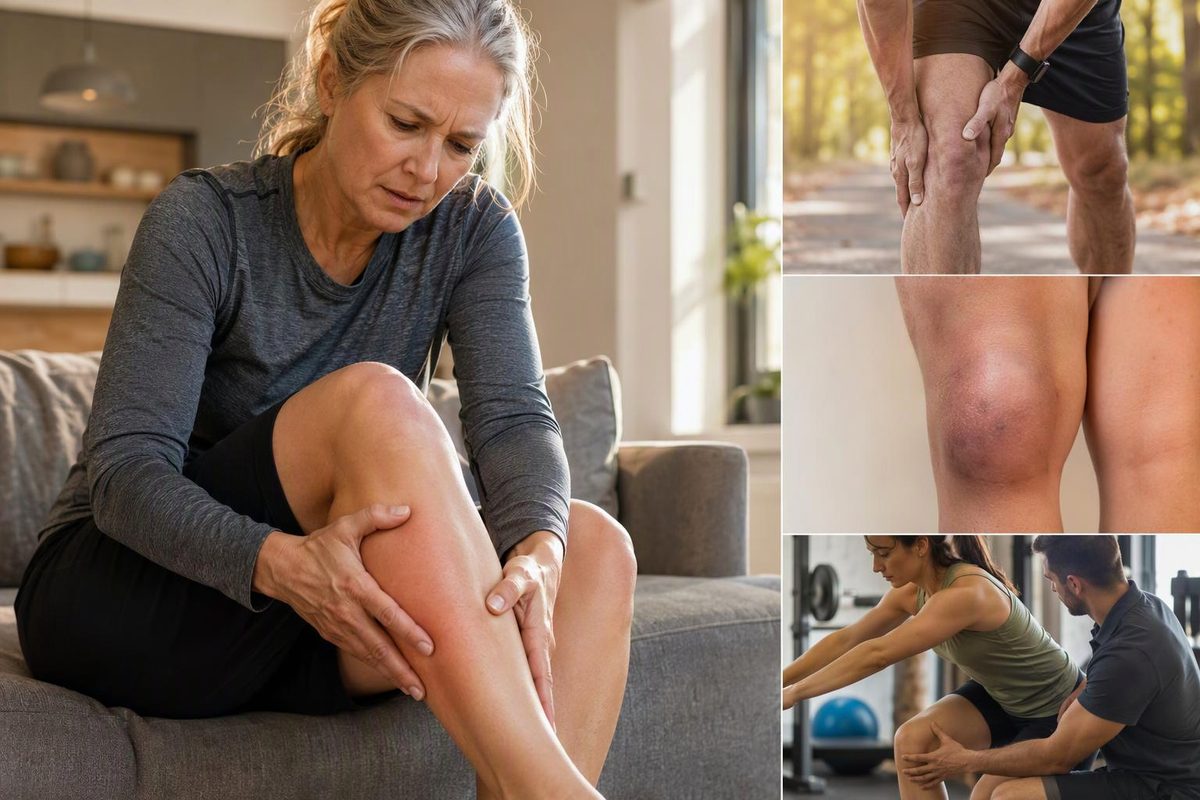
An ache in the crease behind your knee is posterior knee pain, but its location does not identify the cause. An activity-related muscle or tendon problem is possible, while a lump or fullness may be a Baker’s cyst and pain after a twist may involve the meniscus. New one-sided calf swelling, warmth, redness or discoloration needs prompt medical assessment.
Choose your accompanying symptoms and pain pattern to see the appropriate next step.
Posterior Knee Pain Check
This sorts urgency and the broad symptom pattern; it cannot diagnose the cause.
Select the three descriptions. Breathing symptoms override the other answers; calf or severe knee warning signs require prompt assessment.
Source: CDC guidance on blood clots, NHS knee-pain and Baker’s cyst guidance, and AAOS guidance on hamstring and meniscus injuries, as cited in the article.
Check for Urgent Warning Signs First
Seek prompt medical care for new swelling, pain or tenderness, warmth, redness, or discoloration in one leg or calf—especially when several occur together. These are possible signs of a deep vein thrombosis (DVT), which cannot be confirmed or excluded from symptoms alone.
DVT risk is higher with factors such as limited movement, increased estrogen, older age, family history, and some chronic illnesses. The CDC says DVT requires prompt medical attention.
Sudden difficulty breathing, chest pain, fainting, or coughing up blood requires emergency care because it may indicate a clot in the lungs.
Also seek urgent assessment if you cannot bear weight or move the knee, it is badly swollen or misshapen, or it locks or gives way. A hot, red knee accompanied by fever or feeling shivery can indicate infection and also needs urgent care, according to NHS knee-pain guidance. Our knee pain and swelling guide explains these urgency levels in more detail.
An Activity-Related Ache May Come From Muscle or Tendon
Consider what changed just before the pain began: sprinting, hills, a longer walk, deep squats, or a sudden increase in training. The hamstrings cross the knee from the back of the thigh, and the upper calf muscles also cross the back of the joint. Along with the small popliteus muscle, these structures can produce posterior knee pain when injured or overloaded, as described in a clinical review.
A strain is more plausible when the pain started during a forceful movement and is tender along a muscle or tendon. A significant hamstring strain more often causes sudden sharp pain, followed by possible weakness, swelling, or bruising—not merely an unexplained dull ache (AAOS).
Pain that appears only after a recent increase in activity, without major swelling or loss of movement, is more consistent with overload than an injury inside the joint. That pattern still does not identify which muscle or tendon is involved.
Fullness or a Soft Lump May Be a Baker’s Cyst
A Baker’s cyst is a fluid-filled swelling at the back of the knee. It may cause a soft lump, tightness, stiffness, aching, or difficulty bending the knee. Symptoms can feel worse after walking.
In adults, a Baker’s cyst often develops because another issue—such as arthritis, gout, or an injury—is affecting the joint (NHS). The cyst describes where fluid has collected, not necessarily why the knee produced extra fluid.
A new lump should be examined rather than assumed to be a cyst. A ruptured cyst can cause sudden calf pain and swelling that resembles DVT. Rapidly worsening swelling, warmth, bruising, or skin-color change therefore needs urgent assessment rather than home treatment.
Pain After a Twist Can Point Toward the Meniscus
A meniscus is one of the two fibrocartilage pads inside the knee. A tear may follow a pivot or awkward twist, although age-related tears can occur with less force.
Pain accompanied by stiffness, swelling that develops over two or three days, catching, locking, giving way, or reduced motion fits this pattern more than a simple muscle ache (AAOS). These features do not prove a tear. An examination helps distinguish meniscus, ligament, and other joint injuries.
Locking means the knee becomes physically stuck or cannot move through its normal range; it is not simply discomfort during bending. A knee that locks, repeatedly gives way, or will not bear weight needs prompt assessment. See our comparison of a knee sprain vs tear.
A Gradual Ache With Stiffness May Come From the Joint
If there was no clear injury, pain from the knee joint itself can be felt toward the back. Joint irritation, including arthritis, may produce stiffness, swelling, and reduced movement. Extra joint fluid may also contribute to a Baker’s cyst.
In this pattern, location is less informative than whether the knee is swollen, how long stiffness lasts, and which activities aggravate it. General swelling and restricted movement suggest that the joint deserves attention even when the strongest ache is behind the knee.
Mild Activity-Related Pain Can Usually Be Unloaded First
If the ache followed activity, there is no major swelling or injury, and you can walk normally, reduce the aggravating load for a few days. Pause sprinting, hills, deep knee bends, or any movement that clearly increases the pain.
Use cold for swelling or soreness if it helps. Wrap a cold pack in a towel and apply it for up to 20 minutes; do not put ice directly on the skin. This is consistent with NHS self-care advice for knee pain.
Keep movement comfortable by gently bending and straightening the knee within an easy range. Do not force a deep stretch into pain, especially when the cause is uncertain. Stretching aggressively can irritate an injured muscle or compress a swollen joint without addressing the cause.
Restart activity gradually with an easier or shorter session. Scale back if pain rises during the activity, changes your gait, or is clearly worse afterward.
Persistent Pain or Any New Lump Needs Assessment
Arrange a routine clinical or physiotherapy assessment if the ache is constant, keeps returning, limits walking or knee motion, follows a notable injury, or is not clearly improving. Seek an appointment for any unexplained lump behind the knee.
An examination—not the pain location by itself—is what separates a straightforward overload problem from a cyst or an injury inside the joint. New calf symptoms, severe loss of function, a hot red knee with fever, or breathing symptoms move the situation out of routine self-care and into urgent or emergency assessment.