
Treatment for a Torn Meniscus of the Knee: Choosing Your Options
Compare rehabilitation, symptom-relief injections, meniscus repair and trimming—and learn when an early surgical assessment matters.
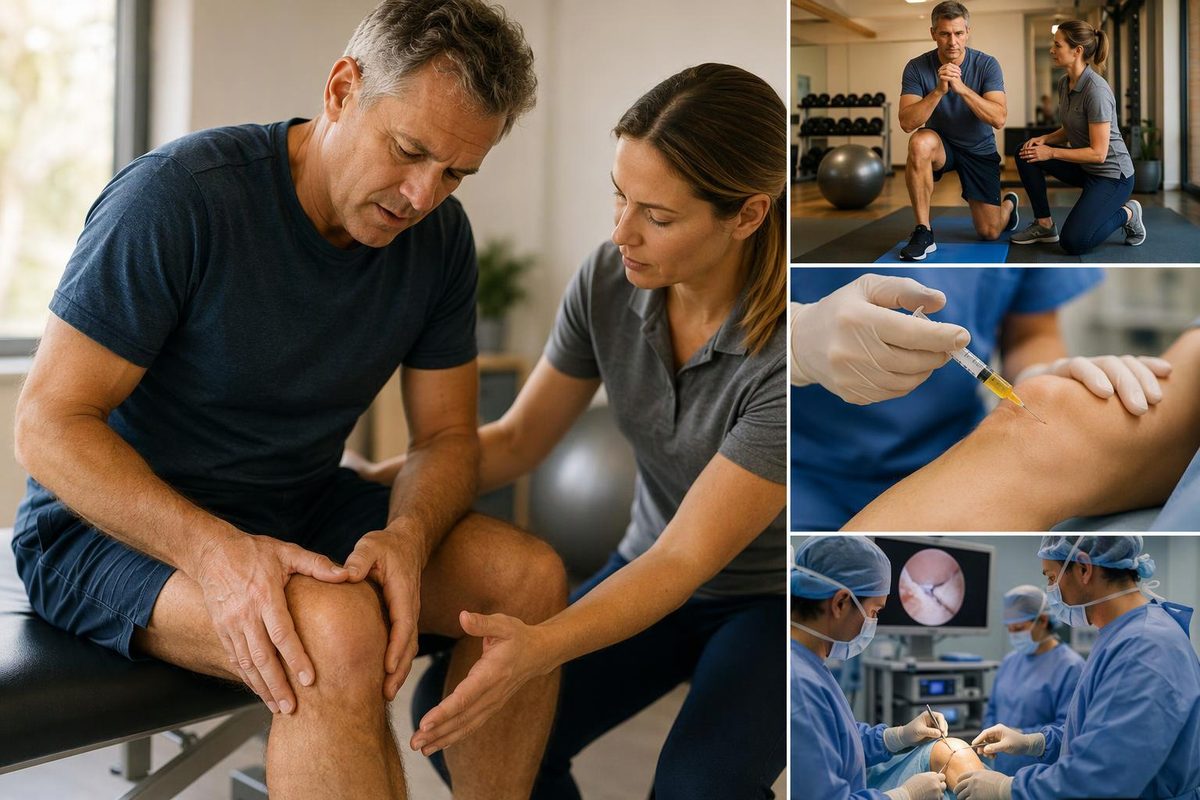
Treatment often starts with rehabilitation and symptom relief. Some tears need surgery to repair or trim the torn tissue, followed by rehabilitation. The important distinction is not simply whether a scan shows a tear. It is whether the tear is injury-related or degenerative, whether it blocks knee movement, and whether the tissue is suitable for repair.
Many tears do not need immediate surgery. But a newly injured knee with displaced tissue or a potentially repairable tear may need an early orthopedic assessment rather than a prolonged trial of home care. Treatment also depends on symptoms, activity goals and the condition of the rest of the knee. AAOS explains these treatment factors.
This guide explains the choices; it cannot determine which tear or treatment you have.
First, check whether waiting is appropriate
Seek urgent medical assessment if you cannot bend or straighten the knee—especially if it feels physically stuck—or cannot bear weight after an injury. Severe post-injury pain, swollen hot skin around the knee, or knee pain with fever also needs urgent assessment. A visibly deformed knee or new numbness or tingling in the knee, leg or toes after injury warrants emergency care. Do not force a stuck knee straight or exercise through it. These are reasons to check for problems beyond a meniscus tear, too. NHS guidance lists these warning signs.
Brief clicking or catching is not the same as a knee that remains locked. Tell the clinician exactly what happens: whether movement briefly hesitates, becomes painful, or is persistently blocked.
Which treatment path fits which situation?
| Situation confirmed by assessment | Usual treatment discussion |
|---|---|
| A degenerative tear related to wear over time, without a locked knee | Exercise-based physical therapy is generally the preferred starting treatment. |
| A recent, nondisplaced tear without a movement block | Rehabilitation may be appropriate, but whether the tear could benefit from repair matters. |
| A recent tear with displaced tissue restricting movement | Early surgical assessment may be needed. |
| Continuing symptoms despite an appropriate rehabilitation plan | Reassess the cause of pain and discuss whether surgery offers a meaningful benefit. Persistent pain alone does not establish that trimming will help. |
A degenerative tear can become symptomatic after a minor twist, so sudden symptoms alone do not establish which group you belong to. AAOS describes how tears develop.
The distinction matters because evidence for one group does not automatically apply to another. In the 2022 five-year ESCAPE trial, 321 adults aged 45–70 with degenerative tears were assigned to physical therapy or arthroscopic trimming. Physical therapy was not meaningfully worse for patient-reported knee function. The trial excluded locked knees, injuries requiring urgent surgery and severe osteoarthritis, so it does not settle those treatment decisions. Read the ESCAPE results and eligibility criteria.
For acute isolated tears—recent tears without associated knee injuries—the 2024 AAOS guideline supports rehabilitation as an option and advises considering early surgery for displaced tears that restrict movement or symptomatic tears that could benefit from repair. Both the rehabilitation option and early-surgery advice are based on expert consensus rather than strong trial evidence. The guideline does not cover degenerative tears, meniscal root tears or tears accompanying an ACL injury. See the AAOS guideline.
What nonsurgical treatment includes
Rehabilitation and activity adjustment
Physical therapy aims to improve movement, strength and day-to-day function. It is active treatment—not simply waiting to see whether the torn edges join together.
During the first few days after an injury, reduce aggravating activities and manage swelling. As symptoms allow, gentle movement replaces complete rest. A rehabilitation plan can then build strength and activity tolerance; a clinician may recommend crutches if weight-bearing needs to be reduced. NHS advice and AAOS guidance describe these measures.
Ask for a review point and functional goals: easier walking, better knee straightening, less swelling, or improved stair tolerance. The ESCAPE trial used 16 therapist-led sessions over eight weeks, but that is a studied program—not a deadline after which everyone needs surgery.
Once nonsurgical care is appropriate, our gentle meniscus exercise starting plan covers individual movements rather than treatment selection.
Pain relief and support
Cold packs wrapped in a towel, elevation and comfortable compression can help manage early symptoms. Remove a compression bandage or nonprescribed knee support when sleeping. Paracetamol/acetaminophen or an anti-inflammatory medicine may help pain; ask a pharmacist or clinician which is safe with your health conditions and other medicines, and follow the product instructions. NHS symptom-relief guidance includes these options.
A support may help comfort, but choosing one is separate from deciding whether a tear needs repair. See our meniscus brace guide for support selection.
Injections
A corticosteroid injection may reduce pain and swelling, but it does not repair the tear. It is a symptom-relief option, not a substitute for assessing displaced tissue or a repairable injury. AAOS explains the distinction.
Platelet-rich plasma, or PRP, is still being studied for meniscus tears. The AAOS guideline allows consideration of PRP as an addition to surgical repair, with a limited-strength option; that is different from showing that a stand-alone injection can replace rehabilitation or surgery. AAOS meniscus overview and acute-tear guideline.
If surgery is considered: repair versus trimming
Both procedures can be performed through arthroscopy, using a small camera and instruments inserted through small incisions.
Meniscus repair stitches the torn tissue together so it can heal. Suitability depends on tear pattern, blood supply and tissue quality, as well as cartilage wear and other patient factors. Repair preserves the knee’s cushioning tissue, but recovery is longer and may involve crutches and movement restrictions. A repair can fail and require further surgery.
Partial meniscectomy, often called trimming, removes damaged tissue rather than joining it together. It may be considered when symptomatic loose tissue has poor healing potential and cannot reasonably be repaired. Recovery is generally quicker, but the removed cushioning tissue is lost. When surgery is indicated for an acute tear, AAOS recommends preserving as much functional meniscus as possible to reduce osteoarthritis risk. AAOS repair guidance and tissue-preservation recommendation.
Surgical risks include infection, blood clots and stiffness. The faster recovery after trimming is therefore not, by itself, a reason to choose it over a suitable repair. AAOS lists repair complications. For practical timeline differences, see recovery by meniscus treatment.
Questions to take to your appointment
- Is this an acute injury, a degenerative tear, or a tear associated with another knee problem?
- Is the tear likely to explain my symptoms, or could arthritis or another injury be contributing?
- Is any tissue displaced, and is the tear repairable?
- If we try rehabilitation first, what goals and review point should we use—and would waiting reduce the chance of repair?
- If surgery is proposed, why repair or trim, what benefit is realistic, and what restrictions and risks should I expect?