
Lateral Collateral Ligament Tear: Treatment and Recovery
Understand LCL tear grades, how clinicians check knee stability, when surgery may be needed, and what recovery means for walking and sport.
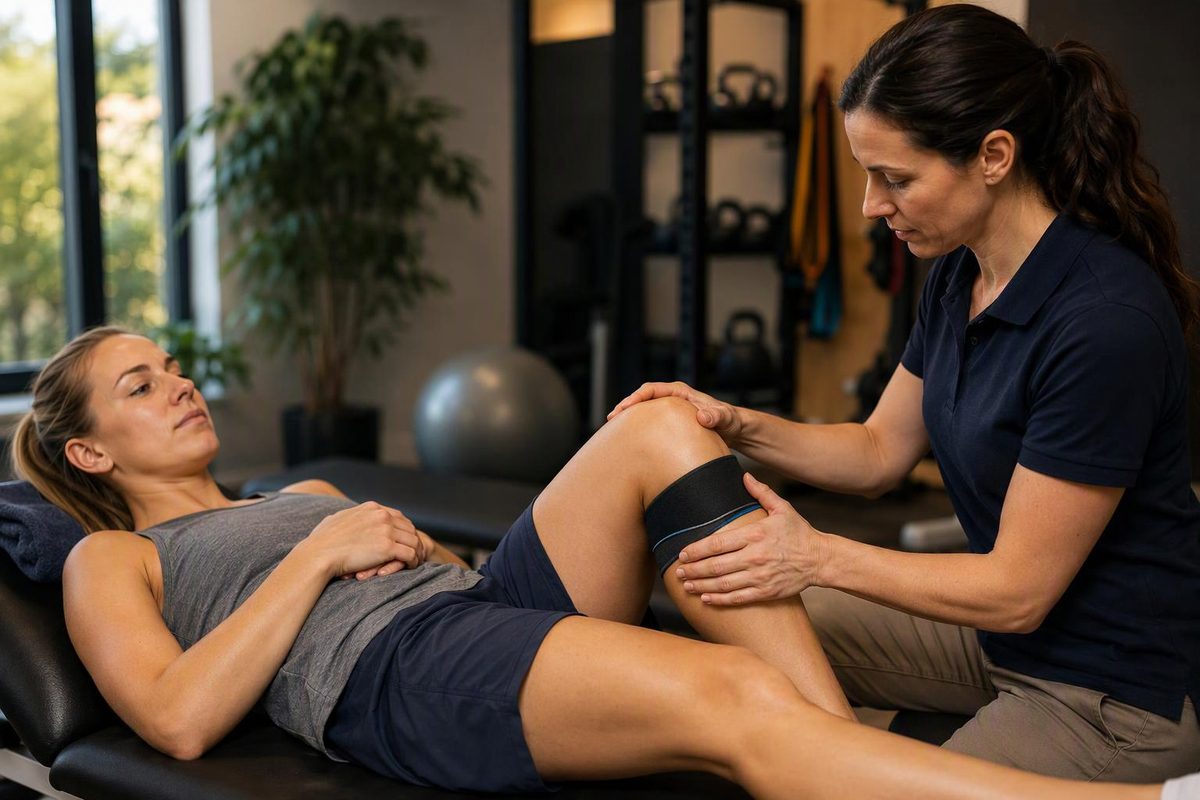
A tear in the lateral collateral ligament (LCL) injures the band connecting your thighbone to the fibula, the smaller lower-leg bone, on the outside of your knee. It helps control sideways movement. Stable, lower-grade LCL injuries can often recover without surgery; a complete tear or damage to other knee structures needs a more individualized plan. The important questions are how loose the knee is and whether the LCL is the only structure injured. AAOS explains these treatment distinctions.
Symptoms and when to seek care
An LCL injury may cause outer-knee pain, tenderness, swelling, stiffness and a feeling that the knee will give way. You may feel a pop during the injury. A typical mechanism is a blow to the inside of the knee that forces it outward. These clues suggest an injury worth examining—not an LCL diagnosis by themselves. AAOS
Arrange an assessment after a suspected ligament injury rather than testing it with a run or repeated sideways movements.
- Seek urgent assessment if the knee is very painful, you cannot bear weight or move it, it is badly swollen or has changed shape, or it locks or gives way. A hot, red knee with fever also needs urgent care. NHS knee-pain guidance
- Go to an emergency department immediately if your foot becomes cool, pale or changes color, or you develop numbness, weakness or difficulty moving your toes after the injury. Cleveland Clinic’s LCL guidance
What the tear grade means
“Sprain” and “tear” are not necessarily different diagnoses. A sprain describes a ligament injury; its grade describes severity.
| Grade | What it usually means |
|---|---|
| 1: mild | The ligament is stretched but intact and still helps keep the knee stable. |
| 2: moderate | A partial tear has loosened the ligament. |
| 3: severe | The ligament is completely torn or pulled off its attachment, with instability. |
These are the AAOS collateral-ligament classifications. Our knee sprain versus tear guide explains the terminology more broadly. Clinicians may also grade the looseness found during examination; that is not necessarily the same as the tear grade on MRI.
The grade is useful, but it is not the entire treatment decision. Clinicians also need to know whether nearby stabilizers are injured. These include the posterolateral corner, a group of structures at the back and outside of the knee that help control rotation. An isolated LCL injury and a combined injury can require different treatment even when the pain feels similar. Clinical study of isolated LCL injuries
How clinicians confirm an LCL injury
Assessment usually starts with how the injury happened, followed by examination of knee movement, tenderness and stability compared with the other knee. The clinician checks other ligaments and surrounding structures, not just the painful spot.
An X-ray cannot show the ligament tear itself, but it can reveal a piece of bone pulled off with the ligament. MRI shows the ligament and other knee tissues, helping identify the extent of damage and associated injuries. AAOS diagnosis guidance
An MRI label does not replace the stability examination. In a case series of 55 elite athletes with isolated LCL injuries, MRI severity and clinical looseness correlated poorly. The study supports considering both findings, rather than assuming that an MRI grade alone settles the need for surgery. Original study
Treatment: protection, rehabilitation or surgery
For stable Grade 1 or 2 injuries, nonsurgical care commonly includes temporary activity restrictions, a hinged knee brace, crutches when needed, and physical therapy to restore movement and strength. How much weight you can put through the leg—and how long you need support—should come from your treating clinician. Being able to take a few steps is not clearance for unrestricted walking. AAOS treatment guidance
While awaiting assessment, reduce loading and avoid running, pivoting or activities that make the knee buckle. A wrapped cold pack for up to 20 minutes can help with pain and swelling; do not apply ice directly to skin. NHS self-care guidance
Rehabilitation progresses from permitted movement to strength, balance and activity-specific tasks. In the elite-athlete study, weight-bearing and brace restrictions varied with clinical looseness, and rehabilitation was supervised by medical teams. Do not start a general knee-strengthening routine before you know your restrictions. Study rehabilitation protocol
Surgery may be recommended when the ligament has pulled off the bone, there are other ligament injuries, or the injury produces substantial instability. AAOS and the isolated-LCL study describe these indications. Options include repair, reattachment or reconstruction using a tissue graft. Cleveland Clinic
A complete tear deserves orthopedic assessment, but the word “complete” on a scan does not automatically determine the operation. Some athletes in the case series had complete tears on MRI but relatively little clinical looseness and were treated without surgery. This does not establish that nonsurgical care works for a severely unstable knee: only one athlete had Grade 3 clinical looseness. Original study
How long does recovery take?
Cleveland Clinic suggests that people with a mild Grade 1 injury may feel better in three to four weeks, while a Grade 2 partial tear may take eight to 12 weeks to recover. Treat these as broad estimates, not deadlines or automatic permission to return to sport. Cleveland Clinic
In the elite-athlete case series, the median return to competition after nonsurgical care was 76 days. That was a selected group with isolated injuries and medical-team supervision—not a prediction for every patient or for combined injuries. Original study
A complete tear, combined injury or surgical reconstruction needs its own recovery timetable. Progress should be based on restored movement, strength and knee stability, followed by a gradual return to the intended activity. Normal walking is a different milestone from running, cutting or contact sport. AAOS return-to-sport guidance
At your appointment, ask: Is this an isolated LCL injury? How stable is the knee? What are my weight-bearing and brace restrictions? What must I achieve before returning to my usual activities? Those answers make a recovery plan more useful than a grade or a week count alone.