
Exercises for a Torn Meniscus: A Gentle Starting Plan
Five exercises for nonsurgical meniscus rehabilitation, with movement cues, a cautious starting trial, pain checks and signs to seek care.
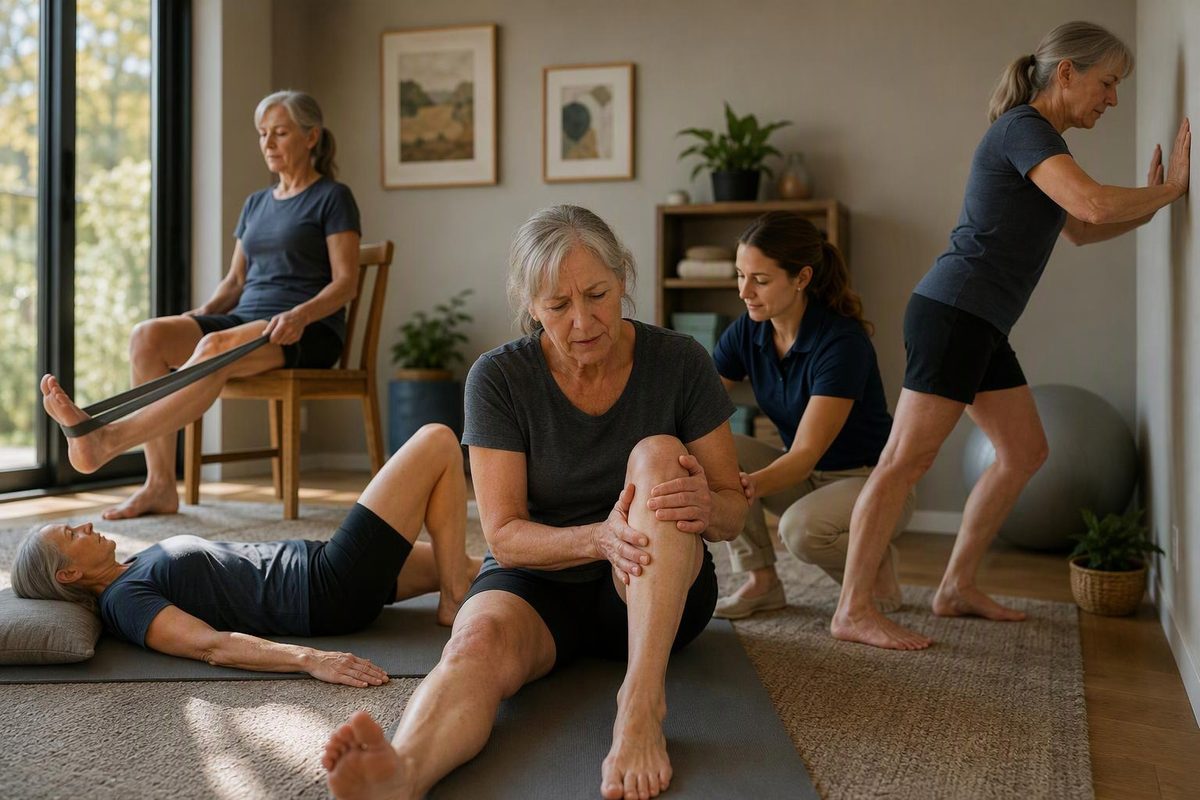
Exercises for a torn meniscus can start with comfortable knee movement and thigh-muscle activation, then progress to hip strengthening and controlled standing exercises. The aim is to improve movement, strength and daily function—not to guarantee that the torn cartilage rejoins. Healing and symptom improvement are different.
The exercises below are options to discuss with your physiotherapist for rehabilitation without surgery. They are not a post-operative protocol: after a meniscus repair or trimming procedure, follow your surgical team’s instructions on bending, weight-bearing and exercise. AAOS explains why rehabilitation differs by procedure.
Check whether home exercise is appropriate
Seek urgent assessment rather than exercising if you cannot bend or straighten your knee, cannot bear weight, have severe pain after an injury, or the knee is hot and swollen—particularly with fever or feeling unwell. A visibly deformed knee or new tingling or numbness after injury needs emergency assessment. Arrange a clinical review for repeated giving way or catching, recurrent swelling, worsening pain, sleep disruption or symptoms that are not improving. These are reasons to reassess the knee, not push harder through a routine. NHS guidance and the EU–US rehabilitation consensus support these checks.
After a fresh injury, rest from exercise and aggravating activities during the first few days. Then introduce gentle movement as symptoms allow; the NHS advises against completely stopping knee movement indefinitely. If the tear is only suspected, an assessment can help distinguish it from other knee injuries. NHS meniscus-tear advice.
Five exercise options
1. Heel slides
- Lie on your back on a bed or mat.
- Slowly slide the affected heel toward your buttock, bending the knee only as far as comfortable.
- Slide it away again to straighten the leg without forcing it.
Keep the movement smooth. Do not pull into deep bending or try to work through a catch. Heel slides are included among the beginner exercises in Oxleas NHS meniscal rehabilitation guidance.
2. Quad sets
The quadriceps are the muscles at the front of your thigh.
- Sit or lie with the affected leg straight and a small rolled towel under the knee.
- Tighten the thigh by gently pressing the back of the knee into the towel.
- Hold for about six seconds, then relax.
This activates the thigh without repeatedly bending the knee. MyHealth Alberta’s meniscus exercise guide includes this exercise.
3. Straight-leg raises
Try these only when you can keep the knee straight throughout the movement.
- Lie on your back with the unaffected knee bent and its foot flat.
- Tighten the affected thigh, keeping that leg straight.
- Lift the heel roughly 20–30 cm, pause briefly, then lower slowly.
If the knee bends as you lift, stay with quad sets and ask your physiotherapist about progressing. Do not add ankle weights initially. See the Alberta exercise instructions.
4. Side-lying leg raises
- Lie on your unaffected side, with your bottom knee bent for support.
- Keep the top leg straight and your hips stacked rather than rolling backward.
- Lift the top leg toward the ceiling, only as far as you can control.
- Lower slowly.
This works the hip muscles without a standing squat. Side-lying hip strengthening is included in Calderdale and Huddersfield NHS meniscal knee-pain guidance.
5. Sit-to-stand: a later step
Add this when standing and walking are comfortable enough and the earlier exercises do not aggravate symptoms.
- Use a stable, relatively high chair, secured against a wall.
- Place your feet hip-width apart, toes pointing forward.
- Lean forward slightly and stand slowly; use your hands if needed.
- Sit down under control, keeping your knees aligned with your feet.
Avoid dropping into the chair or twisting on a planted foot. Sit-to-stand is another option in the NHS meniscal exercise booklet.
Start small and let the knee’s response guide you
If your physiotherapist agrees these movements are suitable, a cautious first trial is one or two exercises, with three repetitions each. If comfortable, add one or two repetitions every few days. This approach is adapted from NHS inform’s general knee-exercise advice, not a validated torn-meniscus program. That guide directs people with a diagnosed condition to follow their healthcare professional’s advice. Use your prescribed repetitions, sets and frequency if you have them.
Muscle effort is expected; sharp joint pain, catching or increased swelling is not something to push through. Stop an exercise that increases knee pain or swelling and ask your physiotherapist before continuing. Check again the following morning: pain should be no worse overall. Do not progress if symptoms are worse. Oxleas guidance and NHS inform’s general symptom checks support this cautious approach.
Initially reduce deep squats, kneeling, pivoting, running and jumping if they aggravate the knee. These are temporary activity modifications, not necessarily permanent bans. Return to running or sport needs more than tolerating these five exercises: movement, swelling, strength and activity-specific control also matter. Meniscus rehabilitation guidance.
Exercise-based physiotherapy is a recommended first approach for symptomatic degenerative tears—changes that develop over time. Some injury-related tears also respond to rehabilitation, but evidence is more limited and certain tear patterns need earlier surgical consideration. A short home routine is a starting point, not a substitute for that treatment decision or a progressive rehabilitation plan. EU–US consensus.