
How to Do a Gentle Scalene Muscle Stretch
Anchor the shoulder and tilt your head away, stopping at a mild pull. Tingling, numbness, weakness, or pain traveling into the arm is not expected.
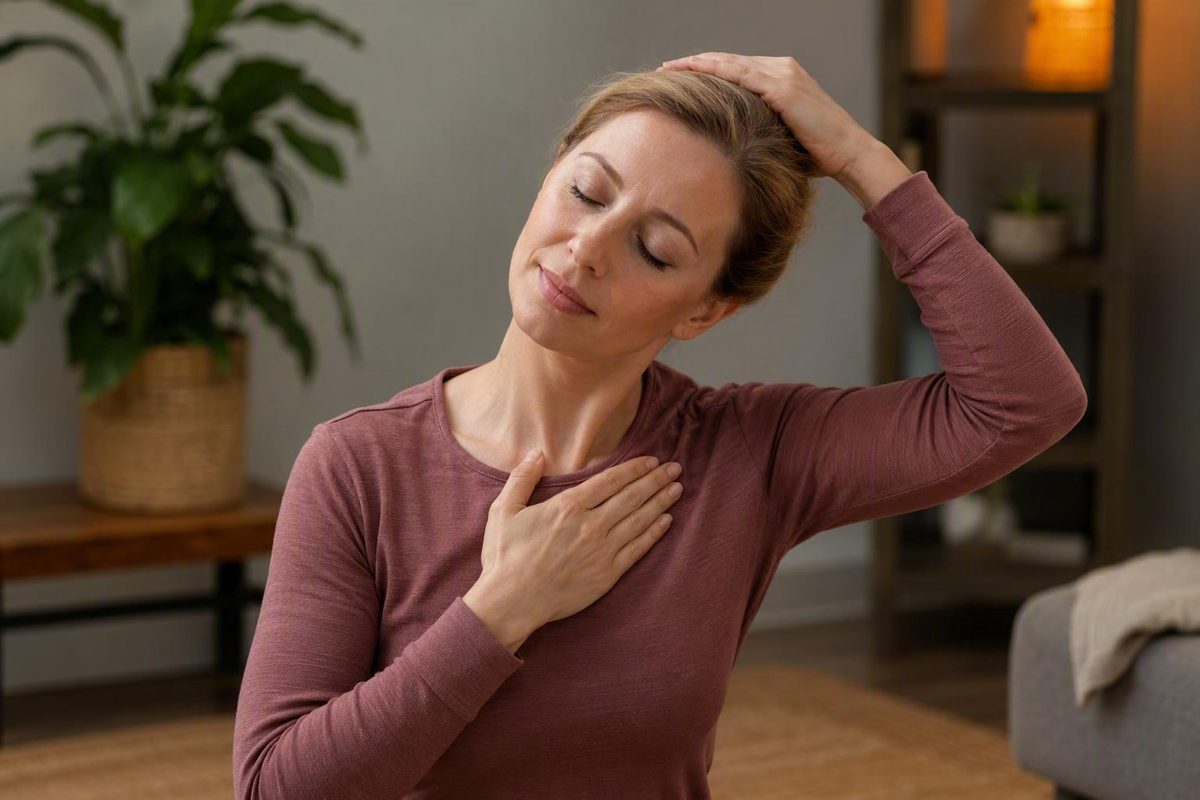
Before You Start: What a Safe Stretch Should—and Should Not—Feel Like
For a gentle scalene muscle stretch:
- Move slowly.
- Keep the shoulder on the side you want to stretch relaxed and down.
- Tilt your head away from that shoulder.
- Stop at a mild, local pull.
- Do not pursue maximum range or force the position.
The expected sensation is a controlled, tolerable stretch along the side or front-side of the neck. Depending on your anatomy and head position, you may feel it near—but generally above—the collarbone.
Stop the stretch immediately if it causes:
- Sharp or worsening pain
- Pressure or constriction in the throat
- Dizziness, faintness, or visual disturbance
- Difficulty breathing
- Numbness, tingling, or weakness
- Pain or other symptoms spreading into the shoulder, arm, or hand
Return your head slowly to neutral. Do not respond by pulling harder or trying a more extreme angle. Hospital neck-exercise guidance advises stopping an exercise if dizziness occurs and seeking professional advice when exercises are painful; applying that same conservative rule here is prudent (Cambridge University Hospitals).
Do not begin neck self-stretching after a recent accident, fall, head injury, or other neck trauma unless an appropriate healthcare professional has advised you to do so. Arrange medical assessment for sudden, severe, or worsening neck pain; pain accompanied by fever or feeling seriously unwell; or persistent arm or hand numbness, tingling, or weakness. Neck pain following an accident or head injury also warrants professional assessment (Goodpath).
This article is for general education. It cannot determine whether your scalenes are responsible for your symptoms or whether stretching is appropriate for a particular injury, diagnosis, previous procedure, or medical condition.
Scalene Anatomy in Plain Language
The scalenes are three paired muscles, with one set on each side of the neck:
- Anterior scalene
- Middle scalene
- Posterior scalene
They run from the cervical vertebrae toward the upper ribs. The anterior and middle scalenes attach to the first rib, while the posterior scalene attaches to the second. Together, they contribute to neck movement and stability and can help elevate the upper ribs during inhalation, particularly when breathing demands increase (anatomy overview).
This arrangement helps explain why a scalene stretch may be felt along the side or front-side of the neck and near the upper collarbone region. The muscles span the area between the neck and the top of the rib cage rather than ending at the top of the shoulder.
The scalene region is anatomically crowded. Nerves supplying the upper limb and a major blood vessel pass through this area. That does not mean an ordinary stretch will injure these structures, but it supports a conservative approach:
- Use low force.
- Do not dig into the lower neck.
- Avoid deep pressure immediately above the collarbone.
- Stop if the movement produces spreading arm symptoms.
Feeling a stretch in the right general area does not prove that you have isolated one scalene. Muscle names help describe an exercise, but the body does not divide movement neatly into one tissue at a time.
The Beginner Seated Scalene Stretch: Step by Step
A seated stretch is a practical starting point because the chair helps stabilize your trunk and gives the target-side hand somewhere to rest or anchor. Begin without pulling on your head.
Stretching the right side
-
Choose a stable chair. Sit with both feet comfortably on the floor. Move away from the backrest if that makes it easier to remain upright.
-
Center your head. Look straight ahead, with your chin level rather than pushed forward or tucked forcefully down.
-
Anchor the right side lightly. Hold the side of the chair with your right hand. Alternatively, rest that hand behind your lower back if the position is comfortable. Do not wrench the arm into place.
-
Relax the right shoulder downward. Do not force it toward the floor. The aim is simply to keep it from rising as your head moves.
-
Tilt your head to the left. Slowly bring your left ear toward your left shoulder. Keep your face approximately forward at first.
-
Stop at a mild pull. The stretch may be felt along the right side or front-right side of your neck. Do not lift the left shoulder toward your ear or continue until the sensation becomes intense.
-
Optionally adjust the emphasis. If the basic position remains comfortable, turn your face only slightly toward the right—the side being stretched—and add a very small upward gaze. This is a commonly described anterior-emphasis cue, not a requirement or proof that you have isolated the anterior scalene (BSR Physical Therapy).
-
Hold without bouncing. Keep breathing normally. Your jaw, throat, hands, and opposite shoulder should remain relaxed.
-
Return in stages. Undo the optional upward gaze and rotation first. Then bring your head gently back to the center and pause in neutral.
Stretching the left side
Reverse every direction:
- Sit upright with your head centered.
- Hold the chair lightly with your left hand or place that hand comfortably behind your back.
- Relax the left shoulder downward.
- Bring your right ear toward your right shoulder.
- Stop when you feel a mild pull along the left side or front-left side of your neck.
- If comfortable, turn your face slightly left and add a very small upward gaze.
- Hold without bouncing while breathing normally.
- Undo the optional adjustment first, then return slowly to neutral.
The hand holding the chair is an anchor, not a lever. You do not need to place the opposite hand on your head. If you use it, let it provide a light directional cue rather than force. Cambridge University Hospitals likewise tells readers not to pull on the head during one of its seated neck stretches.
| Side being stretched | Hand or shoulder anchor | Direction of side bend | Optional rotation and gaze | Expected stretch location |
|---|---|---|---|---|
| Right | Right hand holds the chair or rests behind the back; right shoulder stays relaxed | Left ear moves toward left shoulder | Small turn toward the right with a slight upward gaze | Right side or front-right side of neck, sometimes just above the collarbone |
| Left | Left hand holds the chair or rests behind the back; left shoulder stays relaxed | Right ear moves toward right shoulder | Small turn toward the left with a slight upward gaze | Left side or front-left side of neck, sometimes just above the collarbone |
The two sides do not have to move equally. Stop each side according to its own comfortable range rather than forcing the positions to look symmetrical.
Does Head Position Target the Anterior, Middle, or Posterior Scalene?
Exercise instructions often change the direction of the face, chin, or gaze to alter the emphasis of a side-neck stretch. These labels can help organize the variations, but the available guidance does not establish that any position reliably isolates one scalene.
Neutral gaze: general or middle-scalene emphasis
Begin with the basic ear-to-shoulder movement:
- Keep the target-side shoulder relaxed or lightly anchored.
- Tilt the head away.
- Keep the nose facing approximately forward.
- Stop at a mild side-neck stretch.
This is the simplest option and is sometimes labeled a middle-scalene stretch. It is also a general lateral-neck stretch that may involve the upper trapezius and other tissues. That overlap is expected rather than proof that your technique is wrong.
Slight turn toward the target side: anterior emphasis
For one commonly described anterior-emphasis variation:
- Establish the gentle side bend first.
- Turn your face slightly toward the side being stretched.
- Add only a small upward gaze if it remains comfortable.
For example, to stretch the right side, tilt left and then turn the face slightly right and upward. An athletic-therapy guide describes a similar right-sided position and places the expected sensation at the front-right side of the neck (INSAHYU).
Keep the adjustment small. If the added rotation or upward gaze creates pinching, throat discomfort, dizziness, or a nonlocal sensation, return to the neutral-gaze side bend.
Published instructions are not fully consistent about the rotation used for an anterior stretch. Some direct the face toward the stretched side, while other named variations use a different relationship between head rotation and the anchored arm. Because the instructions conflict and precise isolation has not been demonstrated, treat rotation as an optional comfort-based adjustment—not a mandatory angle.
Downward diagonal: reported posterior emphasis
A position sometimes labeled a posterior-scalene stretch brings the head forward and diagonally toward the opposite armpit. For a right-sided version:
- Keep the right shoulder relaxed or lightly anchored.
- Turn and lower your face toward the left armpit.
- Use a small range and do not pull forcefully.
A clinic guide calls this the “smelling the opposite armpit” variation, but it does not establish that the position selectively stretches or treats the posterior scalene (361 Clinic).
For beginners, the neutral-gaze side bend remains the clearest default. Return to it if rotation, looking upward, or moving diagonally downward causes pinching, throat discomfort, dizziness, a worsening headache, arm symptoms, or any sensation that is not mild and local.
You do not need to identify exactly which scalene feels tight before using a conservative general stretch.
Standing, Lying, and Low-Mobility Modifications
The best variation is not the one that creates the greatest range. It is the one that lets you remain stable, breathe comfortably, and feel a mild local stretch without forcing your neck.
Standing version
A standing scalene muscle stretch uses the same basic sequence:
- Stand with your feet comfortably apart.
- Keep your trunk upright.
- Let the shoulder on the target side relax downward.
- Tilt your head gently away from that side.
- Keep your gaze neutral, or add only a small optional turn and upward gaze.
- Hold without bouncing, then return slowly to the center.
You can rest the target-side hand against your thigh or comfortably behind your back, but do not pull the arm aggressively downward. If standing makes you sway, twist, or lose track of your shoulder position, use a chair instead.
Supported lying version
Lying on your back can reduce the effort needed to hold the trunk upright:
- Lie on a supportive surface with your head comfortably supported.
- Relax both shoulders.
- Keep your chin in a natural position.
- Allow a small head tilt away from the side you want to stretch.
- Stop at a mild side-neck pull.
- Return to the center before repeating.
Do not pull on your head. If the pillow or surface forces your neck too far forward or backward, adjust the support or choose the seated version. Both seated and supine variations appear in general scalene-stretch guidance (Mind Body Spine).
Low-mobility version
If your neck has limited comfortable movement, simplify the exercise:
- Use only a few degrees of side bending.
- Keep your face forward.
- Do not lift your chin.
- Leave both hands relaxed rather than adding pressure.
- Start with a shorter hold.
- Return to neutral if the sensation stops feeling mild and local.
Begin without an assisting hand. Add light manual guidance only if you can keep the movement gentle and controlled; it should not be needed to overcome resistance or force a restricted range.
Some practitioner material describes a clinician-assisted technique that anchors the lower scalene region while arm movement rotates the upper ribs. The available description does not provide a complete self-administration protocol, so do not try to reproduce that upper-rib mobilization as an unsupervised self-stretch. It is different from the low-force neck movement described here.
How Long to Hold the Stretch and How Often to Do It
A conservative starting dose is:
- Hold: 15–30 seconds
- Repetitions: 2–3 per side
- Effort: Mild, never maximal
- Rest: Return to neutral between repetitions
Beginners and people with limited mobility should start at the low end. A short hold in a small, comfortable range is preferable to a longer hold that becomes painful or increasingly intense. One orthopedic exercise guide uses a 30-second hold for 2–3 repetitions, although that prescription should not be treated as a universal dose for every person or condition (Summit Orthopedics).
Published recommendations vary. Available exercise pages describe holds of roughly 10–30 seconds, while frequency suggestions range from several sessions per week to once or twice daily.
During each hold:
- Breathe normally rather than forcing a deep breath.
- Keep the jaw and throat relaxed.
- Do not bounce.
- Check that the sensation stays mild and local.
- Return fully to neutral before the next repetition.
If the stretch causes pain during the movement or leaves your neck noticeably more irritated afterward, stop or reduce the range, hold time, and number of repetitions. Omit rotation and the upward gaze before trying to increase any other part of the exercise. If symptoms are substantial, unusual, spreading, or worsening, seek appropriate guidance rather than repeatedly retesting the stretch.
More force is not a useful progression. The first goal is simply to perform the movement slowly and comfortably while breathing normally. Do not progress by adding aggressive rotation, neck extension, or hand pressure.
Research on broader neck-stretching programs should not be interpreted as proof that this exercise works by itself. A study summarized by BSR Physical Therapy involved 125 women with ongoing neck pain and used a routine containing four neck stretches. Any improvement therefore cannot be attributed specifically to the scalene stretch.
Common Mistakes That Make the Stretch Too Aggressive
Shrugging the target-side shoulder
Reset: Return your head to neutral, let that shoulder relax downward, lightly hold the chair, and restart with a smaller side bend.
Pulling hard on the head
Strong hand pressure can turn a mild movement into a forced stretch before you have time to judge the response.
Reset: Remove the assisting hand and move your head under its own control. If you later add a hand, use it only as a light guide.
Bouncing
Repeated bouncing makes the movement harder to control and is unnecessary for this stretch.
Reset: Enter the position gradually, remain still while holding it, and return slowly to neutral.
Forcing the chin upward
A small upward gaze may alter the front-side emphasis, but it is optional.
Reset: Keep the chin level and establish a comfortable side bend first. Omit the upward adjustment if it causes pinching or discomfort.
Using a large rotation
Trying to look fully over the shoulder is unnecessary.
Reset: Reduce the turn to a barely noticeable adjustment or omit it completely. The neutral-gaze variation is still a valid general side-neck stretch.
Arching or twisting the torso
Leaning the chest, rotating the rib cage, or arching the lower back can create the appearance of more range without giving you better control of the neck movement.
Reset: Keep your breastbone facing forward and your trunk quiet. Use a chair or wall for positional feedback if needed.
Holding the breath
Reset: Reduce the range until you can breathe naturally throughout the hold.
Trying to stretch through throat or arm symptoms
Throat pressure, pinching, dizziness, breathing difficulty, numbness, tingling, weakness, or symptoms traveling into the arm should not be addressed by trying a stronger angle.
Reset: Return gently to neutral and stop. Seek professional guidance if symptoms persist, spread, recur, or worsen.
Pressing deeply above the collarbone
Do not apply deep trigger-point pressure or dig into the soft tissues immediately above the collarbone. Important nerves and blood vessels pass through the scalene region, and the available commercial massage guidance does not provide enough safety detail to support unsupervised deep pressure there.
Forcing the tighter side to match
Unequal range does not explain why the difference exists, and it does not justify forcing the more restricted side.
Reset: Give each side its own comfortable stopping point. Discuss persistent or substantial asymmetry with a qualified clinician, particularly when it accompanies pain or neurological symptoms.
What Scalene Stretching Can—and Cannot—Tell You About Symptoms
A scalene muscle stretch may be one component of broader care for ordinary neck tightness. Depending on the person, a broader approach may also include:
- Changing position regularly
- Taking movement breaks during sustained desk work
- Restoring comfortable general neck motion
- Strengthening the neck, shoulder, or upper-back region
- Temporarily modifying aggravating activities
- Obtaining professional assessment when symptoms persist or do not fit a simple muscular pattern
Prolonged slouching or a forward-head position may accompany neck tightness during sustained desk work. That association does not prove that posture damaged the scalenes or that these muscles caused an individual’s pain. Posture is only one variable, and no single sitting position explains every case of neck discomfort.
Stretching cannot diagnose the source of symptoms. Feeling pulling along the side of the neck does not prove that the scalenes were “short,” while feeling no stretch does not necessarily mean they are normal.
The available pain-reduction finding concerns a multi-stretch neck routine, not the scalene stretch in isolation. It should not be used to claim that this one exercise reduces pain by itself.
Do not use the stretch as a claimed treatment for thoracic outlet syndrome, impaired circulation, altered nerve function, breathing problems, or headaches. The available scalene-specific instructions do not demonstrate that self-stretching corrects those conditions. Arm tingling, numbness, weakness, or radiating pain should not be self-diagnosed as “tight scalenes.”
Arrange medical assessment for:
- Sudden, severe, or worsening neck pain
- Persistent pain, tingling, numbness, or weakness in an arm or hand
- Neck pain accompanied by fever or other systemic illness
- Pain that began after an accident, fall, blow to the head, or other trauma
- Symptoms that are unusual, spreading, or progressively worsening
Use this practical decision rule:
Continue only while the response is mild, local, controlled, and settles normally. Stop and seek appropriate guidance when symptoms are unusual, spreading, persistent, severe, or worsening.
Frequently Asked Questions
Which way should I tilt my head to stretch the right scalene muscles?
Tilt your head to the left, bringing your left ear gently toward your left shoulder while keeping your right shoulder relaxed or lightly anchored.
Begin with your face forward. If the sensation remains mild and local, you may turn your face slightly toward the right and add a very small upward gaze for an anterior-emphasis variation. Rotation is optional; omit it if it causes discomfort, pinching, dizziness, throat pressure, or arm symptoms.
Where should a scalene muscle stretch be felt?
Expect a mild pull along the side or front-side of the neck on the side being stretched, sometimes just above the collarbone. For a right-sided stretch, that means the right side or front-right side of the neck.
It should not produce sharp pain, throat pressure, dizziness, breathing difficulty, numbness, tingling, weakness, or symptoms traveling into the arm.
How long should I hold a scalene stretch?
A conservative starting point is 15–30 seconds for each comfortable hold, with 2–3 repetitions per side. Return your head to neutral between repetitions. Clinic exercise instructions commonly fall within this range, but no single dosage has been established for everyone (Transform Chiropractic).
Start at the low end if you are a beginner or have limited mobility. Stop or reduce the range, duration, and repetitions if the stretch causes pain or increased irritation.
Can I isolate the anterior, middle, and posterior scalenes?
Different head positions are commonly labeled as anterior-, middle-, or posterior-scalene variations, but the available exercise instructions do not validate precise isolation.
A neutral ear-to-shoulder movement is the simplest general variation. A slight turn toward the stretched side with a small upward gaze is often used for anterior emphasis. A downward diagonal toward the opposite armpit is sometimes described as posterior emphasis. Each can also involve other neck tissues, so treat the names as approximate cues rather than proof that one muscle has been isolated.
Should I stretch if I have arm tingling, numbness, or weakness?
Do not continue stretching through those symptoms. Tingling, numbness, weakness, or pain traveling into the arm is not an expected sign of an effective scalene stretch.
Persistent arm or hand neurological symptoms warrant medical assessment, particularly if they are worsening, appeared after trauma, or occur with severe neck pain or systemic illness. Do not try progressively stronger stretches or deep pressure near the collarbone in an attempt to correct them yourself.
A Compact, Repeatable Protocol
Anchor or relax the shoulder on the side you want to stretch, then tilt your head gently away. Keep your face forward at first. If the response remains mild and local, add only a small optional turn toward the stretched side with a slight upward gaze.
Hold for 15–30 seconds, breathe normally, and return slowly to neutral before repeating. Use 2–3 comfortable repetitions per side as a conservative starting point rather than a universal prescription.
Comfort and control matter more than range. Named head positions may change the emphasis, but they do not reliably isolate individual scalenes. Dizziness, throat pressure, breathing difficulty, spreading neurological symptoms, severe or worsening pain, or symptoms following trauma call for stopping and seeking appropriate assessment—not a stronger stretch.