
Knee Pads for Osgood-Schlatter: Pad vs Patellar Strap
Soft pads shield the tender tibial bump from kneeling and contact; patellar straps are optional for running pain. Fit checks, evidence limits, red flags.
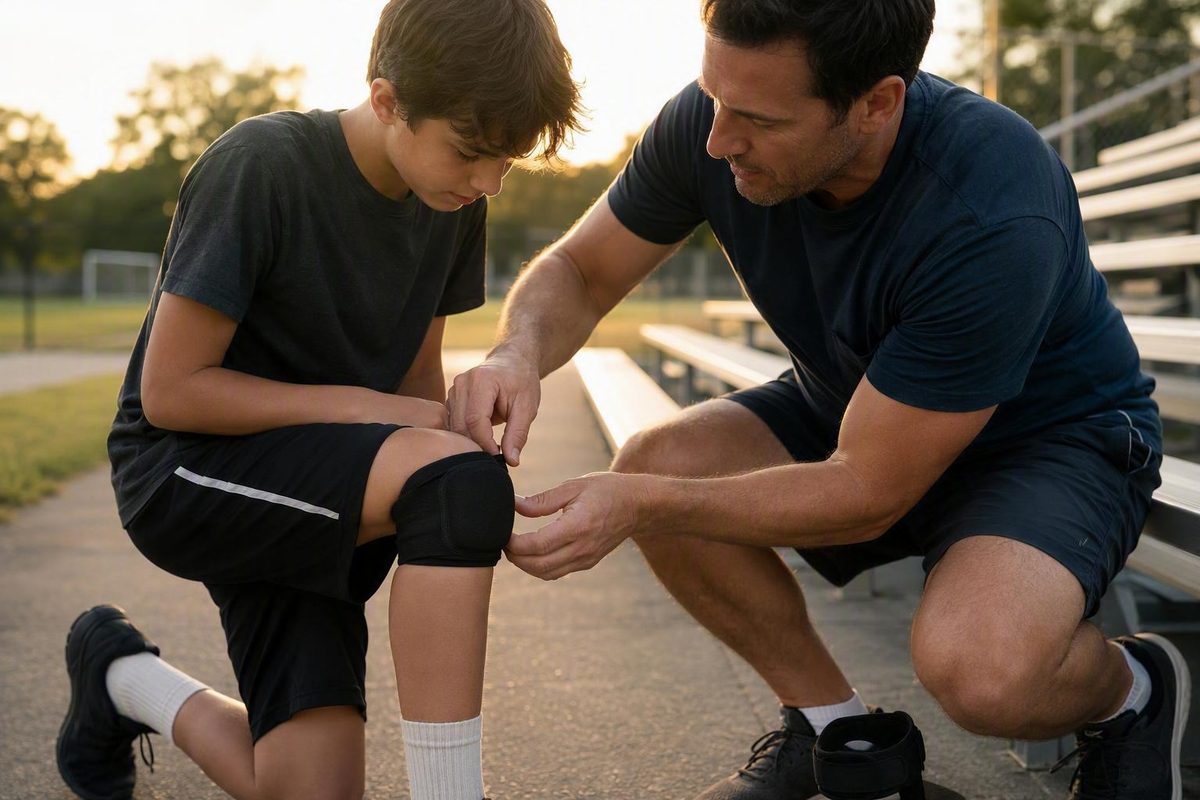
Choose a soft protective knee pad when kneeling, falls, floor contact, or collisions irritate the tender bump below the kneecap. Consider a patellar tendon strap when running or jumping is the main trigger; it may reduce activity-related pain for some athletes, with no guarantee. The two do different jobs, and the guidance reviewed here does not establish that either one heals Osgood-Schlatter disease or shortens its course (HealthyChildren.org guidance on Osgood-Schlatter disease).
Pick the main pain trigger and tick any warning signs; the matching support is highlighted below.
Match a Support to the Pain Trigger
Best match
Soft protective knee pad
Cushions the tender bump against a mat, floor or opponent. Pediatric guidance names wrestling, football, volleyball and basketball.
Protection only. It is not shown to heal the condition, and it may not help pain driven by running or jumping.
With any support: cut the duration, frequency or intensity of the activity that provokes significant pain.
The Four Supports Compared
Soft knee padMatch
Matched to: kneeling, falls, floor or player contact
Limits and source
Pediatric guidance describes knee pads as protection against direct trauma and names wrestling, football, volleyball and basketball.
Not shown to heal the condition or shorten its course. May not help pain caused mainly by running or jumping. Source: HealthyChildren.org.
Patellar tendon strapMatch
Matched to: running, jumping, sport without direct impact
Limits and source
Low profile and less bulky than a full brace. May reduce pain for some athletes.
Relief is not guaranteed. An ideal design, exact pressure and universal fit have not been established, so follow the instructions for the exact model. Source: HealthyChildren.org.
Compression sleeveMatch
Matched to: general coverage, light padding against minor bumps
Limits and source
Osgood-Schlatter-specific effectiveness is uncertain. A padded front can do two jobs, but that does not show it works better than a simple impact pad.
Compression is not shown to speed healing. No figure for benefit: —
Larger or hinged braceMatch
Matched to: a separately assessed need for more structure
Limits and source
Bulkier and not established as superior for routine symptoms. Check league or school rules on hard, exposed or hinged parts.
Not equivalent to clinician-directed immobilization; for severe cases AAOS describes a cast or cast brace. Source: AAOS OrthoInfo.
Sources: HealthyChildren.org and AAOS OrthoInfo guidance cited in the article. The guidance does not rank these supports against each other, so this tool does not either. General education, not a diagnosis.
A Pad Shields the Bump, a Strap Is an Optional Aid for Running Pain
A protective pad puts cushioning between the painful tibial bump and a mat, floor, opponent, or other source of direct contact. It fits the athlete who can run reasonably comfortably but gets tenderness when kneeling, falling on the knee, or being struck there. The pediatric guidance specifically mentions impact protection in wrestling, football, volleyball, and basketball.
A patellar tendon strap is a smaller support worn below the kneecap. It may help reduce pain, but the benefit is not guaranteed, and the available guidance does not establish an ideal design. It is an optional aid for activity-related discomfort, not protection from direct trauma.
If kneeling during wrestling practice is the problem, padding is the more direct match. If repeated running and jumping provoke discomfort without direct impact, a strap is worth discussing with a clinician or physical therapist as an optional comfort aid.
Whatever feels better, relief from a support is not proof that the irritated area has healed. Do not use one to conceal increasing pain or to preserve a training schedule that aggravates the knee.
Four Products Get Sold as Knee Pads, and They Are Not Interchangeable
Shoppers use “knee pad” for impact pads, patellar straps, compression sleeves, and larger braces. Each is built for a different task.
| Support | Matched To | Main Limit |
|---|---|---|
| Soft knee pad | Kneeling, falls, floor or player contact | Protection only; may not help running pain |
| Patellar strap | Running, jumping, sport | Relief not guaranteed; no ideal design established |
| Compression sleeve | General coverage, light padding | Osgood-Schlatter benefit uncertain |
| Larger or hinged brace | A separately assessed need for structure | Bulkier; not shown superior |
The first two rows come from pediatric guidance: knee pads are described as protection against direct trauma, while a patellar tendon strap may reduce pain for some athletes. For severe symptoms, AAOS describes clinician-directed immobilization with a cast or cast brace, not an ordinary sports brace (AAOS guidance on overuse injuries in children).
Comparative clinical superiority among pads, straps, sleeves, and larger braces has not been established by the evidence supporting this guide. That is why there is no “best brace” ranking here. Choose by symptom trigger, intended activity, fit, and professional advice.
A sleeve with a padded front may do two practical jobs, but that does not establish that it works better than a simple impact pad. A larger brace may look more substantial without being more appropriate. More material, straps, or hinges do not automatically mean better Osgood-Schlatter support, and compression should not be read as speeding up healing.
Osgood-Schlatter Pain Sits on the Tibial Tubercle
The pain is typically centered on the tibial tubercle, the prominent bump on the upper shinbone just below the kneecap. The bump may be painful, tender, swollen, or enlarged, and symptoms may occur in one or both knees, according to the HealthyChildren.org guidance.
Symptoms commonly worsen with running and sprinting, jumping and landing, kneeling, repetitive sports participation, growth spurts, and direct contact with the bump. An NHS patient leaflet describes localized pain and swelling at the tibial tuberosity, commonly aggravated by sport, growth spurts, and kneeling.
The condition generally develops gradually in an active, growing child or teenager rather than beginning with one clear traumatic event.
The American Academy of Orthopaedic Surgeons distinguishes front-and-center adolescent knee pain from pain in the upper shinbone just below the kneecap, the characteristic location of Osgood-Schlatter disease (AAOS guide to adolescent anterior knee pain).
Location is a useful clue, not a diagnosis. Do not label new pain as Osgood-Schlatter disease if it began after a fall, twist, collision, or forceful movement. Other injuries can affect the front of a young athlete’s knee and may need different management.
Buy by Fit, Sport Rules, and the Model’s Own Instructions
Define the job first, then check the product against it.
For direct-impact cushioning, the padding has to cover the tender area during the actual activity. Check that its shape and bulk allow the movements the sport requires, and that it works with the uniform and any other protective equipment.
For running and jumping, consider a low-profile patellar tendon strap before assuming a full brace is necessary. Follow the exact manufacturer’s measurement, sizing, placement, and use instructions. Do not transfer placement, pressure, or wear-time instructions from another strap model, because none of those are standardized in the guidance.
For any support:
- Sizing: Use the manufacturer’s size chart for the exact model.
- Skin contact: Look at where seams, edges, pads, and straps will sit against the tender bump.
- Sport compatibility: Check whether the support interferes with kneeling, sprinting, uniforms, or other equipment.
- Rules: Ask the team, league, school, or governing body whether hard, exposed, or hinged components are permitted.
Ask a clinician or physical therapist for fitting help if the instructions are unclear or the support causes concerning symptoms.
Treat phrases such as “stabilizes the condition,” “redistributes force,” “controls tendon tension,” or “reduces swelling” as marketing claims unless credible independent evidence backs them for that product and this condition. Price, popularity, and the number of structural components do not establish clinical effectiveness.
A Support Does Not Replace Cutting the Training Load
If a pad or strap makes practice tolerable but pain becomes progressively stronger during or after sessions, the provoking training load still needs attention.
The practical first step is to reduce the duration, frequency, or intensity of activities that cause significant symptoms and to introduce rest periods. That might mean fewer jumps, shorter running sessions, reduced practice time, or less repeated kneeling. When pain is severe, a more substantial reduction or a temporary break from the provoking sport may be needed, per the AAOS overuse guidance.
Ice after activity is one commonly recommended symptom-management option. Put a cloth or other barrier between the ice pack and the skin to reduce the risk of an ice burn.
Flexibility and strengthening may also form part of broader management. Depending on the athlete’s assessment, a program may include quadriceps and hamstring flexibility, hip strengthening, quadriceps strengthening, balance and knee-alignment practice, and a gradual reintroduction of sport-specific activity.
An NHS children’s physiotherapy program includes hamstring and hip-flexor stretches, hip and quadriceps exercises, bridges, and single-leg balance. Its repetition and daily-frequency fields are left blank for individual completion, so it does not provide a universal exercise dose (University Hospitals Dorset Osgood-Schlatter exercise program).
Activity should increase gradually after symptoms settle. A support that makes activity more tolerable is not, by itself, a reason to restore the previous training load.
Signs That Call for Assessment Before Any Purchase
Arrange an assessment when pain:
- Persists after reducing the activities that provoke it
- Repeatedly limits training or competition
- Interferes with walking or ordinary daily activities
- Follows a distinct fall, twist, collision, or forceful movement
Substantial swelling after an injury, locking, or giving way should not be managed solely by purchasing a pad or brace. These features warrant clinical evaluation.
Severe Osgood-Schlatter symptoms that interfere with walking or daily activity may occasionally require immobilization under a clinician’s direction. AAOS describes a cast or cast brace as an option in severe cases. An ordinary sports brace is not a substitute for prescribed immobilization.
This is general education, not a diagnosis or an individualized treatment plan.
Symptoms Usually Ease as Growth Slows, on No Fixed Schedule
Symptoms commonly improve as growth slows or ends, but individual timelines vary, and the sources used here give no figure for how long that takes. Neither a pad nor a strap is shown to change that timeline.
Both Knees Can Be Involved
Osgood-Schlatter disease may affect one or both knees, according to pediatric guidance. A pad or strap chosen for one knee follows the same trigger logic on the other.
The Bump Can Stay After the Pain Settles
The tibial tubercle can remain prominent after symptoms improve and the adolescent growth spurt ends, according to AAOS guidance. Persistent tenderness, increasing swelling, renewed activity limitations, or pain after a new injury should be assessed rather than automatically attributed to the existing bump.