
Brace for Inside Knee Pain: Which Type Makes Sense?
Compare sleeves, hinged braces and medial unloader braces for inside knee pain, with guidance on when to seek care and how to check fit.
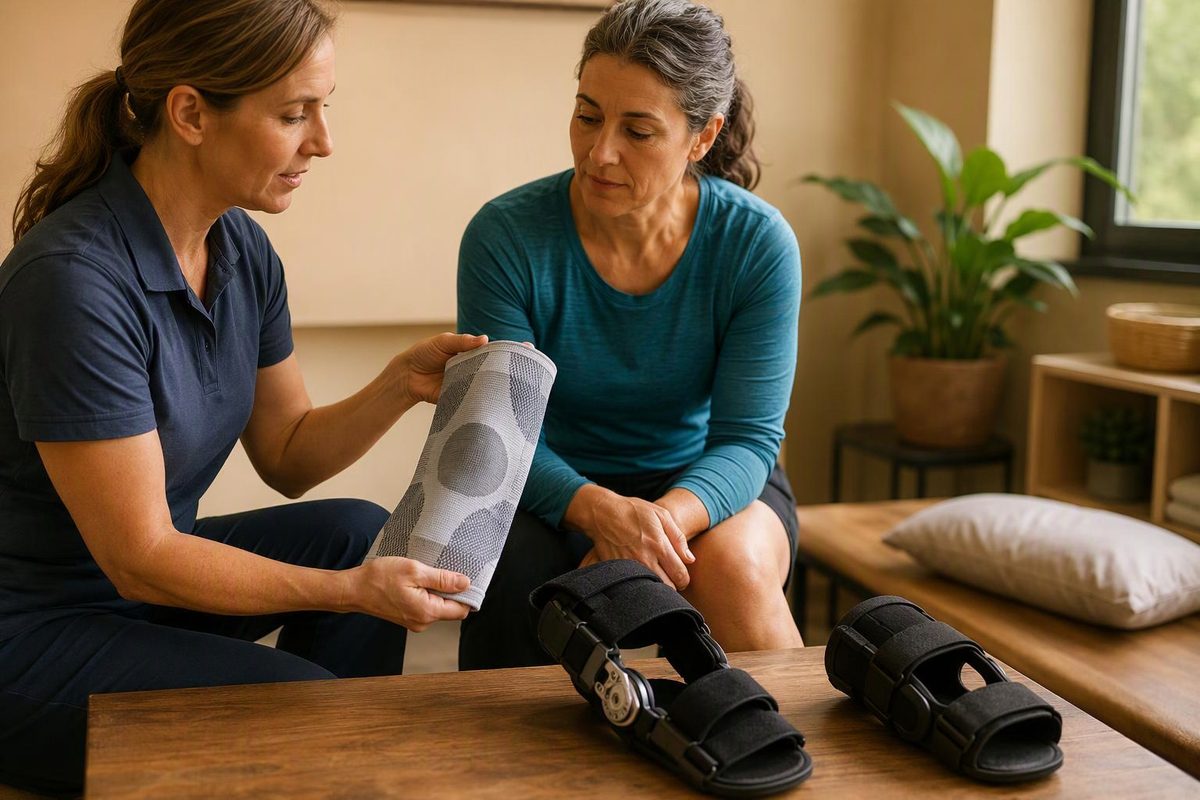
There is no single best brace for inside knee pain. A compression sleeve provides a gentle squeeze; a hinged brace can protect an injured ligament; an unloader brace can shift pressure away from arthritis affecting the inner part of the joint. These are different jobs—not simply levels of “better” support.
The inside of the knee is called the medial side. Pain there does not identify the cause by itself, so the sensible first question is: Does this knee need compression, protection from sideways movement, or a change in joint loading? A clinician can help answer that before you buy a specialized brace.
When assessment comes before shopping
Seek urgent medical advice if your knee is very painful, cannot move or bear weight, is badly swollen or deformed, locks, gives way or painfully clicks, or has redness or heat with fever or shivering. A brace should not be used to push through these symptoms. If pain is not improving within a few weeks, arrange an assessment even without urgent warning signs. These thresholds follow NHS knee-pain guidance.
Match the support to the problem
Compression sleeve: a comfort aid, not ligament protection
A sleeve is stretchy fabric that lightly squeezes the knee. It may help with swelling and comfort in some people with knee arthritis, but it is not a rigid brace. It should not be treated as equivalent to the protective support prescribed for an injured ligament. Cleveland Clinic explains the distinction between sleeves and braces and describes compression as one option for arthritis symptoms.
A sleeve is worth discussing if the aim is symptom relief in an assessed, stable knee—not if you need it to stop the knee buckling. Less pain while wearing one does not establish what is wrong or mean the knee is ready for harder activity.
Hinged brace: protection for an assessed MCL injury
The medial collateral ligament (MCL) runs along the inside of the knee and helps control side-to-side movement. An injury can follow a blow to the outside of the knee or a sudden direction change, with inner-side tenderness, swelling or instability.
For a low-grade MCL injury without associated injuries, a hinged brace may provide stability while movement and rehabilitation continue. That recommendation applies to an assessed ligament injury, not every inner-knee ache. AAOS guidance emphasizes that treatment depends on injury severity and whether other structures are damaged.
If a clinician recommends this type, ask whether it needs adjustable movement limits and when to wear it. Do not choose or change those limits yourself. Our MCL brace guide explains the support options in more detail.
Medial unloader brace: targeted support for inner-compartment arthritis
The medial compartment is the inner part of the joint where the thighbone and shinbone meet. When osteoarthritis affects this area, an unloader brace may help by redistributing pressure away from it. Its frame and adjustment are intended to change loading—not just squeeze the knee. Cleveland Clinic describes this use for inner- or outer-compartment arthritis.
Ask specifically whether the brace unloads the medial compartment of your affected knee. “Hinged” alone does not tell you that: a hinged ligament brace and an unloader have different purposes.
Bracing is not necessary for everyone with osteoarthritis. The UK’s NICE guideline advises against routinely offering braces unless there is instability or abnormal joint loading, therapeutic exercise is ineffective or unsuitable without the device, and the device is likely to improve movement and function. Exercise tailored to the person remains a core treatment.
When none of these is the obvious answer
Tenderness roughly 2–3 inches below the inner knee joint can occur with pes anserine bursitis, irritation of a small cushioning sac near several tendons. Its symptoms can resemble a meniscus tear or MCL sprain. AAOS describes assessment, activity modification and physiotherapy among the approaches to this condition; it does not identify a specific brace as a treatment.
Pain along the joint line after twisting, particularly with catching or swelling, can also occur with a meniscus tear. These clues do not confirm one; AAOS notes that other injuries can cause similar symptoms. If a tear has already been diagnosed, see our meniscus brace comparison for support choices rather than assuming an unloader or MCL brace fits the problem.
Check fit and agree on a purpose
Before buying, follow the exact model’s measurement instructions and confirm whether it is left- or right-specific. Ask the fitter or clinician to show you the position and strap settings.
The brace should be snug and secure, without pain or a feeling that circulation is restricted. Check your skin after use. Stop using it and seek advice if it causes worsening pain, skin damage, tingling or numbness; braces can cause skin irritation, pressure sores or nerve compression. Cleveland Clinic’s fit and safety guidance also makes clear that wear time depends on the reason for support.
Agree on a practical goal—such as more comfortable walking or protection during prescribed rehabilitation—and a review point. The useful purchase is the brace that serves that goal, not the most rigid brace on the shelf.