
Arthritis Exercises for the Knee: A Gentle Starter Routine
Four exercises for knee osteoarthritis, with clear movement cues, a cautious starting dose, progression advice and checks for pain after exercise.
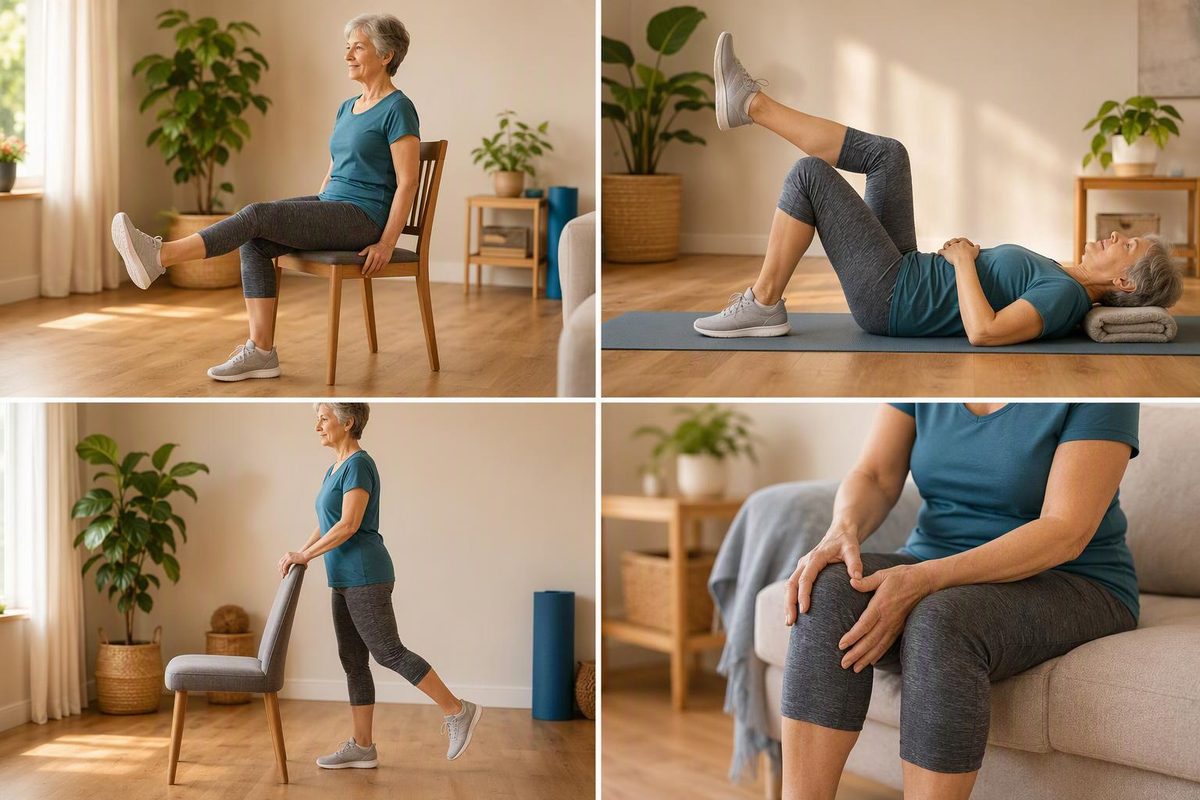
For diagnosed knee osteoarthritis, a useful exercise plan combines comfortable knee movement, muscle strengthening and aerobic activity such as walking or water-based exercise. You do not need to begin with deep squats or a long workout. NICE recommends exercise tailored to your needs, rather than one routine for everyone.
The four exercises below are starting options, not a prescription. If you already have an exercise plan from your healthcare team, follow that plan. If you have another type of arthritis, a recent injury or knee surgery, ask for advice rather than assuming this routine fits.
Check before you start
Seek urgent medical advice instead of exercising if you cannot move the knee or bear weight, it is badly swollen or has changed shape, or it locks or gives way. A hot or red knee with fever or feeling shivery also needs urgent assessment because it can signal infection. These are NHS warning signs, not symptoms to work through.
Four exercises to try
These movements are included in Arthritis UK’s knee exercise guidance. Use a comfortable range; do not force the knee to match the other side.
1. Heel slide: practise bending and straightening
- Lie on your back on a bed, or sit with your legs supported on a sofa.
- Slowly slide one heel towards you, bending the knee only as far as feels comfortable.
- Pause briefly, then slide the heel away to straighten the leg comfortably.
Keep the movement slow rather than pulling the knee into a deep bend. If using a sofa, a smooth tray beneath your foot can help it slide.
2. Knee straightening over a towel: work the thigh muscles
The quadriceps are the muscles at the front of your thigh that straighten your knee.
- Sit on a bed or sofa with your legs out in front of you.
- Place a rolled towel under one knee.
- Tighten the thigh muscles and straighten the knee, lifting your heel while keeping the knee supported on the towel.
- Hold for five seconds, then relax for five seconds.
Lift through the available comfortable range; do not force the knee straight.
3. Straight-leg raise: strengthen without repeated knee bending
- Lie on your back with one knee bent and that foot resting on the bed.
- Keep the other leg straight and slowly lift its heel just off the bed.
- Hold for a slow count of five, then lower gently.
Keep the lifted knee straight without pushing it backwards. If you cannot maintain that position, leave this exercise out for now and ask a physiotherapist for an easier version.
4. Sit-to-stand: practise getting out of a chair
- Use a sturdy chair that cannot slide; avoid a wheeled desk chair.
- Place both feet firmly on the floor.
- Lean forwards slightly and stand up slowly.
- Lower yourself back to the seat under control rather than dropping into it.
Arthritis UK suggests starting from a higher seat, using a cushion if needed. Use your hands for assistance if necessary; do not sacrifice balance to complete a hands-free repetition.
Start small, then build
A cautious first trial is two or three repetitions of one or two exercises, rather than completing the whole routine. Rest between movements. This is a tolerance check, not a full strengthening programme.
As the movements become easier, add one or two repetitions every few days, then introduce another exercise. These starting amounts come from NHS Inform’s general knee exercise advice, not an osteoarthritis-specific prescription. A physiotherapist can help set the longer-term repetitions, resistance and frequency for your osteoarthritis.
Include an activity you can sustain, too. Short walks or water-based exercise are options supported by Arthritis UK’s knee osteoarthritis guidance. Begin with a manageable amount rather than trying to reach your previous activity level immediately.
Use the next morning as a check
Some discomfort can occur when starting exercise for osteoarthritis; it does not automatically mean you should abandon exercise. NICE explains that regular, consistent exercise can reduce pain and improve function, even when it initially feels uncomfortable.
However, your usual knee pain should not be worse overall or worse the following morning—a practical check from NHS Inform. If it is, reduce repetitions, use a smaller comfortable range or allow more rest. Stop a movement that causes new pain rather than repeatedly testing it.
On a more painful day, scale back to comfortable movement instead of pushing through the full routine. Judge progress by everyday tasks—rising from a chair, walking or moving after sitting—not just by your repetition count. If the plan is not helping within the follow-up period agreed with your clinician, or pain prevents you from building it, ask for a review and a tailored exercise programme.