
Which Knee Sleeve Size Chart Applies?
Identical labels do not represent identical body dimensions across products. Choose the exact product first, then follow its chart and measuring method.
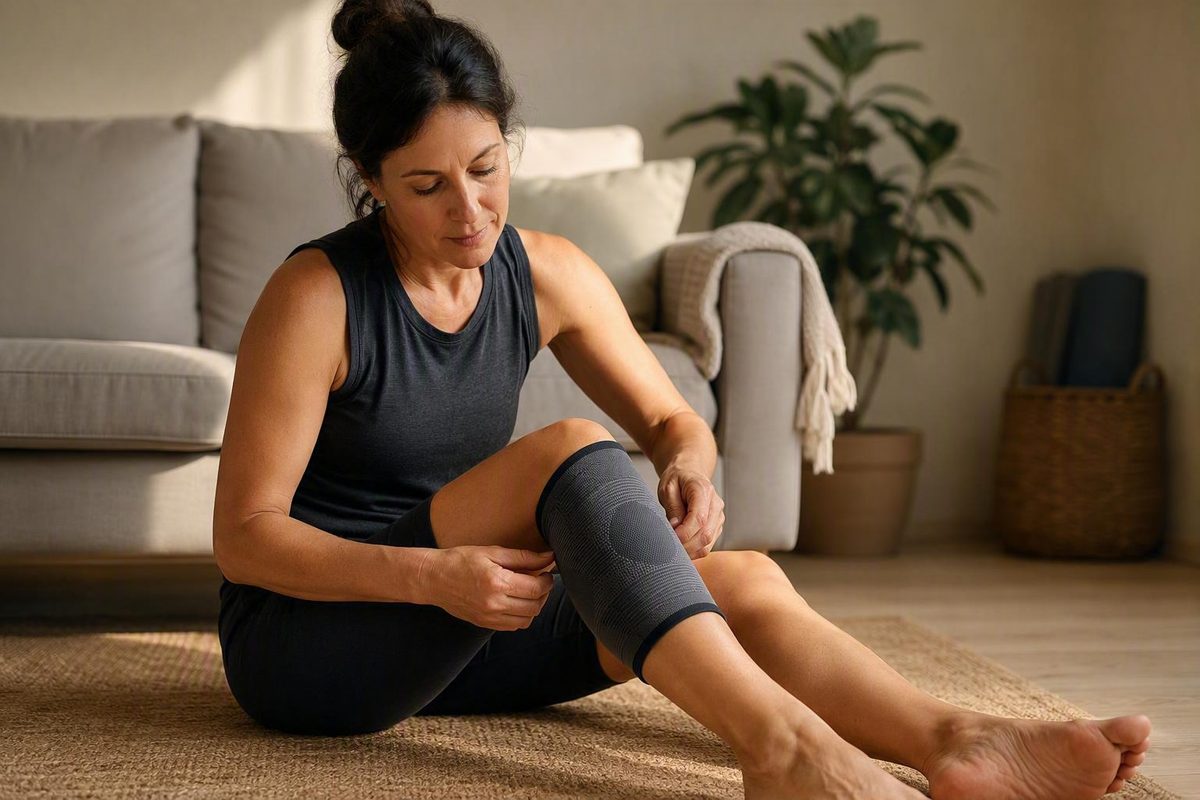
Why There Is No Universal Knee Sleeve Size Chart
There is no reliable universal knee sleeve size chart.
Before measuring, identify all four of these details:
- Brand
- Exact model
- Thickness or product variant
- Current chart for that product
The differences are large enough to change the size you would order:
- SBD Medium covers 33–35.5 cm, according to the SBD knee sleeve size guide.
- Fortex Medium covers 34–36 cm, according to the Fortex knee sleeve size chart.
- Ergodyne ProFlex Medium covers 36–38 cm, according to the Ergodyne ProFlex chart.
- Nike’s first displayed chart assigns Medium to 13.5–15 inches, according to the Nike knee sleeve chart.
Identical labels therefore do not represent identical body dimensions across products.
A chart can also describe one of two different things:
- A body-measurement chart maps your knee, calf, thigh, or knee-width measurement to a product size.
- A garment-dimension table reports the physical dimensions of the sleeve itself.
A sleeve with a listed middle circumference of 24 cm, for example, is not necessarily intended for a person with a 24 cm knee. Stretch, construction, and intended fit affect the relationship. Do not treat garment dimensions as wearer measurements unless the manufacturer explicitly provides that mapping.
Quick-use rule: Select the exact product first. Follow its specified tape location and knee position. Record the original measurement without aggressive rounding. Then use only that product’s chart and boundary instructions.
The charts below provide comparison data, not a fit guarantee. Once the sleeve arrives, use a cautious movement and symptom check to identify obvious fit problems.
How to Measure Your Knee for a Sleeve
Use a soft, flexible measuring tape. Unless the product says otherwise, place it flat and level against bare skin. If the exact product permits a base layer, measure over the same light, fitted layer you intend to wear beneath the sleeve. Do not measure over bulky trousers and assume that result will transfer to bare-skin use.
The tape should make even contact without twisting, sagging, or digging into the leg. Do not pull it hard enough to compress or indent the skin.
Follow the product’s landmark
The center of the kneecap is a common primary landmark, but it is not universal. Depending on the product, you may be asked to measure:
- Around the center of the kneecap
- Directly underneath the kneecap
- Across the kneecap to obtain knee width
- Around the calf
- Around the thigh or quadriceps
- At several points on the leg
POD Active, for example, uses circumference directly underneath the kneecap and knee width across its center. Both measurements are taken while standing with the leg fully straight. Nike instead asks for circumference at the knee center with the knee slightly bent.
Do not substitute a convenient landmark. A measurement taken above the knee cannot be compared directly with a chart that expects the widest part of the calf, and neither can replace circumference at the kneecap unless the product instructions say so.
Follow the specified knee position
Use the position required by the exact chart:
- SBD: leg straight, muscles relaxed
- Fortex: leg straight
- Gymshark: leg straight
- Ergodyne ProFlex: knee extended
- POD Active: standing with the leg fully straight
- Nike: knee slightly bent
These are product-specific methods, not interchangeable techniques. If a generic measuring article conflicts with the exact product page, follow the product-specific instruction.
Repeat and record the measurement
Measure each required location two or three times. Write down every reading rather than relying on memory. If the readings differ, check that:
- The tape is at the same landmark each time
- The tape remains level
- Your leg is in the prescribed position
- Your muscles are relaxed if required
- You are not tightening the tape progressively
Repeat the process rather than rounding toward the size you hope to buy. Near a boundary, a small rounding change can alter the chart result.
Measure both legs when asymmetry is possible. Using the larger measurement for one shared size is a commonly published practical approach, but it does not override the product’s instructions.
Inches and centimeters
Use the original unit shown by the product chart whenever possible. If conversion is necessary, use:
- 1 inch = 2.54 cm
- Inches × 2.54 = centimeters
- Centimeters ÷ 2.54 = inches
Retain sufficient precision near a boundary. Do not turn a detailed converted result into a whole number if doing so could move it from one listed range to another.
Measurement worksheet
| Field | Your entry |
|---|---|
| Brand | |
| Exact model and variant | |
| Sleeve thickness | |
| Required knee position | |
| Right knee circumference | |
| Left knee circumference | |
| Right calf circumference | |
| Left calf circumference | |
| Right thigh circumference | |
| Left thigh circumference | |
| Knee width, if required | |
| Intended permitted base layer | |
| Preferred fit | |
| Original unit used | |
| Date measured |
SBD and Fortex Knee Sleeve Size Charts
SBD and Fortex use different circumference ranges and different calf rules. Their tables must not be used interchangeably.
SBD knee sleeve size chart
For SBD, measure around the center of the kneecap with the leg straight and the muscles relaxed.
| SBD size | Knee circumference |
|---|---|
| 3XS | 23–25.5 cm (9–10 in) |
| 2XS | 25.5–28 cm (10–11 in) |
| XS | 28–30.5 cm (11–12 in) |
| S | 30.5–33 cm (12–13 in) |
| M | 33–35.5 cm (13–14 in) |
| L | 35.5–38 cm (14–15 in) |
| XL | 38–40.5 cm (15–16 in) |
| 2XL | 40.5–43 cm (16–17 in) |
| 3XL | 43–45.5 cm (17–17.9 in) |
| 4XL | 45.5–48 cm (17.9–18.9 in) |
| 5XL | 48–51.5 cm (18.9–20.3 in) |
SBD also asks buyers to measure the thickest part of the calf. It says to consider one size larger when the calf exceeds the knee measurement by more than 1.6 inches. That is SBD’s product guidance, not a universal calf formula. The company also advises new users to choose the indicated fit rather than sizing down, especially at Medium or smaller.
Example: A 34 cm knee falls within SBD Medium. Assuming the calf does not trigger SBD’s separate guidance, Medium is the indicated chart size.
Fortex knee sleeve size chart
For Fortex, measure around the center of the kneecap with a straight leg and a soft, flexible tape.
| Fortex size | Knee | Quad | Calf |
|---|---|---|---|
| 3XS | 26–28 cm | 34–36 cm | 27–29 cm |
| 2XS | 28–30 cm | 36–38 cm | 29–31 cm |
| XS | 30–32 cm | 38–40 cm | 31–33 cm |
| S | 32–34 cm | 40–42 cm | 33–35 cm |
| M | 34–36 cm | 42–44 cm | 35–37 cm |
| L | 36–38 cm | 44–46 cm | 37–39 cm |
| XL | 38–40 cm | 46–48 cm | 39–41 cm |
| 2XL | 40–42 cm | 48–50 cm | 41–43 cm |
| 3XL | 42–44 cm | 50–52 cm | 43–45 cm |
| 4XL | 44–46 cm | 52–54 cm | 45–47 cm |
| 5XL | 46–48 cm | 54–56 cm | 47–49 cm |
Fortex says to use calf circumference when it is larger than knee circumference and to size up when uncertain, particularly with stiff sleeves.
The supplied Fortex guide does not define the exact landmarks for its quad and calf measurements. Do not infer a distance above or below the kneecap from another company’s guide. Ask Fortex to clarify the correct locations if those measurements affect your choice.
Boundary comparison: A 34 cm knee falls within SBD Medium. In the Fortex table, 34 cm is the shared endpoint of Small and Medium. The same measurement therefore produces a straightforward chart result for one brand and a boundary decision for the other.
Conflicting knee and calf example: A 37 cm knee maps to Fortex Large. A 39 cm calf is the shared endpoint of the Large and XL calf ranges. Because Fortex says to use the calf when it is larger than the knee and recommends sizing up when uncertain, its guidance points this boundary example toward XL rather than making XL the only mathematical range match.
Nike and Ergodyne ProFlex Size Charts
Nike and Ergodyne use different knee positions. Keep their charts separate and retain the original units supplied by each company.
Nike knee sleeve size charts
Nike instructs buyers to measure circumference at the center of a slightly bent knee. Its page displays three tables, including two carrying the same “Knee Sleeves” label. The supplied page does not identify which products correspond to those two tables, so confirm the applicable table on the exact product page or with Nike support before ordering.
First displayed Knee Sleeves chart
| Size | Circumference |
|---|---|
| XS | 12–12.5 in |
| S | 12.5–13.5 in |
| M | 13.5–15 in |
| L | 15–17 in |
| XL | 17–19 in |
| XXL | 19–21 in |
Second displayed Knee Sleeves chart
| Size | Circumference |
|---|---|
| XS/S | 14–15 in |
| S/M | 14.5–15.5 in |
| L/XL | 15.5–16.5 in |
| XXL/XXXL | 16–17.5 in |
Multi-Wear Sleeves chart
| Size | Circumference |
|---|---|
| XS/S | 10–15 in |
| S/M | 11–16 in |
| L/XL | 12–16.5 in |
| XXL/XXXL | 12.5–17.5 in |
Nike says that when a measurement is on the borderline between two listed sizes, the smaller option gives a tighter fit and the larger option a looser fit. Apply that instruction only after establishing which table belongs to the product. Do not choose whichever displayed range gives the preferred answer.
Ergodyne ProFlex knee sleeve size chart
Ergodyne instructs buyers to measure around the center of the knee with the knee extended.
| Ergodyne ProFlex size | Knee circumference |
|---|---|
| X-Small | 12–13 in (31–33 cm) |
| Small | 13–14 in (33–36 cm) |
| Medium | 14–15 in (36–38 cm) |
| Large | 15–16 in (38–41 cm) |
| X-Large | 16–18 in (41–46 cm) |
| 2X-Large | 18–20 in (46–51 cm) |
Example: A correctly taken Ergodyne measurement of 14.5 inches maps to Medium. On Nike’s page, 14.5 inches appears within multiple displayed ranges, depending on which table applies. That does not permit the Ergodyne result to be transferred to Nike. It shows why both the model and the measuring method must be confirmed first.
POD Active, Gymshark, and Charts That Need Extra Caution
Not every knee product uses only circumference at the kneecap. Some use width, below-kneecap circumference, multiple body dimensions, or the dimensions of the sleeve itself. These tables require closer reading.
POD Active: knee width and circumference
POD Active uses two measurements while the user is standing with the leg fully straight:
- Knee width: measured across the center of the kneecap
- Knee circumference: measured directly underneath the kneecap
The following general categories appear in the POD Active sizing guide.
| POD category | Knee width | Knee circumference |
|---|---|---|
| Youth/Youth Tall | 3.46–3.70 in (88–94 mm) | 10.80–11.60 in (275–295 mm) |
| X-Small | 3.70–4.01 in (94–102 mm) | 11.60–12.60 in (295–320 mm) |
| Small | 4.01–4.25 in (102–108 mm) | 12.60–13.40 in (320–340 mm) |
| Medium | 4.25–4.48 in (108–114 mm) | 13.40–14.10 in (340–360 mm) |
| Large | 4.48–4.72 in (114–120 mm) | 14.10–14.80 in (360–380 mm) |
| X-Large | 4.72–5.00 in (120–127 mm) | 14.80–15.80 in (380–402 mm) |
| 2X-Large | 5.00–5.27 in (127–134 mm) | 15.80–16.80 in (402–420 mm) |
| 3X+ | 5.27–5.55 in (134–141 mm) | 16.80–17.40 in (420–442 mm) |
POD recommends the larger size when a measurement falls between sizes. It describes the desired result as comfortably snug after walking and bending the leg.
However, the extracted formatting does not unambiguously preserve how every POD Knee Sleeve product label maps to the general measurement columns. Check the exact product guide before ordering rather than assuming every POD product follows the table identically.
Gymshark 5 mm and 7 mm sleeves
Gymshark says to measure knee-joint circumference with the leg straight. Its displayed entries for the 5 mm and 7 mm sleeves are reproduced below exactly as published in the Gymshark knee sleeve guide.
| Size | Displayed measurement |
|---|---|
| S | greater than 20 cm |
| M | 33–34 cm |
| L | 35–36 cm |
| XL | 37–38 cm |
| XXL | less than 39 cm |
The Small and XXL inequalities create broad overlap with the other entries and may reflect a publishing or extraction error. They should not be silently reversed or “corrected.” Verify the values directly with Gymshark before relying on them.
Gymshark Onyx garment dimensions
| Size | Height | Top circumference | Middle | Bottom |
|---|---|---|---|---|
| S/M | 20 cm | 34 cm | 24 cm | 23 cm |
| L/XL | 22.5 cm | 37 cm | 27.5 cm | 26 cm |
These are presented as dimensions of the Onyx sleeve, not as a verified mapping from wearer circumference to size. Do not compare your knee circumference directly with the middle dimension and assume it determines your size.
GO Sleeves also publishes a knee sleeve chart, but the supplied page presents its chart as images rather than verifiable text. Without dependable numerical ranges and measuring instructions, it is better to omit the figures than reconstruct or estimate them.
Data-quality checklist
Before trusting an unfamiliar chart, ask:
- Does it show body measurements or garment dimensions?
- Is it for the exact brand, model, thickness, and current version?
- Does it specify the tape landmark and knee position?
- Are there shared endpoints, overlapping ranges, gaps, or malformed symbols?
- Does it explain which measurement controls when knee, calf, thigh, or width results conflict?
- If the mapping remains unclear, can the manufacturer confirm it in writing?
What to Do at a Size Boundary or When Measurements Conflict
There is no sound universal rule to “always size up” or “always size down.” Start with the exact manufacturer’s instruction, then consider sleeve stiffness, desired fit, intended wear duration, and whether every required body measurement remains within range.
Use this sequence:
- Confirm the exact chart. Check the model, thickness, and variant.
- Repeat the measurement. Preserve the original value rather than rounding it.
- Inspect the boundary. Determine whether the ranges share an endpoint, overlap, or leave a gap.
- Take every additional measurement required. This may include calf, thigh, or knee width.
- Apply that manufacturer’s stated rule.
- Check exchange or return options before experimenting with a deliberately tighter size.
- Use a cautious movement and symptom check after the sleeve arrives.
The available brand rules illustrate why they cannot be blended:
- Nike: smaller for a tighter fit or larger for a looser fit at a boundary.
- POD Active: choose the larger size when between sizes.
- Fortex: size up when uncertain, especially with stiff sleeves.
- SBD: new users should choose the indicated fit rather than size down, particularly at Medium or smaller.
Calf instructions also differ. SBD says to consider one size larger when the calf exceeds the knee by more than 1.6 inches. Fortex says to use calf circumference whenever it is larger than knee circumference. Applying Fortex’s rule to an SBD sleeve—or vice versa—would create a sizing method that neither company publishes.
An exact endpoint can legitimately appear in two sizes. Fortex’s 34 cm knee value, for example, is both the upper endpoint for Small and the lower endpoint for Medium. That is a reason to apply the brand’s uncertainty guidance, not a reason to ignore it.
Do not assume a tighter sleeve is medically safer, more supportive, or more effective. A larger sleeve is not automatically better either: it may slip, roll, bunch, or fail to remain centered.
When knee, calf, thigh, and width measurements point to different sizes, use the product’s stated priority. If the manufacturer has not identified a controlling measurement, ask for guidance instead of averaging unrelated dimensions or inventing a formula.
If your body size is changing, remeasure closer to the purchase date. That can make the measurement more current, but it cannot guarantee a future fit.
How a Correctly Sized Knee Sleeve Should Feel
A chart provides a starting point. A home movement check can reveal obvious fit problems, but it cannot guarantee correct sizing or establish that the sleeve is medically suitable.
Put the sleeve on and center it according to the product instructions. Then:
- Walk for several minutes.
- Bend and straighten the knee repeatedly.
- If normally appropriate for you, perform a familiar controlled movement such as a squat.
- Check whether the sleeve shifts, rolls, or creates concentrated pressure.
- Recheck how the lower leg feels and looks.
A plausible fit should stay centered, feel evenly snug, and permit the expected range of motion without sharp pain or significant restriction.
Signs that the sleeve may be too loose include:
- Slipping down
- Rolling at an edge
- Bunching behind the knee
- Repeatedly moving away from the kneecap
- Needing frequent readjustment during ordinary movement
Precautionary signs that it may be too tight include:
- Pain
- Numbness or tingling
- New or increasing swelling
- Significant restriction of movement
- Deep marks that persist
- Marked lower-leg color change
Remove the sleeve rather than trying to tolerate those symptoms. Commercial fit guidance similarly treats numbness, tingling, swelling, restricted movement, and lower-leg color changes as reasons to reject a fit rather than “break it in” (knee sleeve fit-check guidance).
Fortex provides a model-specific donning method: fold the sleeve’s top outward until it meets the bottom, pull the folded sleeve to the middle of the knee joint, and then unfold it so the kneecap is near the sleeve’s center. That method is an example for Fortex sleeves, not a universal instruction.
Difficulty alone does not prove that the sleeve fits. Position, movement, and symptoms still need to be checked.
An apparently good fit also does not establish that the sleeve will prevent injury, treat pain, improve circulation, speed recovery, or enhance strength. A size chart answers a limited question: which listed size is the most reasonable starting point for the required measurements.
When to Remeasure—and When Sizing Is Not the Main Issue
Remeasure when:
- Your weight or leg muscle size has changed substantially
- Swelling has changed
- You have sustained a new injury
- A long time has passed since your previous purchase
- You switch to another brand, model, thickness, or design
- You plan to use a different base layer that the product permits
Some commercial fitting guides suggest periodic remeasurement at roughly 6–12 months, but that is practical shopping guidance rather than a medical rule. Remeasure sooner whenever your current dimensions may no longer match your old record (commercial remeasurement guidance).
If the product permits layering, measure over the same light, fitted base layer you intend to wear. Do not assume that a result taken over thick clothing applies when the sleeve is later worn against bare skin.
Check the manufacturer’s current chart at the time of purchase.
Ordinary slipping or tightness may be a sizing problem. Persistent swelling, swelling following an injury, locking, giving way, or notable circulation-related signs should not be handled simply by ordering another size. This article provides general information rather than diagnosis or treatment; Knee Pain Zone’s own general-education notice directs readers with locking, giving way, or swelling after an injury toward clinical attention.
Before buying, complete this checklist:
- Exact brand and model confirmed
- Thickness or variant confirmed
- Current product chart located
- Correct landmark used
- Required knee position followed
- Both legs measured
- Calf, thigh, or width checked when required
- Any permitted base layer included appropriately
- Original measurement units preserved
- Boundary or conflict rule verified
- Unclear chart details confirmed with the manufacturer
- Movement and symptom check completed after delivery
The letter on the label is not enough. The best available sizing decision combines the exact product chart, the prescribed measuring method, any additional dimension rules, and a practical fit check. If the chart is unclear, verify it rather than guessing. If symptoms extend beyond ordinary fit trouble, address the knee issue rather than continuing to experiment with sleeve sizes.
Knee Sleeve Sizing FAQ
What is the average knee sleeve size for adults?
There is no dependable “average” adult knee sleeve size. Medium means 33–35.5 cm for SBD, 34–36 cm for Fortex, and 36–38 cm for Ergodyne ProFlex. Nike’s first displayed chart instead gives Medium as 13.5–15 inches. Other products use combined sizes, overlapping ranges, or different measurement landmarks.
Measure the location required by the exact product instead of choosing a size based on an assumed adult average.
Should I measure my knee straight or bent for a knee sleeve?
Use the position specified for the exact product. SBD, Fortex, Gymshark, Ergodyne ProFlex, and POD Active call for a straight or extended leg in their supplied instructions. Nike specifies a slightly bent knee.
Do not transfer a measurement taken in one position to a chart that requires another.
Should I size up if my calf is bigger than my knee?
Only if the product’s guidance says to. Fortex says to use calf circumference whenever it is larger than knee circumference. SBD instead says to consider one size larger when the calf exceeds the knee by more than 1.6 inches.
Other products may use a different rule or no calf rule at all. If a chart provides calf ranges but does not explain the landmark or priority measurement, contact the manufacturer rather than borrowing SBD’s or Fortex’s method.
How tight should a knee sleeve feel?
It should feel evenly snug, remain centered, and permit expected movement without sharp pain or significant restriction. It should not cause numbness, tingling, new swelling, marked lower-leg color change, or persistent deep pressure marks.
A sleeve that slips, rolls, bunches, or repeatedly moves away from the kneecap may be too loose. Remove a sleeve that produces concerning neurological or circulation-related signs rather than trying to tolerate the fit.
Can I use a Nike, SBD, or Fortex chart for another brand?
No. Those charts are specific to their respective products and measuring instructions. Nike uses a slightly bent knee, while SBD and Fortex use a straight leg. Their size ranges, boundary rules, and treatment of calf measurements also differ.
Another company’s table can be used for comparison, but not to assign a purchase size. For an order, confirm the exact model and follow its current knee sleeve size chart.