
Knee Hurts After Driving? Causes, Relief and Red Flags
Adjust your seat, move gently and check pedal control. Know when persistent pain, injury, one-sided calf swelling or sudden breathlessness need care.
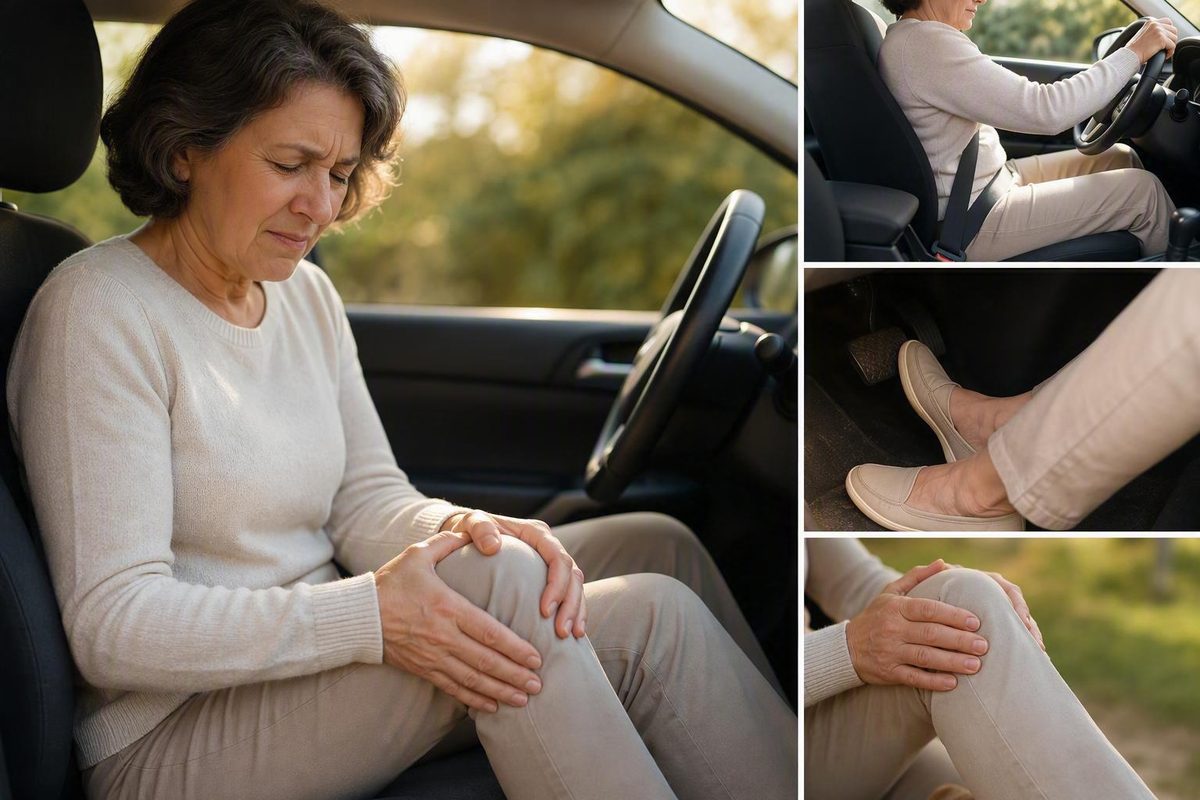
If your knee hurts after driving, common possible aggravators include holding the knee bent, staying relatively still, repeatedly operating the pedals, and fatigue in the surrounding muscles. These factors can produce stiffness or aggravate an existing knee problem, but pain after a journey does not prove that driving damaged the joint or identify one underlying condition. “Driver’s knee” is an informal description, not an official diagnosis. Hinge Health’s clinician-reviewed overview explains the term and its limitations.
For mild symptoms without a recent injury, park somewhere safe, get out, walk briefly, and gently bend and straighten the knee. Do not drive again if pain makes braking, accelerating, clutch use, or rapid movement between pedals painful, hesitant, or unreliable.
The short answer: change position, move gently, and check whether you can drive safely
Start by separating a mild positional ache from symptoms that require a different response.
A knee held in one position may feel stiff when you first stand. If the discomfort is mild, there was no injury, and you can walk normally, try a few minutes of comfortable movement. Notice whether the knee loosens as you walk and whether gentle bending and straightening feel easier over time. Improvement may identify prolonged positioning as an aggravating factor, but it still does not establish a diagnosis.
Before another journey, focus on function rather than the pain score alone: Can you control the vehicle normally? You must be able to move promptly and accurately between the pedals and press each one fully without guarding, weakness, hesitation, or unpredictable pain. If you cannot, arrange another way to travel.
Use this basic triage rule:
- Mild, isolated aching or stiffness: gentle movement and a cautious seat adjustment may be reasonable.
- Marked swelling, a recent injury, locking, giving way, or loss of function: seek clinical assessment rather than relying on generic exercises.
- New one-sided calf or whole-leg swelling: seek prompt medical assessment for a possible vascular problem.
- Sudden breathlessness, chest pain, or coughing blood: call emergency services.
What the location and pattern of pain can—and cannot—suggest
Pain location can provide clues, but it cannot diagnose the problem. Use this table as a decision guide only.
| Symptom pattern | Possible explanation | Reasonable next step | Signs that need assessment |
|---|---|---|---|
| Ache or stiffness at the front of the knee after sitting with it bent | Anterior or patellofemoral irritation is compatible with this pattern, particularly if stairs, bending, kneeling, or rising from a chair also hurt. NHS guidance includes driving among common triggers for this symptom pattern. | Try gentle movement and compare symptoms after changing one seat setting. | Swelling, giving way, locking, persistent pain, or reduced function |
| Tenderness focused just below the kneecap | Patellar tendon irritation is one possibility, but driving-related pain alone cannot establish patellar tendinopathy. NHS Lanarkshire describes the typical location and overload association. | Reduce the aggravating task and arrange a review if symptoms recur. | A pop or snap, severe pain or swelling, or inability to straighten the knee |
| Fullness, tightness, pain, or a lump behind the knee | A Baker’s cyst is one possibility. In adults, these cysts usually reflect an underlying knee problem that produces excess joint fluid rather than driving itself. AAOS explains the symptoms and underlying causes. | Book an assessment, especially if movement is restricted or a lump persists. | Increasing calf pain or swelling |
| Pain on the outside of the knee | Several structures can cause lateral pain. Iliotibial-band irritation is one possibility, but location alone is insufficient for diagnosis. NHS musculoskeletal guidance outlines this differential. | Note which activities and movements provoke it; seek review if it persists. | Trauma, instability, swelling, locking, or worsening limitation |
| New one-sided calf or whole-leg swelling, tenderness, discoloration, or prominent veins | DVT must be considered, especially when additional clot risk factors are present. Isolated knee aching does not mean a clot is likely. AAOS lists the relevant DVT signs and risk factors. | Seek prompt medical assessment; DVT cannot be confirmed or excluded at home. | Sudden breathlessness, chest pain, or coughing blood requires emergency care |
Front-of-knee discomfort after driving is therefore more informative when it forms part of a wider pattern. Similar pain during stairs, inclines, kneeling, bending, or getting up from a chair is compatible with anterior knee irritation. It does not prove that the patellofemoral joint is the only source of symptoms.
Likewise, tenderness immediately below the kneecap may occur with patellar tendon irritation, but that condition is generally associated with tendon overload. A single episode after driving is not enough to identify patellar tendinopathy.
Pain behind the knee needs particular care if you can feel a lump or the knee feels unusually full or tight. A Baker’s cyst can restrict movement or cause swelling, but an examination may be needed to determine whether a lump is fluid-filled and to look for an underlying knee condition.
Outer-knee pain is also nonspecific. Avoid assuming that it is iliotibial-band irritation merely because of its location, especially if the knee has been injured, is swollen, locks, or feels unstable.
A short symptom log can make practical experiments and any clinical visit more useful. Record:
- which knee is affected;
- the exact location of the pain;
- whether symptoms begin during the drive, when you stand, or later;
- journey length and traffic conditions;
- whether the affected leg operates the accelerator and brake, clutch, or neither;
- any swelling, warmth, lump, locking, or giving way;
- any recent impact, twist, surgery, or injection;
- whether walking or changing one seat setting helps.
Improvement after walking or changing the seat identifies a possible aggravating factor. It does not reveal the underlying diagnosis.
A before-, during-, and after-driving plan
Before driving, make all adjustments while parked. Position the seat so that you can reach and fully operate every pedal without stretching the leg straight or crowding the knee into a sharply bent position. Your back and hips should feel supported, and your leg should not need to twist or reach for the pedals.
Change only one variable at a time. You might adjust seat distance for one journey, then test seat height on another comparable trip. Changing everything at once makes it difficult to identify what helped. There is no well-supported universal knee angle, seat height, or pedal distance that suits every body and vehicle.
Wear footwear that stays secure on your feet and allows predictable pedal pressure. Before setting off, confirm that you can move between the pedals and press them fully without pain or hesitation.
During a longer trip, plan safe stopping opportunities in advance based on the journey length and when your symptoms usually begin. Published guidance suggests different intervals, so there is no evidence-based break schedule that fits every driver. The practical aim is to stop somewhere safe before stiffness or pain becomes distracting.
Once securely parked, get out and walk briefly. You can also gently bend and straighten the knee. Never stretch, move a foot away from the controls, change your seat position, or treat cruise control as an opportunity to exercise while the vehicle is moving. Maintaining control of the vehicle takes priority.
After driving, choose gentle movement rather than immediately sitting still again if walking feels comfortable. For a mild flare, warmth or cold may feel soothing, but neither is suitable for every knee problem.
If you use ice, wrap it in a damp cloth rather than placing it directly on the skin. Limit the application to about 10–15 minutes and check the skin regularly. Seek professional advice before using ice if you have numb skin, impaired circulation, cold sensitivity, or another relevant medical condition. If you are unsure whether a pain medicine or anti-inflammatory is safe, ask a pharmacist or clinician—particularly if you take other medicines, have other health conditions, or are pregnant. These precautions are consistent with Newcastle Hospitals’ clinical self-care guidance.
Do not assume that a brace, compression, an injection, or medication is the routine answer to pain after driving. Whether any of these is appropriate depends on the cause of the symptoms and your wider health.
Three gentle exercises to try only when the vehicle is parked
This routine is for mild, non-traumatic symptoms. Do not use it instead of assessment after major trauma or if you have severe swelling, cannot bear weight, cannot straighten the knee, or the joint locks.
Choose a secure location away from moving traffic. Do not exercise on a motorway shoulder or beside passing vehicles. The standing stretch needs firm ground and stable support; the straight-leg raise should be done only where you can lie down safely and comfortably.
- Seated knee bend and straighten
Sit upright with your foot on the floor. Slowly slide the foot back to bend the knee, then move it forward and straighten the knee through a comfortable range. Keep the movement smooth and do not force the end position.
Repeat several times, stopping once the knee feels looser or if it becomes clear that the movement is aggravating your symptoms.
- Supported standing hamstring stretch
Stand next to a stable support. Place the heel of the affected leg slightly in front of you, keeping that knee comfortably straight without forcing it backward. Bend the supporting knee slightly and hinge forward from the hips until you feel a gentle stretch behind the thigh.
Keep your back comfortable. Do not bounce or push into pain. This setup follows the supported hamstring-stretch technique in NHS musculoskeletal guidance.
- Straight-leg raise
Lie on your back with the comfortable knee bent and the affected leg straight. Gently tighten the muscle at the front of the straight thigh, then lift the heel a short distance while keeping the knee straight. Pause briefly and lower the leg with control.
Stop if you cannot keep the knee straight or if the movement clearly aggravates the pain. Straight-leg raises and gradual knee mobility are included in Leeds Teaching Hospitals’ knee-rehabilitation guidance.
Use your response as the guardrail. Mild discomfort may be acceptable if it settles promptly, but stop if an exercise causes a substantial increase in pain, new swelling, giving way, or deterioration that persists afterward.
If the pain repeatedly returns, an individualized assessment and strengthening plan is more useful than continually adding generic exercises.
The driving-readiness check
Road safety—not pain intensity alone—should decide whether you drive.
Before setting off, while parked, confirm that you can:
- sit without the pain becoming distracting;
- move rapidly and accurately between the pedals;
- press the accelerator, brake, and clutch, as applicable, through the necessary range;
- react without hesitation, weakness, guarding, or unpredictable pain.
If any part of that check is unreliable, do not drive. Arrange alternative transport even if you believe the underlying knee problem is minor.
After a knee injury, return to driving only when you can perform an emergency stop without discomfort or hesitation. This is the standard given in Leeds Teaching Hospitals’ return-to-driving advice.
Recent surgery, an injection, a significant injury, a restrictive brace, or medication that affects alertness may require individualized advice. There is no universal waiting period that is appropriate for every procedure, injury, or driver.
Book a routine clinical or physiotherapy assessment if the pain persists or begins interfering with commuting, work, sleep, walking, exercise, or ordinary activities. You should not have to keep testing an unreliable knee in traffic before deciding that it needs attention.
When knee or leg pain after driving needs medical care
Emergency care
Call emergency services for sudden shortness of breath, sudden chest pain, or coughing blood. These symptoms can occur if a blood clot travels to the lungs and causes a pulmonary embolism. AAOS describes these DVT and pulmonary-embolism warning signs.
Prompt assessment
Seek prompt medical assessment for new one-sided calf or leg swelling, tenderness, discoloration, or prominent veins—especially after prolonged immobility or if you have risk factors such as a previous DVT, recent leg surgery, cancer, pregnancy, hormonal medicines, smoking, obesity, or an inherited clotting disorder.
Also seek prompt knee assessment after a high-force impact; a painful twist, pop, or snap; severe or rapidly increasing swelling; inability to bear weight or straighten the knee; visible deformity; or a hot, red, swollen joint. NHS guidance advises urgent assessment for severe symptoms after trauma, including a painful pop or snap and an inability to straighten the knee. Review the relevant NHS warning signs.
Keep clot risk in proportion. Ordinary, isolated knee aching after a drive is not evidence that DVT is likely. Concern rises when calf or whole-leg symptoms appear, particularly alongside personal risk factors, and a suspected clot must be evaluated clinically.
Increasing calf pain and swelling can also occur with a Baker’s cyst complication. Because that presentation can resemble DVT, do not try to distinguish the two at home.
Routine appointment
Arrange a clinical or physiotherapy review for pain that persists or worsens; recurrent swelling; locking or giving way; reduced mobility; a lump behind the knee; night pain; or symptoms that interfere with daily life or safe pedal control.
Most mild knee discomfort after driving can begin with a more comfortable seat setup, gentle movement in a secure parked location, and attention to how the knee responds. The goal is not to diagnose yourself with “driver’s knee.” Prioritize reliable pedal control, and seek the appropriate level of care for persistent symptoms, a major injury, one-sided calf swelling, or signs of pulmonary embolism.