
Muscle-Sparing Knee Replacement Recovery Time
Compare knee replacement timelines, evidence for earlier mobility, and realistic milestones for walking, driving, work, stairs, and sport.
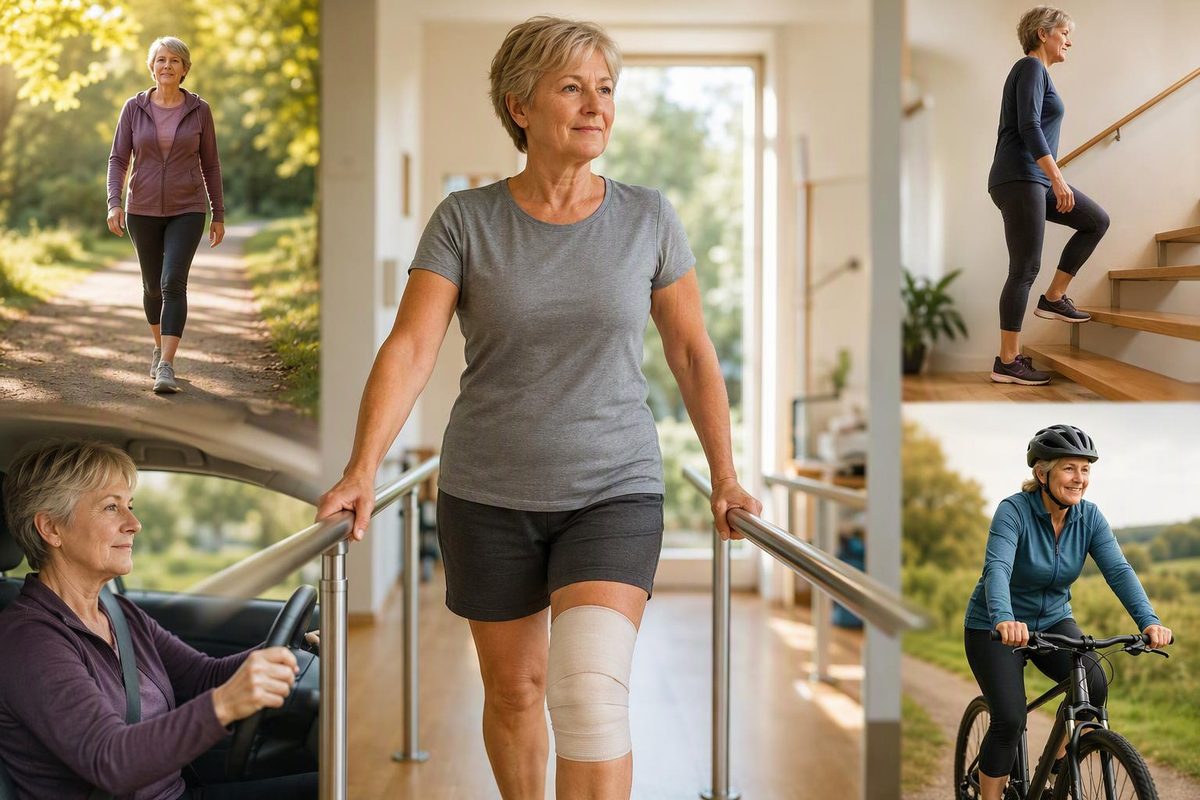
Muscle-sparing knee replacement may make the first days and weeks easier, but it does not make total knee replacement a minor procedure. Some patients regain early mobility sooner, while pain, swelling, wound healing, rehabilitation and the broader 6–12-month recovery process remain.
Choose an activity goal to compare the available recovery estimates.
Recovery Milestone Comparison
Published ranges are general planning guides unless the result says no reliable figure is available.
Walking Unassisted
Muscle-Sparing / Subvastus
14–21 days
Use the general range for planning. Studies suggest an early mobility benefit but do not establish a separate typical day.
Traditional Medial Parapatellar
14–21 days
AAHKS says patients commonly progress to a cane or no aid at two to three weeks.
What Can Change This Timing?
Walking safety, balance, strength, pain control, complications and the care team's advice matter more than the calendar.
Sources: AAOS and AAHKS recovery guidance; 2019 meta-analysis of 1,112 patients and 1,439 knee replacements. Approach-specific dates were not reported for every milestone.
Published evidence does not provide dependable approach-specific dates for every activity. The ranges below are broad planning estimates for total knee replacement generally, not promises for a particular technique or patient.
| Time After Surgery | What May Be Realistic |
|---|---|
| Day 0–1 | Stand and walk with staff using a walker or crutches; begin prescribed exercises. |
| Weeks 1–2 | Manage pain and swelling, protect the wound and take short, frequent walks. Help at home may still be needed. |
| Weeks 2–3 | Some patients progress to a cane or no walking aid. Function and the care team’s advice—not the calendar—should determine this. |
| Weeks 3–6 | Many people resume most basic daily activities. Pain with activity and at night can continue. |
| Weeks 4–6 | Driving and desk work may become possible for some people. Physical work usually takes longer. |
| At 3 months | Many usual activities may be possible, although strength, stamina and swelling may not be back to normal. |
| 6–12 months | Strength and endurance can continue improving toward their eventual level. |
A muscle- or quadriceps-sparing approach may move some early milestones forward. It does not guarantee an unusually fast result.
Muscle-Sparing Describes Several Different Approaches
The conventional medial parapatellar approach opens the joint beside the kneecap and extends the opening into the quadriceps tendon. Tissue-sparing approaches try to reduce disruption of the extensor mechanism—the muscles and tendons that straighten the knee.
The labels are not interchangeable. The American Academy of Orthopaedic Surgeons describes quadriceps-sparing techniques as avoiding trauma to the quadriceps tendon and muscle, while midvastus and subvastus approaches use different routes and may make small muscle incisions. All use the same general type of knee implants, and all still involve removing damaged cartilage and some bone (AAOS).
A shorter skin incision alone is not proof of less disruption underneath. The American Association of Hip and Knee Surgeons says most studies have not found that a smaller incision by itself improves pain or recovery. Limited exposure can also make the operation more difficult (AAHKS).
Jiffy Knee is a branded procedure rather than a separate type of implant. Its website says surgeons lift the muscle aside rather than cutting muscles or tendons, although the skin and joint capsule are opened (Jiffy Knee). That description is not independent evidence that every advertised recovery result will apply to an individual patient.
When discussing a “muscle-sparing” operation, ask for the exact anatomical approach. The operative plan matters more than the marketing term.
The Measured Advantage Is Mainly in Early Recovery
The best-supported advantage is in early recovery, not the final outcome.
A 2019 meta-analysis included 1,112 patients and 1,439 knee replacements. Compared with the conventional medial parapatellar approach, quadriceps-sparing surgery was associated with:
- About 6° more knee motion at 1–2 weeks
- Slightly lower pain on the first postoperative day
- A hospital stay shorter by an average of just under one day
- Longer surgery and tourniquet times
There was no significant difference in knee motion at 4–8 weeks or at 3 months. The hospital-stay and pain findings varied substantially among studies. The review combined eight randomized trials with eight retrospective studies, so it supports a possible early benefit rather than a precise personal timetable (2019 meta-analysis).
A separate literature review found possible immediate postoperative benefits but also noted reports of longer operating times and complications, leaving the overall safety and effectiveness debate unsettled (review of minimally invasive approaches). AAOS says current evidence suggests that long-term benefits do not differ from those of conventional total knee replacement.
This distinction explains why a person may walk more comfortably early on without reaching complete recovery months ahead of someone who had a conventional approach.
Walking Progress Depends on More Than the Incision
AAHKS says most patients walk with a walker the day after surgery and use a cane or no aid at two to three weeks. It places return to most activities at up to three months and maximal recovery of strength and endurance at roughly 6–12 months. AAOS says most normal daily activities are possible within three to six weeks (AAOS).
These ranges can shift with preoperative strength and mobility, age, other health conditions, pain control, complications, home support and participation in rehabilitation. The surgical approach is only one factor.
Walking without an aid is not simply a date on the calendar. The knee must be stable enough that the person is not limping heavily, reaching for furniture or at risk of falling. A surgeon or physical therapist may recommend keeping a cane longer even when pain is improving.
Stairs also require more than basic walking ability. Strength, balance, knee motion, the height of the steps and access to a railing all matter. The cited guidance does not provide a reliable approach-specific number of days to independent stairs, so ask the surgeon for results from comparable patients rather than assuming that a muscle-sparing label guarantees an early date.
Swelling often lasts longer than the first functional gains. Moderate to severe swelling may occur during the first days or weeks, while milder swelling can continue for three to six months (AAOS recovery guidance). A gradual decline is more reassuring than swelling that is new or worsening. See what progress can look like three months after total knee replacement.
Driving Requires Control, Reflexes and Medication Clearance
Do not drive based only on a clinic’s advertised average. AAOS advises waiting until opioid pain medicine is no longer needed and strength and reflexes have recovered sufficiently. You also need enough knee bend to get into the car and enough muscle control and reaction time for braking and acceleration.
AAHKS gives four to six weeks as a common range, sometimes sooner after left-knee surgery, but recommends discussing clearance with the surgeon. The published guidance does not establish a separate, dependable driving range for muscle-sparing surgery.
Which knee was replaced and whether the vehicle has an automatic transmission can affect the physical demands, but neither replaces medical clearance. A person who can walk comfortably may still be unable to perform an emergency stop safely.
Work and Exercise Follow Function Rather Than Branding
A sedentary worker may return in roughly four to six weeks. Work involving prolonged standing, lifting, climbing or travel may require up to three months, according to AAHKS. Compare the job with current walking safety, stamina, knee motion and medication use rather than using the operation’s brand name to set a return date.
Continue the exercises prescribed by the surgical or physical-therapy team. Walking helps, but AAOS cautions that it does not replace targeted rehabilitation. Lower-impact activities such as cycling, swimming, golf and pickleball are generally preferred after recovery. High-impact running and jumping are commonly discouraged because they place greater stress on the implant.
The cited sources do not give one exact day for returning to sport after either approach. The activity, implant, previous experience and surgeon’s restrictions must be considered. “Most activities” at three months should not be interpreted as automatic clearance for every sport.
Surgeon Experience May Matter More Than the Approach Name
A small scar or branded recovery promise should not be the only basis for choosing surgery. Ask the surgeon:
- Which exact approach do you use, and what muscle, tendon and capsule tissue is divided?
- How many knee replacements have you performed with this approach?
- What are your own rates of infection, readmission, stiffness and revision?
- What are your typical times to a walker, cane, independent stairs, driving and work?
- Would my anatomy, weight, previous surgery, deformity or stiffness make exposure difficult?
- Would you switch to a conventional approach if visibility or implant positioning were inadequate?
AAOS notes that minimally invasive techniques are not suitable for everyone. They may be less appropriate after previous knee surgery or for people with substantial deformity or factors that could complicate exposure or wound healing. Surgeon training and experience matter because limited exposure can make accurate implant placement harder.
Do not confuse the surgical approach with navigation technology. A muscle-sparing operation may or may not use a robot. These are separate choices; our comparison of robotic and traditional knee replacement explains what robotics changes and what it has not clearly improved.
Worsening Symptoms Need Prompt Medical Advice
Contact the surgical team promptly for increasing wound redness, tenderness or drainage; persistent fever; shaking chills; worsening pain at rest and with activity; or new or increasing calf, ankle or foot swelling. Calf pain, tenderness or redness can also indicate a blood clot.
Sudden chest pain or shortness of breath needs emergency care because it may indicate a clot that has traveled to the lungs.