
Robotic vs Traditional Knee Replacement: Is It Better?
See what the 339-patient RACER-Knee trial found on pain, function, precision, safety, operating time, recovery and the added cost of Mako surgery.
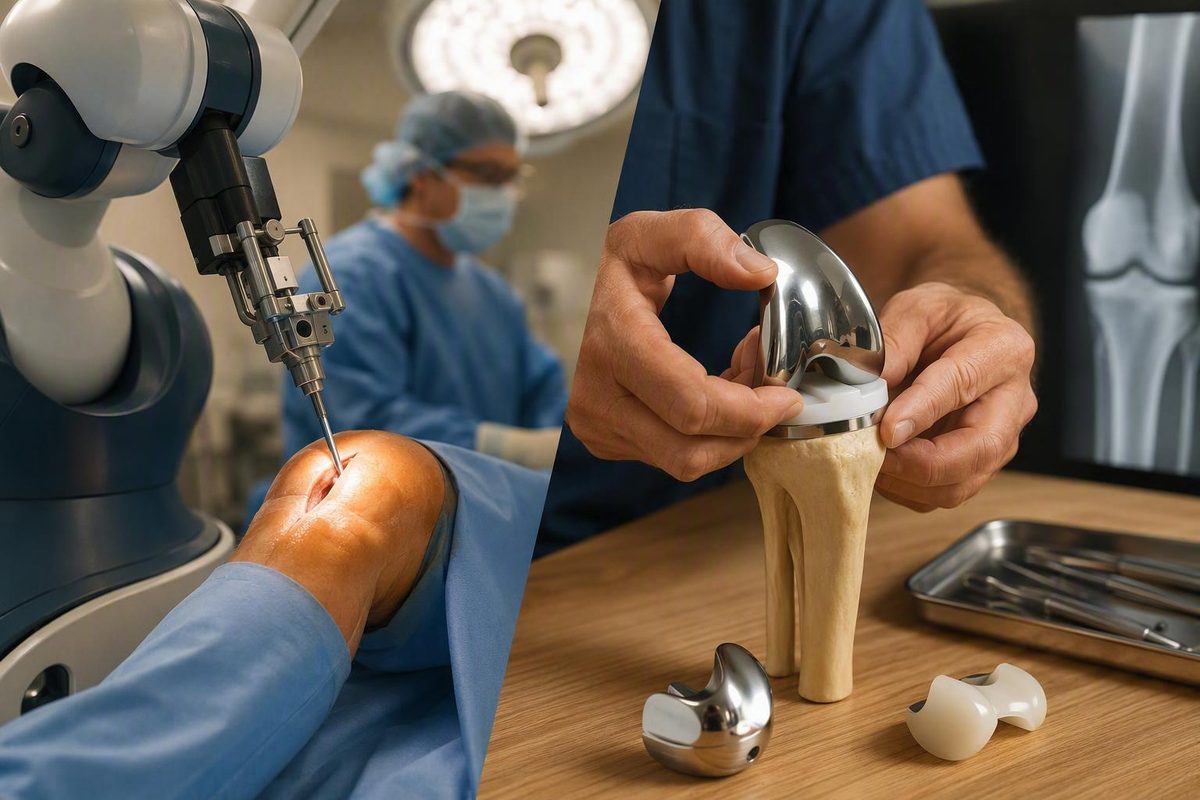
Robotic knee replacement is more precise, but the best head-to-head evidence does not show that it produces a better-feeling or better-functioning knee after one year. In the 339-patient RACER-Knee trial, the 12-month Forgotten Joint Score was 49.2 with Mako robotic assistance and 50.2 with conventional surgery; the adjusted difference was −1.5 points (p=0.62), against a prespecified 12-point threshold for clinical importance. Pain and function were similar, serious adverse events affected 16 participants in each group, and robotic surgery cost about £950 more and took 10.5 minutes longer.
Set what matters to you, then compare the trial results and the evidence-weighted decision.
Use the priority controls for a personal evidence weighting, then filter or sort the RACER-Knee results. Scores show which option the available evidence favors; they are not predicted success rates.
Move each priority from 0 (not relevant) to 5 (decisive).
Robotics gains points for precision; conventional surgery gains points for lower cost and operating time. Recovery and comparable experience add equally to both.
Method: each priority’s selected weight is assigned to the option favored by the evidence. A tied outcome adds the same weight to both. This does not estimate your medical outcome.
A dash means the cited trial summary did not provide a numerical value or the outcome remains unknown.
| Robotic Mako | Conventional | ||
|---|---|---|---|
| Forgotten Joint Score, 12 months | 49.2 | 50.2 | No superiority Adjusted difference −1.5; 95% CI −7.5 to 4.5; p=0.62. Clinical target: 12 points. |
| Oxford Knee Score | Similar; numerical figure — | Similar; numerical figure — | No advantage shown |
| Early and 12-month pain | Similar | Similar | Even |
| Walking, mobility and recovery | Similar | Similar | Even |
| Bone-cut and alignment precision | More precise | Less precise relative to Mako | Favors robotic |
| Participants with one serious adverse event | 16 | 16 | Even |
| Operating time | 10.5 minutes longer on average | Reference | Favors conventional |
| First-year NHS cost | Approximately £950 more | Reference | Favors conventional |
| First-year cost-effectiveness | Not cost-effective at assessed NHS thresholds | Lower-cost comparator | Favors conventional |
| Long-term implant survival | — | — | Unknown |
| Long-term revision risk | — | — | Unknown |
Source: RACER-Knee randomized trial and University of Warwick trial summary. Trial population: 339 patients, 33 surgeons and 10 Great Britain hospitals; outcomes shown through 12 months.
The default static comparison remains visible without JavaScript.
For a routine total knee replacement, those findings do not support paying substantially more or travelling solely to obtain robotic surgery. Robotics may still be useful when unusual anatomy, severe deformity or existing hardware makes planning and instrument placement difficult. In that situation, the relevant question is whether an experienced surgeon has a specific technical reason to use it—not whether a hospital markets it as newer technology.
What Mako Assistance Changes
Both operations replace damaged knee-joint surfaces with artificial components. Conventional surgery uses manual cutting guides, anatomical landmarks, preoperative images and the surgeon’s judgment. Mako robotic-arm-assisted surgery adds computer modelling, anatomical tracking, planning software and boundaries that help the surgeon execute planned bone cuts.
The robot does not examine the patient, select the implant or perform the replacement independently. The surgeon registers the knee with the system, adjusts the component plan, controls the cutting process, balances the ligaments and decides whether the plan should change.
A robotic workflow may involve a preoperative CT scan, bone-mounted tracking arrays, registration of the physical knee to a digital model and additional operating-room setup. Requirements vary by platform; not every system uses the same imaging or instruments. University of Iowa Health Care describes the technology as surgeon-controlled guidance and notes that it can add imaging, work, operating time and expense (University of Iowa Health Care).
“Manual” does not mean unplanned, while “robotic” does not mean autonomous. In either procedure, the surgeon remains responsible for implant choice, alignment strategy, bone removal, soft-tissue balance, stability and complication management.
RACER-Knee Found No Patient-Reported Advantage
RACER-Knee was a pragmatic, multicentre randomized controlled trial of Mako robotic-arm-assisted and conventional total knee replacement. Participants and outcome assessors were masked to the assigned procedure, and the primary analysis followed the intention-to-treat principle.
The trial enrolled 339 patients with advanced knee osteoarthritis. Thirty-three surgeons at ten hospitals in Great Britain performed the operations (RACER-Knee trial record). This design provides stronger evidence about cause and effect than comparisons based on retrospective hospital records.
The primary outcome was the Forgotten Joint Score at 12 months. This questionnaire measures how often a person is unaware of the replaced joint during daily life; a higher score is better.
The mean score was 49.2 after robotic surgery and 50.2 after conventional surgery. The adjusted difference was −1.5 points, with a 95% confidence interval from −7.5 to 4.5 and p=0.62. Investigators had specified 12 points as the difference that would be considered clinically important (RACER-Knee publication).
The result does not establish that conventional surgery is superior. It shows that the trial found no meaningful evidence of robotic superiority. Walking ability, mobility, recovery, early and 12-month pain, and the likelihood of another operation during follow-up were also similar (University of Warwick trial summary).
The findings apply to group averages, not every patient. They concern Mako as used in the participating hospitals, not every robotic platform. They cover the first 12 months and cannot establish whether either approach produces better implant survival over a decade or longer.
Some patients with inflammatory arthropathy, previous fractures or a need for complex implants were excluded. The trial therefore does not settle whether robotic guidance improves outcomes in every difficult reconstruction. Exclusion also does not prove that robotics is better in those cases; it leaves the question open.
Better Alignment Did Not Produce Better Recovery
Robotic assistance improved the precision of bone cuts, alignment and implant positioning. These are technical outcomes. Pain, walking, joint awareness, complications, revision surgery and implant survival are outcomes patients directly experience.
Greater technical accuracy may be valuable without creating a measurable improvement in every other outcome. An implant being closer to a planned angle does not by itself establish less pain, easier stair climbing, faster return of motion or longer implant life.
Recovery also depends on factors that the robot does not control: preoperative muscle condition, deformity, general health, pain sensitivity, implant design, fixation, ligament balance, postoperative swelling, rehabilitation and complications. Swelling and stiffness during recovery can affect function even when component placement closely matches the plan.
RACER-Knee therefore supports a narrow but clinically useful conclusion: Mako executed the surgery more precisely, but the additional precision did not produce better average pain, mobility, walking, recovery or joint awareness during the first year.
Claims that robotic replacement is “more personalized” or “better aligned” should not be treated as proof that it feels more natural. Claims of longer implant life require long-term revision and survival data, which the current 12-month results cannot provide. Ten-year RACER-Knee follow-up is planned.
Short-Term Safety Was Comparable
Sixteen participants in each RACER-Knee group experienced one serious adverse event. That supports comparable trial safety rather than a safety advantage for robotic surgery.
The equal count does not prove that every individual complication has exactly the same probability. A 339-patient trial may not detect small differences in uncommon events, and it does not establish long-term equivalence. Safety also depends on the patient’s health, the surgeon, the operating team and the hospital’s systems.
Observational research has reported some favorable signals for robotics. A Cleveland Clinic retrospective study reviewed 895 records and used propensity matching to compare 85 robotic operations with 255 manual procedures. Average hospital stay was 0.48 days with robotics and 1.2 days with manual surgery; 98.8% and 96.8%, respectively, went home (Cleveland Clinic analysis).
Other results in that study did not favor robotics consistently. Robotic operations lasted 113 minutes versus 105 minutes. Maximum knee flexion at 90 days was 117.8 degrees versus 120.3 degrees, and median postoperative physical-therapy visits numbered 11.5 versus 10.0. There were no significant differences in perioperative pain, opioid use, 90-day complications or reoperations, or several one-year pain and quality-of-life measures.
A U.S. inpatient database analysis included 541,122 conventional and 17,249 robotic procedures performed from 2016 through 2019. Robotic replacement was associated with stays nearly half a day shorter and lower recorded rates of infection, excessive blood loss, fracture, dislocation and mechanical prosthesis complications (UT Southwestern summary).
These were observational associations, not randomized findings. Hospitals that own robots may differ in staffing, procedure volume, patient selection, discharge pathways and resources. Statistical adjustment cannot remove every unmeasured difference. A shorter admission may be convenient, but it does not prove less pain, better movement or longer implant survival.
Robotics Added Time and Cost
In RACER-Knee, robotic procedures took an average of 10.5 minutes longer and cost approximately £950 more. The accompanying analysis found that robotic assistance was not cost-effective during the first year under the NHS thresholds assessed (University of Warwick cost summary).
That £950 figure is a trial resource-cost difference, not a universal surcharge or a prediction of an individual bill. Costs elsewhere depend on the hospital, platform, procedure volume, equipment contracts, imaging, insurance and whether the facility already owns the system.
The U.S. inpatient database analysis reported that robotic procedures cost about $2,400 more on average, with differences reaching $15,000 in some adjusted comparisons. Those administrative figures likewise cannot predict what a particular patient will owe.
Potential additions include a CT scan, tracking components, platform-specific disposable equipment, setup and calibration time, and extra operating-room time. Not every robotic system requires every item.
Before paying or travelling, request written estimates for both approaches. The comparison should include the surgeon, hospital, imaging, implant, anesthesia, technology charge, mobility aids, therapy and follow-up. Confirm whether postoperative problems could require travel back to the operating center.
When the first-year patient outcomes are similar, added cost and follow-up inconvenience deserve more weight. A patient facing little additional expense may value the planning precision. Someone facing a large uncovered charge or difficult travel can reasonably decide that the demonstrated benefit does not justify it.
Complex Knees May Present a Different Decision
Robotic guidance may be technically useful when standard landmarks or instruments are difficult to use. Examples include major deformity, substantially altered anatomy or existing hardware that obstructs conventional instrumentation.
Three-dimensional mapping can help a surgeon plan around obstacles, and tracked instruments can help execute that plan. University of Iowa orthopedic surgeon Nicolas Noiseux has described using robotics particularly for extreme deformity or hardware that interferes with conventional instruments. That is a clinical rationale, not randomized proof that these patients experience less pain, fewer complications or fewer revisions.
Surgeon experience matters in either approach. A frequently used robot does not compensate for poor judgment, while a highly experienced conventional surgeon is not providing outdated care. The meaningful comparison is between the complete options available: surgeon, technique, implant, hospital, rehabilitation pathway, cost and access to follow-up.
A robotic recommendation is more persuasive when the surgeon can identify the anatomical problem it addresses, explain why conventional instruments would be less suitable and describe substantial experience with that specific platform. For a routine knee, precision alone is a weak reason to accept a major extra bill or inconvenient travel.
Questions That Clarify the Choice
Ask the surgeon how many total knee replacements they have performed with each approach and how often they use the proposed robotic platform. Experience with one system may not transfer fully to another.
Ask what measurable difference they expect for your knee. Separate claims about alignment from claims about pain, walking, range of motion, discharge, complications and durability. If the expected benefit is technical rather than patient-experienced, that should be stated clearly.
Confirm whether a CT scan or other additional imaging is required, whether tracking pins will be used and whether the implant, fixation, anesthesia or rehabilitation plan changes. These details distinguish the effect of robotic assistance from other parts of the care pathway.
Request the surgeon’s tracked complication, readmission and revision rates, including whether results differ between robotic and conventional cases. Also ask what happens if the robotic system cannot be used as planned; the team should have a conventional backup plan.
Finally, ask whether the recommendation would change if both procedures cost the same, and whether it would change if robotics cost substantially more. A balanced explanation should identify circumstances in which the surgeon would choose conventional surgery.
The Robot Does Not Operate Independently
The surgeon plans and performs the replacement. The robotic system supplies mapping, tracking, alignment feedback, instrument guidance or movement boundaries. The surgeon remains responsible for bone preparation, implant placement, ligament balance and changes to the operative plan.
Faster Recovery Is Not Established
The strongest randomized evidence found similar pain, mobility, walking, recovery and joint awareness through 12 months. Retrospective studies have associated robotics with shorter hospital stays or slightly more home discharges, but those results may reflect hospital protocols, patient selection and surgeon practice.
A shorter stay is not the same as less pain or better long-term function. Patients focused on rapid recovery should compare pain-control protocols, walking schedules, discharge criteria, therapy access and home support rather than assuming the robot determines the pathway.
Longer Implant Survival Remains Unproven
Robotic systems can place components more precisely, but no current first-year result establishes that robotically placed knees last longer or require fewer revisions. Implant durability must be studied over many years. Planned ten-year RACER-Knee follow-up may provide a more useful answer.
Insurance Coverage Requires an Individual Estimate
There is no universal price difference or coverage rule. RACER-Knee found an added cost of approximately £950 in the NHS analysis, while a U.S. observational database reported about $2,400 more on average. Neither figure predicts an individual bill.
Ask the hospital and insurer whether the scan, equipment, technology, facility, implant or postoperative care creates separate charges. Obtain written estimates for both procedures, including deductibles, coinsurance and possible out-of-network services.
This is general medical information, not an individual treatment recommendation, consistent with Knee Pain Zone’s medical-information boundary. An orthopedic surgeon must assess the knee, general health, imaging, goals and alternatives before recommending either operation.